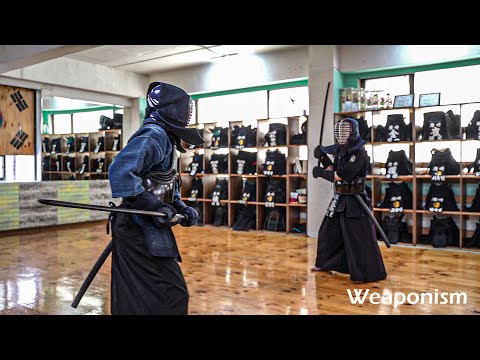
KENJUTSU vs KENJUTSU
0
Kenjutsu Cut·Weaponism
#katana #japanesesword #kendo PU Katana Purchase Link -🔪🔪 https://s.click.aliexpress.com/e/_ACBbut (We purchased and …
Translation: Sword Art Cuts
The Kenjutsu Cut subfamily encompasses the primary cutting techniques of classical Japanese swordsmanship, classified by their trajectory and target. [1] The major cuts include shōmen-uchi (straight downward to the centreline), kesagiri (diagonal cut following the line of a monk's kesa sash), yokogiri (horizontal cut), and gyaku-kesagiri (reverse diagonal). [1],[2] Proper kenjutsu cutting mechanics require coordination of the hips, shoulders, and hasuji (blade alignment) to deliver cuts that would cleanly bisect a target with a live blade. [2],[3]
Kenjutsu cutting techniques were developed on the battlefields of feudal Japan and refined through centuries of kata transmission within koryū schools. [1] Tameshigiri (test cutting on straw or bamboo targets) was practised during the Edo period to verify cutting mechanics, a tradition that continues in modern iaidō and battōjutsu. [2],[3]
Kenjutsu cutting techniques use the katana's curved blade geometry and two-handed grip to deliver powerful slicing cuts capable of cutting through armour gaps, limbs, and bone. [1]
Kenjutsu cutting is tested in tameshigiri (test cutting) competitions and demonstrated in koryū embu (demonstrations) at events like the Nippon Budokan Kobudo Taikai. [1]
No images yet for this technique.
Sign in to suggest an image.
#katana #japanesesword #kendo PU Katana Purchase Link -🔪🔪 https://s.click.aliexpress.com/e/_ACBbut (We purchased and …
Kenjutsu Drop, Cut! Presented by Dana "Shihan" Abbott, a modern-day Samurai. Shihan trained in Yokohama, Japan for 14 …
No instructional courses yet for this technique.
Sign in to suggest a course.
Risk of injury to the person this technique is applied to
Edged weapons cause fatal lacerations; historical battlefield mortality rates >30% (Amberger 1999)
Skill level needed to execute this technique reliably
Whether this technique is allowed under major competition rule sets
The Book of Five Rings (Miyamoto Musashi, 1645)
Alias sources — [1] Japanese Swordsmanship (Warner & Draeger, 1982) [2] The Book of Five Rings (Musashi, trans. Harris, 1974) [3] The Book of Five Rings (Musashi, trans. Harris, 1974)
Effectiveness sources — [1] Classical Bujutsu (Draeger, 1973)
Established Japanese martial arts naming convention — native Japanese term (和語/漢語)
Alias sources — [1] Japanese Swordsmanship (Warner & Draeger, 1982) [2] The Book of Five Rings (Musashi, trans. Harris, 1974) [3] The Book of Five Rings (Musashi, trans. Harris, 1974)
Effectiveness sources — [1] Classical Bujutsu (Draeger, 1973)
wrist control for edge alignment, grip endurance, footwork precision
quick wrists, strong forearms, good posture
forearm extensors/flexors, deltoids, core, calves
Every move, in any martial art, shares a few universal traits. Mix and match below to pinpoint the right tool — or compare equivalents across styles.
The Dō Cut targets the opponent's torso with a diagonal or horizontal cut to the midsection, one of the four primary target areas in both kenjutsu and kendō. [1] The dō cut requires precise blade angle to connect with the relatively flat surface of the torso, and in kendō it demands a distinctive follow-through where the striker passes to the side after contact. [1,2] In kenjutsu the dō cut is valued as an effective attack against opponents who raise their guard high, exposing the midsection. [2,3]
The Kote Cut targets the opponent's wrist or forearm, striking the area just above the hand to disable the opponent's ability to wield the sword. [1] In kendō, the kote strike targets the right kote when the opponent is in chūdan-no-kamae, requiring less travel distance than a men strike and making it one of the fastest attacks. [1,2] In kenjutsu the kote cut was a primary battlefield strategy for disabling an opponent without requiring a lethal blow, and it is frequently scored as a counter-technique when the opponent initiates an overhead attack. [2,3]
The Men Cut is a descending vertical or slightly diagonal cut to the top of the opponent's head, the most fundamental and frequently practised technique in Japanese swordsmanship. [1] A correct men cut requires raising the sword above the head, driving it downward with snap of the wrists (tenouchi), and in kendō executing fumikomi with the right foot and passing through the opponent — all unified with a spirited kiai. [1,2] The men cut is the first technique taught to beginners in both kenjutsu and kendō and the most commonly scored ippon in competition at all levels. [2,3]
The Tsuki Thrust targets the throat protector (tsuki-dare) of the men with a straight forward thrust of the shinai tip, making it the only non-cutting technique among kendō's four scoring actions. [1] Tsuki is the most dangerous technique in kendō due to the risk of injury if misdirected, and it is therefore restricted in competition — generally permitted only for adults at dan-grade level. [1,2] A valid tsuki must contact the tsuki-dare squarely with the kensen (sword tip) while demonstrating full body commitment and zanshin. [2,3]
While standing is simpler, Channel8TGN emphasizes that staying in seiza position with your knees underneath you and a strong back is harder but essential for consistency—it allows you to strike more easily and establish proper rhythm over time with practice.
Channel8TGN recommends holding the object at eye level before dropping it. If you hold it too high or too low, you won't hit it consistently because you'll be taking your hands to different levels rather than focusing on the object itself.
Channel8TGN advises pulling the saiya (sheath) way back over to your left hip and turning it flat to the ground. Keeping the sheath too far out may feel comfortable but will prevent you from drawing the sword as far as needed.
Channel8TGN suggests starting with simple household items like a tennis ball, bean bag, empty water bottle, or rolled-up sock, or a wooden dowel about 24 inches long—all are effective for learning the technique.
The Kenjutsu Cut subfamily encompasses the primary cutting techniques of classical Japanese swordsmanship, classified by their trajectory and target. The major cuts include shōmen-uchi (straight downward to the centreline), kesagiri (diagonal cut following the line of a monk's kesa sash), yokogiri (horizontal cut), and gyaku-kesagiri (reverse diagonal).
Kenjutsu cutting techniques were developed on the battlefields of feudal Japan and refined through centuries of kata transmission within koryū schools. Tameshigiri (test cutting on straw or bamboo targets) was practised during the Edo period to verify cutting mechanics, a tradition that continues in modern iaidō and battōjutsu.
FIK Kendo: legal — Legal, valid strike requires correct form (datotsu-bu), spirit (kiai), and fo…
Danger rating 9/10. Extreme — edged weapons cause fatal lacerations; historical battlefield mortality rates >30% (Amberger 1999)
The standard setup chain: Assume Guard (Kamae/Hut) → Measure Distance (Ma-ai) → Initiate Cut/Thrust → Follow Through (Zanshin).
Standard counters include: Parry (Absetzen) — deflect the incoming blade with a counter-displacement / Void (Step Back) — withdraw from measure to avoid the cutting arc / Counter-Cut (Nachreisen) — strike into the opponent's opening during their attack.
Common variants: Standard cut (primary cutting angle from the ready stance); Thrust (tsuki) (straight thrust targeting the throat, chest, or face); Rising cut (kiri-age) (upward diagonal cut from low to high); Diagonal cut (kesa-giri) (downward diagonal cut following the kimono line).
Kenjutsu cutting is tested in tameshigiri (test cutting) competitions and demonstrated in koryū embu (demonstrations) at events like the Nippon Budokan Kobudo Taikai.
Top errors to watch for: Cutting with arm strength — Japanese cutting uses hip rotation, core engagement, and tenouchi for power / Poor hasuji (edge alignment) — the edge must be aligned with the cut direction; misalignment causes the blade to boun… / Using the same grip pressure throughout the cut — the grip tightens only at the moment of impact (tenouchi) / Not following through the cut — the blade must travel through the target, not stop on contact.
The Kenjutsu Cut is also known as Ken no Kiri, Katana Cut, Kenjutsu Kiri-Waza.