Core Principles of Close-Space Sasae Tsurikomi Ashi
This technique relies on three fundamental elements: tight body spacing, powerful hip rotation, and a blocking foot action. The sasae (block or prop) is the final component of the movement, not the primary force generator. Success depends on eliminating distance between uke and tori while maintaining control.
Understanding Sasae as a Blocking Action
Sasae literally means to block or stop, and the foot performs exactly this function by intercepting uke's ankle. This is not a sweeping motion but rather a strategic placement that completes the throw initiated by hip rotation and body positioning.
Grip Placement and Body Positioning
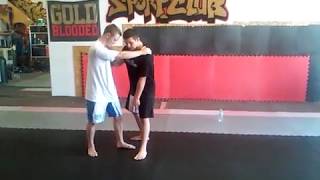
The grip must be secured around the deltoid region with the fist oriented sideways, not across the shoulder. Tori's right hip should be positioned directly against uke's hip with minimal space, creating the foundation for the pulling action. This compact positioning is critical to the technique's effectiveness.
Entry and Tai Sabaki Mechanics
From the close position, tori pulls uke directly into the hip while executing a small, circular turning motion with the lead foot. The tai sabaki is subtle and compact rather than a large step, maintaining the no-space relationship between bodies. This rotation establishes the rotational momentum needed for the throw.
The Pulling and Hip Rotation Sequence
As uke is pulled into tori's hip, a powerful hip rotation begins simultaneously. The right hand drives the pull while the entire body rotates in a coordinated motion. The foot placement acts as the final punctuation mark, occurring after the primary force has already been committed.
Full-Commitment Execution and Finishing Position
This is a full-force throw requiring complete commitment and body weight; attempting to control the intensity will undermine effectiveness. Tori must finish in a chest-to-chest position, with the body rotating as a unified unit rather than twisting backward. The rotation should be complete and powerful, maintaining hip torque throughout.
Variation as Harai Tsurikomi Ashi
This technique can be modified by adding more sweep into the foot action, transitioning it toward a harai (sweep) variation. The fundamental mechanics remain unchanged, with grip, positioning, and hip rotation being the decisive factors. Both variations achieve the same result through slightly different foot employment.
Common Mistakes and Proper Alignment
Tori must avoid twisting the body backward or losing the no-space positioning during execution. The grip orientation is critical—taking the grip over the shoulder rather than to the side compromises the pulling angle and body alignment. Maintaining compact spacing throughout eliminates escape routes and ensures the hip rotation translates fully into throwing power.
CLOSE SPACE HIP ROTATION SASAE TSURIKOMI ASHI
Key Takeaways
- •Core Principles of Close-Space Sasae Tsurikomi Ashi
- •Understanding Sasae as a Blocking Action
- •Grip Placement and Body Positioning
- •Entry and Tai Sabaki Mechanics
Here is a powerful foot prop or block throw where you use a strong circular body rotation with your hips to throw your opponent. Go to www.amazon.com or www.ymaa.com to get Steve Scott's books THE JUDO ADVANTAGE, SAMBO ENCYCLOPEDIA and JUJI GATAME ENCYCLOPEDIA. Join the Steve Scott Training Group on Facebook at https://www.facebook.com/groups/1094841137237608/ Donations are appreciated. To donate, use this link https://www.paypal.com/cgi-bin/webscr?cmd=_s-xclick&hosted_button_id=85EKWV8KBFASS Our channel was started in 2010 as an extension of our program at Welcome Mat. Welcome Mat was founded in 1969 by Steve Scott in Kansas City, Missouri, USA and has produced thousands of successful students, athletes and coaches in a variety of grappling sports. View over a thousand videos on the subjects of judo, freestyle judo, Shingitai Jujitsu, sambo, submission grappling and sport jujitsu are on our YouTube channel. Browse through our playlists to see what we have on our channel. If a video is listed as "private" is it because that video is still in development or scheduled for later viewing. Comments are moderated. Please keep your comments on topic and think before posting them. Comments containing profanity, racial, religious or sexual slurs and comments that are insulting will not be permitted and those posting such comments will be blocked from the channel. Criticism is okay but trolling isn't. You can subscribe for free to our channel at http://youtube.com/user/welcomematstevescott. We strive to provide fundamentally sound and technically innovative skills and information on a variety of grappling sports. We appreciate your support! Please tell others about our channel. You can help support our channel by going to our online store and purchasing items. Go to http://www.WelcomeMatStore.com. We have a variety of books, shirts and other items for sale. Music for the Freestyle Judo show provided by YouTube Copyright Free Audio featuring "Fiend" by Sting and performed by the Jingle Punks and "All This Down Time" by Sting and performed by the Jingle Punks. Visit our club web site at http://www.WelcomeMatJudoClub.com. For information on the Judo Black Belt Association, go to http://www.judoblackbelt.com. Thank you for watching our video. Please tell others about our channel. Our videos are all original material and are copyrighted. Reproduction or showing these videos without the specific permission of Steve Scott is prohibited. #SasaeTsurikomiAshi #AshiWaza #welcomematstevescott
Frequently Asked Questions
What does this video teach about standard sasae tsurikomi ashi?
This video covers core principles of close-space sasae tsurikomi ashi, understanding sasae as a blocking action, grip placement and body positioning. It provides detailed instruction from welcomematstevescott.
How long does it take to learn standard sasae tsurikomi ashi?
The basic mechanics can be understood in a single session, but developing reliable execution requires consistent drilling over weeks of practice. This 8-part breakdown helps structure your training by isolating each phase of the technique.
What are the key details for finishing standard sasae tsurikomi ashi?
This technique can be modified by adding more sweep into the foot action, transitioning it toward a harai (sweep) variation. The fundamental mechanics remain unchanged, with grip, positioning, and hip rotation being the decisive factors. Both variations achieve the same result through slightly different foot employment.
Related videos
Sasae Tsurikomi Course - Standard Fundamentals by Vladislav Koulikov
The Grapplers Guide by Jason Scully
Sasae tsurikomi ashi 1/2 | Online Judo Lesson You Can Do At Home Alone!
Shintaro Nakano
Hiza Guruma Combinations
WINNING
hiza guruma
Shintaro Higashi
No Gi Judo Throw | Sasae Tsurikomi Ashi
LongShot Martial Arts