Introduction to Closed Guard Fundamentals
Closed guard represents one of jiu-jitsu's most advantageous positions, functioning as an inverted mount that provides superior safety and control. The practitioner uses both legs and hands against the opponent's upper body, creating simultaneous site control and mount access opportunities. Unlike other positions, closed guard severely limits high-percentage attacks, forcing the opponent to stand and disengage.
Core Mechanics: Knee Pressure and Hand Position
Effective closed guard relies on leg and core strength rather than arm pulling alone. The practitioner should prioritize knee control to maintain pressure and pull the opponent inward, as legs generate significantly more force than hands. Contested hand positioning in the middle of the body determines offensive capability—inside hand control allows head grabs, overhooks, and shoulder crunches.
The Top Lock Position
When the opponent bases their hands in the armpits, the practitioner executes a four-finger grab and controls the elbow toward the belly button. By shifting the hips slightly and locking the legs above the shoulder, the practitioner establishes the top lock—a fundamental position offering multiple offensive submissions. Maintaining the elbow inside the hip is critical for executing leg climbs and submission chains.
Armbar Execution from Top Lock
From the top lock, the practitioner under-hooks the opponent's leg and uses the back of the knee and quad to control the head angle. The leg slides directly over the head without a wide arc, with the heel positioned at the crown for maximum leverage. The practitioner can finish via straight armbar or use the safer thumb-break variation by pulling the thumb over the hip.
Triangle and Reverse Triangle Transitions
If the opponent escapes the armbar by removing their arm, an immediate triangle submission becomes available. Should the opponent hide their arm during the escape, the practitioner transitions to a reverse triangle with a full figure-four leg lock. These automatic position transitions ensure continuous offensive pressure regardless of opponent defensive adjustments.
Kimura Lock Setup and Finishing
The Kimura attack begins by using the fingers to peel the opponent's wrist after establishing control of the elbow. Once the wrist is visible, the practitioner secures the Kimura grip and drives the elbow toward the sternum while lifting upward. The submission's power derives from complete shoulder and head lock, requiring only millimeter adjustments for the tap rather than full arm displacement.
High Cross Sweep to Mount Position
The high cross sweep provides the primary no-gi method for transitioning from closed guard to mount. The practitioner gains inside hand position by controlling and pulling the opponent's hand inward, then rotates the hips to establish a perpendicular angle using helicopter leg momentum. With proper pressure and leg compression, the scissor motion generates the sweep while blocking the opponent's arm escape.
Back Take via Shoulder Crunch
The shoulder crunch grip represents the most effective no-gi back-take mechanism from closed guard. The practitioner feints a hip bump to draw the opponent's weight forward, then suddenly switches direction and jumps the hips upward. The wrist-to-wrist grip with a high elbow and head pinch ensures maximal shoulder pressure and broken posture, transitioning into the back-take sequence.
Elevated Basics: The Ultimate No-Gi Closed Guard Guide
Key Takeaways
- •Introduction to Closed Guard Fundamentals
- •Core Mechanics: Knee Pressure and Hand Position
- •The Top Lock Position
- •Armbar Execution from Top Lock
🔺 Welcome to IsakIvanovicjj - Your Gateway to BJJ Mastery! 🔺 📚 Today's Lesson: "Elevated Basics: The Ultimate No-Gi Closed Guard Guide" 🥋 Are you ready to transform your No-Gi Closed Guard game? Dive into our comprehensive guide, where we unravel the secrets and advanced fundamentals of No-Gi Closed Guard. 🌟 What You'll Learn: - The key elements that turn basic Closed Guard techniques into powerful tools. - In-depth breakdowns of high-efficiency moves and controls in the No-Gi setting. - Rare and highly effective details that elevate your ground game. 🔗 Stay Connected: - Follow on Instagram: @IsakIvanovicjj 🛒 Gear Up: Looking to upgrade your training gear? Check out our latest collection at [MatMerchants.com](http://www.matmerchants.com) for premium BJJ apparel and accessories. 📈 Enhance Your Skills: If you're finding this video helpful, please like, share with your training partners, and don't forget to subscribe for more in-depth guides and techniques. 🙏 Appreciate your support: Thank you for watching! Your journey to mastering BJJ is important to us. Keep training, keep improving, and see you on the mats! Remember, "Elevated Basics" aren't just techniques; they're the building blocks to mastering the art of Brazilian Jiu-Jitsu! 🥋
Related Techniques
Frequently Asked Questions
What does this video teach about from guard?
This video covers introduction to closed guard fundamentals, core mechanics: knee pressure and hand position, the top lock position. It provides detailed instruction from IsakIvanovicjj.
How long does it take to learn from guard?
The basic mechanics can be understood in a single session, but developing reliable execution requires consistent drilling over weeks of practice. This 8-part breakdown helps structure your training by isolating each phase of the technique.
What are the key details for finishing from guard?
The high cross sweep provides the primary no-gi method for transitioning from closed guard to mount. The practitioner gains inside hand position by controlling and pulling the opponent's hand inward, then rotates the hips to establish a perpendicular angle using helicopter leg momentum. With proper pressure and leg compression, the scissor motion generates the sweep while blocking the opponent's arm escape.
Related videos
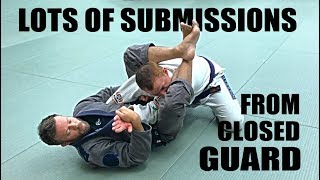
Jiu-Jitsu Submissions | Lots of Closed Guard Submissions
Knight Jiu-Jitsu
How to NEVER Get Stuck in the Closed Guard Again! | Jiu Jitsu Tutorial
Matt Arroyo Jiu Jitsu
Two Fundamental Takedowns from the Clinch
roymarsh jiujitsu

How To DOMINATE THE CLINCH in UFC 5 (CLINCH GUIDE) | EA SPORTS UFC 5
IC4Games
Dominate the Muay Thai Clinch with Petchboonchu
fightTIPS