Technique Overview
Harai Tsurikomi Ashi is presented as a transitional throw that follows an Ouchi Gari setup. The technique relies on action-reaction principles, where the initial attack creates the conditions for the follow-up throw to succeed.
Setup Mechanics
Rather than executing a complete Ouchi Gari hook, the setup uses a stabbing motion to the opponent's thigh, followed by an upward kick to generate backward movement. This action creates a reactive weight shift onto the opponent's right foot, which becomes the target for the sweep.
Initial Attack
The initial thrust involves kicking upward and stabbing the opponent's leg to force backward movement. Hand action and body positioning work together to push the opponent back while maintaining the targeted weight on the reaction leg.
Transition to Harai Tsurikomi Ashi
As the opponent's leg extends backward, the thrower follows through with continued backward pressure while rotating their own foot sideways. The hand action moves in the opposite direction to body movement, creating opposing forces that unbalance the opponent.
Hip Action and Leg Extension
The throw requires significant kuzushi and dropping of the hips similar to Ura Nagi mechanics. The legs extend fully to push the opponent's leg backward while the shoulders rotate forward, creating the rotational momentum necessary for the throw.
Grip and Setup Position
Standard kumite grip is maintained with the lapel held at chest height by the collarbone, not high or low. The initial attack is executed from distance with the leg kept low during the kick to maximize leverage.
Execution Sequence
The complete sequence involves kicking, lifting upward while pushing forward to create shoulder rotation, and controlling the opponent's torso while their legs extend backward. The technique requires full commitment and cannot be executed half-heartedly to be effective.
Key Training Principles
Hand action is essential to the technique's success; the sweep alone is insufficient. The technique works equally well from both sides and should be practiced as a complete kinetic chain rather than isolated movements.
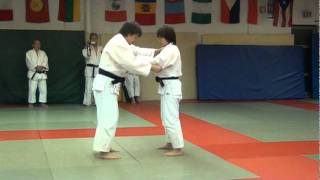
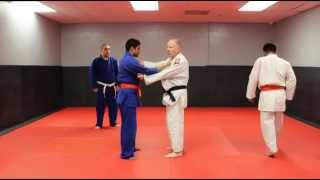
Ouchi Gari setup for Harai Tsurikomi Ashi
Key Takeaways
- •Technique Overview
- •Setup Mechanics
- •Initial Attack
- •Transition to Harai Tsurikomi Ashi
Here's a beautiful combination that I am a very big fan of - Ouchi Gari into Harai Tsurikomi Ashi. This combination is extremely effective and relies on a 'driving' or 'pushing' Ouchi Gari which created momemtum as your opponent moves back, which in turn you capitalise on to execute Harai Tsurikomi Ashi. Give it a go and let me know what you think in the comments! Like us on Facebook at: www.Facebook.com/SampsonJudo Follow us on Instagram at: www.Instagram.com/SampsonJudo www.sobelljudoclub.com www.judoforall.org.uk Finger tape: https://amzn.to/2zbqvyh Mizuno Judogi: https://amzn.to/3gasbZz Pre-washed soft black belt: https://amzn.to/2XpNIEK My ultimate technique reference book: https://amzn.to/2LT46Zk Mind over muscle by Jigoro Kano: https://amzn.to/2zeDTSi
Related Techniques
Frequently Asked Questions
What does this video teach about harai tsurikomi ashi?
This video covers technique overview, setup mechanics, initial attack. It provides detailed instruction from Sampson Judo.
How long does it take to learn harai tsurikomi ashi?
The basic mechanics can be understood in a single session, but developing reliable execution requires consistent drilling over weeks of practice. This 8-part breakdown helps structure your training by isolating each phase of the technique.
What are the key details for finishing harai tsurikomi ashi?
The complete sequence involves kicking, lifting upward while pushing forward to create shoulder rotation, and controlling the opponent's torso while their legs extend backward. The technique requires full commitment and cannot be executed half-heartedly to be effective.