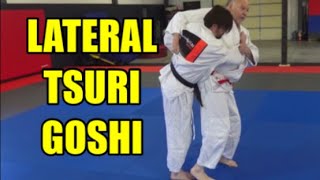
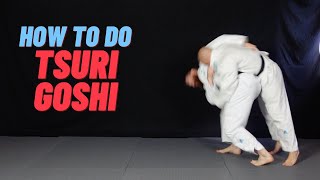
Understanding Tsuri Goshi: The Lifting Principle
Tsuri goshi derives its name from the Japanese word for fishing—the fundamental concept of lifting and pulling an opponent. This throw exists in two primary variations: ko-tsuri goshi and o-tsuri goshi, each employing distinct mechanics and footwork patterns.
Ko-Tsuri Goshi vs. O-Tsuri Goshi
Ko-tsuri goshi resembles o goshi but requires gripping the belt and executing an upward lift rather than a sweeping hip rotation. O-tsuri goshi maintains the turning mechanics of o goshi but incorporates the lifting principle, offering practitioners two distinct technical approaches to the same throw.
Maintaining Continuous Kuzushi
Effective execution of tsuri goshi depends on maintaining continuous kuzushi throughout the technique. Any interruption in this chain reaction compromises the throw's effectiveness; practitioners must determine whether to pull up, out, or around based on their opponent's height and positioning.
Body Mechanics and Head Positioning
Proper execution requires turning the head while executing an upward lifting motion with the hips. Solo practice can be developed by rocking the body to generate the lifting motion, emphasizing the connection between head positioning and hip elevation.
Footwork Distinctions
Ko-tsuri goshi employs uki goshi-style footwork, while o-tsuri goshi utilizes o goshi footwork. Ko-tsuri goshi's narrower step prevents excessive shoulder strain caused by arm bending and allows the elbow to rise naturally during the lifting motion.
Belt Grip Placement and Leverage
Optimal grip placement on the belt falls between center and far-side positioning, neither too central nor excessively extended. This intermediate placement maximizes lift efficiency; grips placed too far result in elbow extension that reduces upward force generation.
Hip Positioning and Target Placement
The hip bone should aim directly into the matah, the inside point of the opponent's V-stance. This precise targeting creates the lift necessary to elevate the opponent's center of gravity and commit them to the throw.
O-Tsuri Goshi: Grip and Entry Mechanics
When executing o-tsuri goshi against an opponent facing sideways, position the armpit at mid-chest height rather than high on the shoulder. This positioning enables proper pulling mechanics and prevents the arm from becoming trapped during the rotation.
Velocity Through Rotational Whipping
Generating velocity through rapid head rotation and hip whipping amplifies throwing power, similar to how tornado rotation generates force. This accelerated turning motion significantly increases throw effectiveness and should be emphasized in practice.
Tsuri-Goshi Tips | Riki Judo Dojo
Key Takeaways
- •Understanding Tsuri Goshi: The Lifting Principle
- •Ko-Tsuri Goshi vs. O-Tsuri Goshi
- •Maintaining Continuous Kuzushi
- •Body Mechanics and Head Positioning
Riki sensei explained tsuri-goshi (釣腰 - lifting hip throw) during judo class on 2-25-2022. 0:00 O-tsuri-goshi & ko-tsuri-goshi 0:18 O-goshi vs. ko-tsuri-goshi 0:35 Kuzushi never stops 1:04 How to practice tsuri-goshi 1:24 Footwork 2:01 Hand placement for ko-tsuri-goshi 2:35 Hip strike target 2:50 Hand placement for o-tsuri-goshi 3:34 Whip it good 3:47 Turn your head 4:00 You don't have to grab the belt Riki sensei began Judo in Okinawa and is a Shichidan with over 56 years of study, practice, competition and teaching. He competed for 25 years at the local, national and international levels. A few of the great Judoka Riki sensei has studied and practiced with include: Kotani, Daigo, Ito, Inokuma, Okano, Kimura, Kaminaga and Nakatani. See Riki sensei teach every Monday, Wednesday, Thursday and Friday evening at 535 W. Iron Ave, Mesa, AZ 85210. Youth classes are 6 - 6:55 PM, adult classes are 7:00 - 8:30 PM. For more info, please visit rikidojousa.com The purpose of this YouTube channel is to pass on the original, traditional, authentic Kodokan Judo that Riki sensei loves so much. Riki sensei's students maintain this YouTube channel (and are responsible for any errors), but you can find more of his thoughts at the Riki Judo Dojo Facebook page: https://www.facebook.com/Riki-Judo-Dojo-USA-194351210607759 14
Frequently Asked Questions
What does this video teach about standard tsuri goshi?
This video covers understanding tsuri goshi: the lifting principle, ko-tsuri goshi vs. o-tsuri goshi, maintaining continuous kuzushi. It provides detailed instruction from Riki Judo Dojo.
How long does it take to learn standard tsuri goshi?
The basic mechanics can be understood in a single session, but developing reliable execution requires consistent drilling over weeks of practice. This 9-part breakdown helps structure your training by isolating each phase of the technique.
What are the key details for finishing standard tsuri goshi?
When executing o-tsuri goshi against an opponent facing sideways, position the armpit at mid-chest height rather than high on the shoulder. This positioning enables proper pulling mechanics and prevents the arm from becoming trapped during the rotation.