Tsuri-Goshi Tips | Riki Judo Dojo
0
Standard Tsuri Goshi·Riki Judo Dojo·Added by Admin
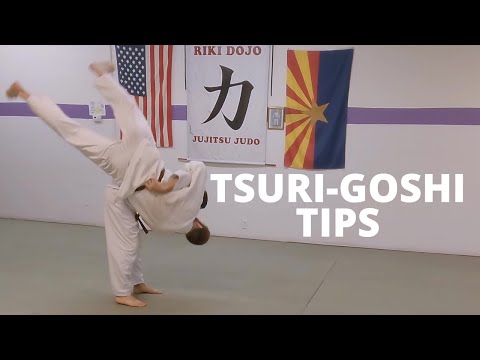
Riki sensei explained tsuri-goshi (釣腰 - lifting hip throw) during judo class on 2-25-2022. 0:00 O-tsuri-goshi & ko-tsur…
Translation: lifting hip throw
Standard Tsuri Goshi executes the classical lifting hip throw where the thrower grips the opponent's belt with one hand, turns in, lifts the opponent onto the hip with an upward spring of the legs, and throws them forward over the hip. [1] The belt grip allows the thrower to generate significant vertical lift, elevating the opponent's centre of gravity above the hip fulcrum before the forward rotation. [1],[2] The throw produces a high-amplitude finish when the lift is powerful enough to fully elevate the opponent before the projection. [2],[3]
Tsuri goshi (lifting hip throw) uses a belt or waist grip to lift the opponent onto the hip, providing a very secure connection that makes the throw difficult to counter once the lift is achieved. [1] The lifting action elevates the opponent's centre of gravity above the thrower's hip, creating a strong wheeling action. [2]
The standard tsuri goshi is scored in IJF competition. [1]
No images yet for this technique.
Sign in to suggest an image.
Riki sensei explained tsuri-goshi (釣腰 - lifting hip throw) during judo class on 2-25-2022. 0:00 O-tsuri-goshi & ko-tsur…
No instructional courses yet for this technique.
Sign in to suggest a course.
Risk of injury to the person this technique is applied to
Hane-Goshi uses springing hip action; moderate amplitude
Skill level needed to execute this technique reliably
Whether this technique is allowed under major competition rule sets
Kodokan Judo — Official Nage-waza Classification
Traditional Judo throwing technique terminology (Kodokan Institute)
Official Kodokan ground technique classification system
Standard Japanese martial arts terminology (kanji/hiragana)
Established Japanese martial arts naming convention — native Japanese term (和語/漢語)
Traditional Judo throwing technique terminology (Kodokan Institute)
hip rotation speed, core strength, lower back stability
strong hips and core, good flexibility for turning entry
hip rotators, core, quadriceps, latissimus dorsi
The direction of pull depends on what works best for your specific situation—it's situational. According to Riki Judo Dojo, you need to experiment to find which pulling angle is most effective for you.
Avoid pulling downward on a shorter opponent, as it only causes them to bend more. Instead, maintain constant kazushi (off-balance) throughout the technique, since losing it breaks the chain reaction needed for the throw.
Turn your head and use a rocking motion with your body to lift your opponent—practice this motion on your own first to develop the timing and leverage needed.
Keep your hand in a proper position (not bent backward, which strains your shoulder) and use your shoulder to strike your opponent as you come over, then lift up before grabbing the belt and finishing the throw.
Standard Tsuri Goshi executes the classical lifting hip throw where the thrower grips the opponent's belt with one hand, turns in, lifts the opponent onto the hip with an upward spring of the legs, and throws them forward over the hip. The belt grip allows the thrower to generate significant vertical lift, elevating the opponent's centre of gravity above the hip fulcrum before the forward rotation.
The standard form of tsuri goshi has been part of the Kodokan curriculum since the original gokyo, representing the belt-grip hip throw tradition in judo. The technique is demonstrated in the Nage no Kata as a representative koshi-waza technique.
IJF: legal — Legal throwing technique; IBJJF: legal — Legal at all belt levels; UWW: legal — Legal in both freestyle and Greco-Roman; Unified MMA: legal — Legal throwing technique; ADCC: legal — Legal; FIAS Sport Sambo: legal — Legal; FIAS Combat Sambo: legal — Legal
Danger rating 5/10. High — Hane-Goshi uses springing hip action; moderate amplitude
The standard setup chain: Grip Setup (Kumi-kata) → Off-Balance (Kuzushi) → Entry (Tsukuri) → Execution (Kake).
Standard counters include: Lower Centre of Gravity — bend knees and drop hips to make the throw harder to execute / Block the Hip — post hand on the thrower's hip to prevent loading / Step Around — circle away from the throw direction to avoid being loaded / Grip Break — deny the thrower their preferred gripping configuration.
Common variants: Standard hip throw (full turn-in with hip below the opponent's centre of gravity); No-gi hip throw (adapted without gi grips, using overhook and collar tie); Drop hip throw (dropping to one knee to lower the fulcrum point); Combination hip throw (chaining from a failed foot technique or hand technique).
The standard tsuri goshi is scored in IJF competition.
Top errors to watch for: Shallow belt grip that slips during the lift — grip deeply and firmly / Not squatting low enough before the lift — the explosive straightening is the power source / Pulling horizontally with the belt instead of vertically — the 'tsuri' (lift) must go upward / Entering with the feet too far apart, which reduces leg drive.
The Standard Tsuri Goshi is also known as Tsuri Goshi, Classical Lifting Hip Throw, Standard Lift-Pull Hip, Kihon Tsuri Goshi.