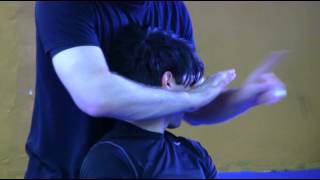
Foundation: Establishing Stance and Awareness
The practitioner must adopt a firm, grounded stance to prevent being lifted or thrown by the attacker. Mental composure is critical—the defender should appear uncomfortable to the aggressor while remaining internally calm and ready to execute techniques. This psychological element prevents the attacker from escalating their assault.
Escape Method One: Rotational Release
From the rear waist grip, the defender initiates controlled rotation rather than allowing the aggressor to control the direction. The technique involves swinging the body around while maintaining stance integrity, disrupting the attacker's grip through momentum and positional change. This method works effectively from multiple angles—rear, front, and sides.
Escape Method Two: Palm Strike to Waist Bone
After establishing a firm stance and subtle movement to distract the attacker, the defender executes a precise palm strike targeting the attacker's iliac crest (waist bone). The strike must be deliberate and anatomically specific to maximize effectiveness. This technique forces the aggressor to release the grip due to pain and shock.
Escape Method Three: Foot Stomp with Follow-Up
The defender stamps on the attacker's instep or foot multiple times to weaken their lower body stability and disrupt their ability to maintain the grip. After each stomp, the defender follows up with a palm strike and steps out of danger. The key principle is that the attacker must move with the defender's momentum or risk severe injury.
Method Three Application: Side and Multiple Angle Variations
The stomp-and-strike sequence remains effective from side angles and when repeated in succession. If the attacker attempts to resist the defender's directional movement after stomping, additional force compounds the injury risk. The defender can layer strikes and foot work to ensure successful escape regardless of the attacker's resistance level.
Escape Method Four: Hand Control and Pull Release
As a fourth technique, the defender establishes firm stance while appearing to struggle, then transitions to directly controlling and pulling the attacker's hands apart to break the waist grip. This method prioritizes hand-fighting and grip strength over striking techniques.
Self-defense moves for release of strong waist grip from the back
Key Takeaways
- •Foundation: Establishing Stance and Awareness
- •Escape Method One: Rotational Release
- •Escape Method Two: Palm Strike to Waist Bone
- •Escape Method Three: Foot Stomp with Follow-Up
Self defense moves for release of strong waist grip from the back Subscribe to our YouTube channel for more Self-defense video everyday Share the video
Frequently Asked Questions
What does this video teach about standard rear waist lock?
This video covers foundation: establishing stance and awareness, escape method one: rotational release, escape method two: palm strike to waist bone. It provides detailed instruction from Self defense Classes.
How long does it take to learn standard rear waist lock?
The basic mechanics can be understood in a single session, but developing reliable execution requires consistent drilling over weeks of practice. This 6-part breakdown helps structure your training by isolating each phase of the technique.
What are the key details for finishing standard rear waist lock?
The stomp-and-strike sequence remains effective from side angles and when repeated in succession. If the attacker attempts to resist the defender's directional movement after stomping, additional force compounds the injury risk. The defender can layer strikes and foot work to ensure successful escape regardless of the attacker's resistance level.