The Core Advantage of Double Sleeve Guard
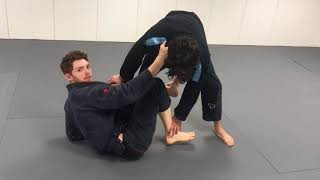
The fundamental strength of double sleeve guard lies not in the lasso hook or foot positioning, but in the grip control itself. By securing both sleeves, the guard player dictates what the opponent can and cannot grab, making this grip superiority the primary reason double sleeve is so difficult to pass.
The Critical Mistake: Neglecting Grip Control
Most practitioners make the fundamental error of focusing exclusively on leg defense while ignoring grip integrity. Once the top player establishes control of the guard player's pants, they can systematically work their way up to the shin, forcing defensive reactions that compromise the entire position.
How Poor Grip Defense Leads to Position Breakdown
When the guard player reacts to a Torreando attempt by framing instead of maintaining sleeve grips, they sacrifice control and initiate a defensive sequence. This defensive mentality—rather than an actual guard pass—is the true cost of allowing initial pants contact, as the player must abandon grips to defend subsequent attacks.
Preventing Pants Contact: The Prevention Strategy
The guard player must maintain hand position near the hips to intercept any leg-grab attempts before they develop. By keeping hands ready to block lateral movements, redirect attempted grabs, or reposition the lasso, the practitioner can maintain distance and prevent the opponent from establishing any grip advantage on the legs.
Maintaining Distance Through Shoulder and Hip Movement
When the opponent attempts to extend the guard player's arms or walk backward, the guard player must follow using synchronized shoulder and hip movement while keeping elbows anchored to the ribs. This distance maintenance prevents arm extension, which would eliminate grip leverage and allow the opponent to establish controlling grips on the legs.
The Quality Distinction in Double Sleeve Positioning
Not all double sleeve configurations are equal; the difference between controlling grips with compressed elbows versus extended arms is the difference between dominance and defense. A seemingly minor difference in arm extension fundamentally shifts control of the position from the guard player to the passer, making proper positioning non-negotiable.
From Control to Offense: Reading and Attacking
Once grip control is established and distance is maintained, the guard player can breathe, assess the opponent's movements, and identify vulnerability patterns. This controlled environment allows for conscious decision-making about submissions or transitions, rather than reactive defensive scrambling.
Double Sleeve as a Positional Nexus
Double sleeve guard functions not as a terminal position but as a platform for transitioning into the guard player's primary system. By mastering grip control in double sleeve, practitioners can smoothly flow into their preferred guard variations while maintaining the offensive advantage gained through superior positioning.
Key Details to not having your guard passed from Double Sleeve/Spider Guard
Key Takeaways
- •The Core Advantage of Double Sleeve Guard
- •The Critical Mistake: Neglecting Grip Control
- •How Poor Grip Defense Leads to Position Breakdown
- •Preventing Pants Contact: The Prevention Strategy
In this video, I go through what I think is the most important thing you need to know to control someone from Double Sleeve/Spider Guard. Let me know if you have any suggestions or questions, and share if this helped you! #bjj #spiderguard #jiujitsu
Related Techniques
Frequently Asked Questions
What does this video teach about one-sleeve spider guard?
This video covers the core advantage of double sleeve guard, the critical mistake: neglecting grip control, how poor grip defense leads to position breakdown. It provides detailed instruction from Pedro Ramalho.
How long does it take to learn one-sleeve spider guard?
The basic mechanics can be understood in a single session, but developing reliable execution requires consistent drilling over weeks of practice. This 8-part breakdown helps structure your training by isolating each phase of the technique.
What are the key details for finishing one-sleeve spider guard?
Once grip control is established and distance is maintained, the guard player can breathe, assess the opponent's movements, and identify vulnerability patterns. This controlled environment allows for conscious decision-making about submissions or transitions, rather than reactive defensive scrambling.
Related videos
Jiu Jitsu Techniques - Passing The Spider Guard
Ricardo Cavalcanti BJJ
Passing Spider Guard - Clearing Feet on Biceps (BJJ / Jiu Jitsu)
Brian Glick
The first Spider Guard sweep you should learn - BJJ Spider Guard - Part 1 of 2
MMA Leech
Lasso Guard Sweeps
The Grapple Lab
Understanding the De La Riva Guard
JonThomasBJJ