Transitioning from Close Guard
The instructor begins from a closed guard position and opens the guard deliberately to demonstrate the spider guard transition. While opening the guard unnecessarily during live rolling is inadvisable, this controlled setup allows students to practice proper positioning fundamentals.
Initial Hip Positioning
The practitioner steps one foot on the opponent's hip while executing hip escapes to reposition both legs to the inside of the opponent's arms. This fundamental repositioning requires multiple hip escapes performed sequentially to establish proper spider guard structure.
Hip Escape Mechanics
Hip escapes are performed by posting the foot on the opponent's hip and driving the hips laterally away from the center line. This movement creates the necessary angle and space to transition both knees inside the opponent's arm frames progressively.
Establishing Open Guard Structure
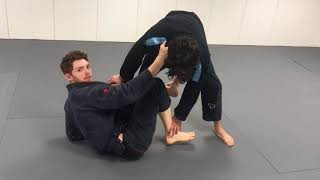
After achieving both knees on the inside of the opponent's arms, the practitioner presses the foot against the hip while continuing hip escapes to create separation and establish a proper open guard position. The extended leg distance provides optimal positioning for the upcoming sweep mechanics.
Foot Placement on the Knee
One foot transitions from the hip to the opponent's knee while the other foot plants on the opponent's bicep at the joint. Proper foot placement on the bicep—at the joint itself rather than the middle of the arm—ensures secure arm control and prevents slippage during the sweep.
Elevating the Opponent's Elbow
The practitioner uses the foot on the bicep to drive the opponent's elbow upward and away from the body, disrupting the opponent's base and balance. This elevation must continue until the elbow passes the shoulder line, at which point stability is critically compromised.
Executing the Sweep
Once the opponent's arm is elevated and elbow control is established, the practitioner simultaneously extends the legs, kicks the knee toward the mat, and pulls the opponent's knee toward the chest. These three actions performed together generate the momentum needed to complete the sweep successfully.
Disconnecting the Elbow and Transition
As the sweep completes, the practitioner must disconnect their elbow from the mat to maintain control and transition into the top position. The final driving motion through the foot toward the mat, combined with the pulling action, carries the practitioner directly into mount position as the opponent is swept.
The first Spider Guard sweep you should learn - BJJ Spider Guard - Part 1 of 2
Key Takeaways
- •Transitioning from Close Guard
- •Initial Hip Positioning
- •Hip Escape Mechanics
- •Establishing Open Guard Structure
Watch our Special FREE Tutorials at http://www.mmaleech.com/free-stuff/ Go to our Facebook page for the latest trends in BJJ and MMA. https://www.facebook.com/mmaleech. Professor Gustavo Gasperin teaches the details of a basic spider guard sweep, distance management and proper control. Facebook: https://www.facebook.com/mmaleech/ Instagram: https://www.instagram.com/mmaleech/ BJJ Courses: https://www.mmaleech.com/best-bjj-instructionals-for-beginners/
Related Techniques
Frequently Asked Questions
What does this video teach about standard spider guard?
This video covers transitioning from close guard, initial hip positioning, hip escape mechanics. It provides detailed instruction from MMA Leech.
How long does it take to learn standard spider guard?
The basic mechanics can be understood in a single session, but developing reliable execution requires consistent drilling over weeks of practice. This 8-part breakdown helps structure your training by isolating each phase of the technique.
What are the key details for finishing standard spider guard?
Once the opponent's arm is elevated and elbow control is established, the practitioner simultaneously extends the legs, kicks the knee toward the mat, and pulls the opponent's knee toward the chest. These three actions performed together generate the momentum needed to complete the sweep successfully.
Related videos
Jiu Jitsu Techniques - Passing The Spider Guard
Ricardo Cavalcanti BJJ
Passing Spider Guard - Clearing Feet on Biceps (BJJ / Jiu Jitsu)
Brian Glick
Key Details to not having your guard passed from Double Sleeve/Spider Guard
Pedro Ramalho
Lasso Guard Sweeps
The Grapple Lab
Understanding the De La Riva Guard
JonThomasBJJ