Understanding Spider Guard Mechanics
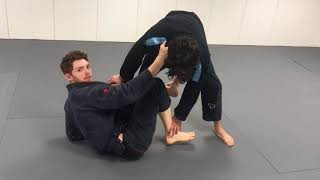
Spider guard presents a significant control challenge because the opponent combines upper body grip dominance with lower body leg pressure. The feet positioned on the biceps work synergistically with sleeve grips to maintain inside position control. Success in passing requires addressing both the upper and lower body threats simultaneously rather than attempting to break free from grips alone.
The Critical Importance of Maintaining Grips
When caught in spider guard, the passer must never allow their hands to become ungripped from the opponent's legs. Without grips, the opponent can freely off-balance, rotate, and remove the passer from position with minimal effort. Securing cuff grips on the pants immediately upon recognizing the spider guard position prevents the opponent from exploiting hand freedom.
Establishing Base Control with Cuff Grips
The passer secures both cuff grips on the outside of the opponent's pants, ensuring fingers remain external to the gi. These grips serve as the foundational anchor point, preventing the opponent from manipulating the passer's position. From this locked position, the passer can begin executing systematic leg clearance techniques.
Squaring Up and Closing the Distance
The passer steps to a square position directly facing the opponent, eliminating angular advantages that allow hip mobility. By closing both elbows inward rather than allowing them to flare outward, the passer reduces the opponent's mechanical leverage. This positioning creates the optimal setup for driving the opponent's legs toward the mat.
Executing the Heel Drive Leg Clearance
Maintaining tight elbow positioning and cuff grip control, the passer steps backward while driving the opponent's heels toward the floor through a controlled snapping motion. This circular arm action combined with backward stepping removes the opponent's feet from the bicep position simultaneously. Once the opponent's legs are neutralized on the mat, the passer can begin closing the knee line and establishing top control.
Managing Persistent Single-Leg Hooks
When the opponent maintains a grip and leg hook despite the initial clearance attempt, the passer must immediately address the remaining threat rather than allowing prolonged tension. The passer steps out laterally on the hooked side and positions a knee wedge behind the opponent's hamstring to immobilize the leg. This positioning prevents the opponent from resetting to a square spider guard configuration.
The Knee Wedge and Elbow Rotation Technique
With the knee wedge secured behind the opponent's hamstring, the passer drives downward to anchor the leg, then rotates the elbow over the top of the opponent's foot. This circular motion bypasses the opponent's heel pressure and establishes control over the inside position. The technique exploits the leg's immobilized state created by the knee wedge pressure.
Controlling the Inside Position and Passing Options
Once the elbow is positioned over the line of the opponent's toes with the knee wedge maintaining leg pressure, the passer can flare the elbow inward to dominate the inside control position. From this dominant position, the passer may choose to execute inside-style passes or transition to sidearm passing angles. The key principle is maintaining leg immobility throughout the passing sequence.
Passing Spider Guard - Clearing Feet on Biceps (BJJ / Jiu Jitsu)
Key Takeaways
- •Understanding Spider Guard Mechanics
- •The Critical Importance of Maintaining Grips
- •Establishing Base Control with Cuff Grips
- •Squaring Up and Closing the Distance
Passing Spider Guard - Clearing the Feet: if you’re trapped in a spider guard - even a basic spider guard, with double sleeve cuff control and feet inside the biceps - you lose mobility, stability and control. Today we cover 2 methods of clearing those annoying feet off your biceps. We start with the principle of always regrouping, even if those grips aren’t optimal. Then we look at circling the feet to the inside and taking them off your arms with a downward thrust. Finally, we see that with a one-handed grip, we can use the knee as a wedge behind the hamstring to add some slack and clear the elbow over the top. Thanks for watching - put questions in the comments and we'll get to them :) === Like this video? Subscribe here: https://bit.ly/subscribeBZG === PLEASE CHECK OUT ⬇️ 🚨 INSTAGRAM: http://www.instagram.com/bzglick 🚨 FACEBOOK: http://www.facebook.com/bzglick 📹 VIDEOS @ THEDOJO.COM : https://bit.ly/glick_thedojo 🥋 SHOYOROLL: https://shoyoroll.com/ 🙇🏻 BROOKLYN BJJ: https://www.brooklynbjj.com
Related Techniques
Frequently Asked Questions
What does this video teach about one-sleeve spider guard?
This video covers understanding spider guard mechanics, the critical importance of maintaining grips, establishing base control with cuff grips. It provides detailed instruction from Brian Glick.
How long does it take to learn one-sleeve spider guard?
The basic mechanics can be understood in a single session, but developing reliable execution requires consistent drilling over weeks of practice. This 8-part breakdown helps structure your training by isolating each phase of the technique.
What are the key details for finishing one-sleeve spider guard?
With the knee wedge secured behind the opponent's hamstring, the passer drives downward to anchor the leg, then rotates the elbow over the top of the opponent's foot. This circular motion bypasses the opponent's heel pressure and establishes control over the inside position. The technique exploits the leg's immobilized state created by the knee wedge pressure.
Related videos
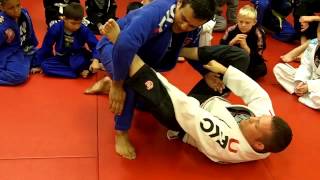
Jiu Jitsu Techniques - Passing The Spider Guard
Ricardo Cavalcanti BJJ
Key Details to not having your guard passed from Double Sleeve/Spider Guard
Pedro Ramalho
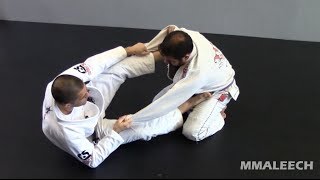
The first Spider Guard sweep you should learn - BJJ Spider Guard - Part 1 of 2
MMA Leech
Lasso Guard Sweeps
The Grapple Lab
Understanding the De La Riva Guard
JonThomasBJJ