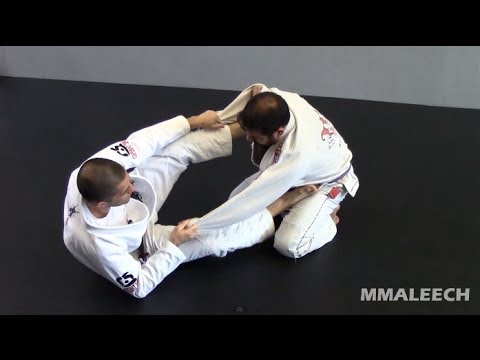
The first Spider Guard sweep you should learn - BJJ Spider Guard - Part 1 of 2
0
Standard Spider Guard·MMA Leech·Added by Admin
Watch our Special FREE Tutorials at http://www.mmaleech.com/free-stuff/ Go to our Facebook page for the latest trends in…
Translation: standard spider guard
The Standard Spider Guard establishes the full spider guard with both hands gripping the opponent's sleeves, both feet placed on the biceps, and the legs extended to create maximum distance and control. [1] The standard spider guard is the base position from which all spider guard attacks originate — sweeps using leg push-pull mechanics, triangle choke entries by pulling one arm in, and omoplata set-ups. [1],[2] The four-point control (two grips, two feet) provides a comprehensive framework for attacking from the back. [2],[3]
Spider guard was developed in gi BJJ competition in the 1990s and became one of the dominant open guard systems. [1]
Spider guard is one of the most commonly played open guards in IBJJF competition. [1]
No images yet for this technique.
Sign in to suggest an image.
Watch our Special FREE Tutorials at http://www.mmaleech.com/free-stuff/ Go to our Facebook page for the latest trends in…
No instructional courses yet for this technique.
Sign in to suggest a course.
Risk of injury to the person this technique is applied to
Guard positions are defensive; injury risk comes from transitions, not the position itself
Skill level needed to execute this technique reliably
Whether this technique is allowed under major competition rule sets
Jiu-Jitsu University (Saulo Ribeiro, 2008)
Alias sources — [1] IBJJF Rules (2024) [2] Jiu-Jitsu University (Ribeiro, 2008) [3] The Guard (Moreira & Beneville, 2003)
Effectiveness sources — [1] Jiu-Jitsu University (Ribeiro, 2008) [2] Mastering Jujitsu (Gracie & Danaher, 2003)
Standard katakana transliteration of Western martial arts terminology (外来語) — used in Japanese MMA, boxing, and BJJ communities
Alias sources — [1] IBJJF Rules (2024) [2] Jiu-Jitsu University (Ribeiro, 2008) [3] The Guard (Moreira & Beneville, 2003)
Effectiveness sources — [1] Jiu-Jitsu University (Ribeiro, 2008) [2] Mastering Jujitsu (Gracie & Danaher, 2003)
hip flexibility, active legs, grip management
long legs for distance control and guard retention
hip flexors, adductors, quadriceps, core, grip
Start by opening your guard and stepping on your opponent's hip. Use hip escapes to move your legs from the outside of their arms to the inside of their arms, hip skating side to side until both knees are positioned on the inside.
Place your foot on your opponent's bicep, specifically targeting the joint area so your foot stays stuck and traps their arm, rather than placing it further down the arm where it might slip around.
Once your foot is locked on the bicep, extend your legs, pull your opponent's knee toward you, kick their knee, and drive your foot toward the mat all at the same time to complete the sweep.
Push your opponent's elbow upward away from their ribs until it passes the line of their shoulder, which disrupts their balance and sets up the sweep.
The Standard Spider Guard establishes the full spider guard with both hands gripping the opponent's sleeves, both feet placed on the biceps, and the legs extended to create maximum distance and control. The standard spider guard is the base position from which all spider guard attacks originate — sweeps using leg push-pull mechanics, triangle choke entries by pulling one arm in, and omoplata set-ups.
The standard spider guard is the foundational spider guard position, representing the base configuration of the spider guard system that has been a staple of gi competition since the 1990s. It is one of the most commonly taught open guard positions in gi BJJ.
IBJJF: legal — Legal — guard is fundamental to BJJ, sweeps from guard score 2 points; IJF: restricted — Guard pulling penalized as non-combativity — groundwork from guard permitted …; ADCC: legal — Legal, guard pull penalized -1 point in points portion; Unified MMA: legal — Legal — no penalty for playing guard; FIAS Sport Sambo: legal — Legal
Danger rating 2/10. Low — guard positions are defensive; injury risk comes from transitions, not the position itself
The standard setup chain: Achieve Guard Contact → Control Grips → Manage Distance → Threaten Submissions/Sweeps.
Standard counters include: Guard Pass — systematically work to clear the legs and establish a dominant position / Leg Pin — control one or both legs to neutralize guard retention / Pressure Passing — use heavy chest pressure to flatten and immobilize the guard player.
Common variants: Spider guard (gripping both sleeves with feet on the biceps for distanc…); De la Riva guard (one hook behind the opponent's lead leg with opposite foo…); Lasso guard (lasso grip wrapping the leg around the opponent's arm); Collar-sleeve guard (controlling collar with one hand and sleeve with the othe…).
Spider guard is one of the most commonly played open guards in IBJJF competition.
Top errors to watch for: Gripping the sleeves too shallow — grip deep at the wrist or cuff for maximum control / Placing the feet on the wrong part of the bicep — the ball of the foot should press into the upper bicep / Extending both legs fully without variation — bend and extend alternately to create angles / Holding spider guard without threatening sweeps — the opponent will eventually strip a grip; attack before that.
The Standard Spider Guard is also known as Sutandādo Supaidā Gādo, Full Spider Guard, Double Sleeve Spider, Classic Spider Guard.