Common Sidekick Error: Roundhouse Confusion
Many practitioners inadvertently perform a roundhouse kick instead of a true side kick. This occurs because the technique relies heavily on quadriceps extension while neglecting glute engagement. Identifying this fundamental error is the first step toward correcting the movement pattern.
The Stomp Analogy
The side kick should be visualized as a downward stomp rather than a sweeping motion. This mental cue encourages simultaneous activation of both quadriceps and glutes. Proper execution requires both muscle groups to extend simultaneously—quads extending the knee while glutes drive the hip downward.
Understanding the Sideline Reference
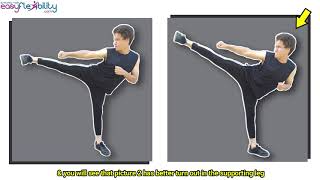
The sideline is an imaginary vertical plane bisecting the body when facing laterally. This reference point ensures proper hip alignment throughout the technique. The heel should remain on or slightly forward of this sideline during the chambered position.
Chamber Position: Heel Placement
In the chambered position, the heel must be positioned on or slightly in front of the sideline with the knee angled downward. This setup stretches both the glutes and quadriceps, creating optimal conditions for linear power generation. Correct positioning prevents the circular motion characteristic of roundhouse kicks.
Extension Mechanics: Linear vs. Circular Motion
When both muscle groups contract simultaneously, the leg travels in a linear path along the sideline. This differs markedly from roundhouse techniques that follow circular trajectories. Proper execution ensures the heel traces the sideline rather than arcing outward.
Hip Pop: Adding Rotational Power
At the moment of extension, a deliberate hip pop adds significant power through glute activation and rotational torque. This final-second acceleration mirrors the hip twist used in punching techniques. The shoulder and nose must remain aligned on the sideline throughout this rotation.
Upper Body Positioning During Hip Pop
While the hip pops forward, the shoulder must not cross the sideline—maintaining alignment with the nose toward the target. This constraint prevents loss of power and maintains structural integrity. Proper positioning locks in the twisting force generated by the hip rotation.
Foot Rotation: Partial to Full
The base foot executes a partial rotation during the chambering phase, progressing to a full rotation as extension occurs. This sequential rotation maximizes hip drive and aligns the striking surface with target contact. Complete toe-pointing away from the kick occurs only at full extension.
Taekwondo | SHORT LESSON: Side Kick (Technical Troubleshooting)
Key Takeaways
- •Common Sidekick Error: Roundhouse Confusion
- •The Stomp Analogy
- •Understanding the Sideline Reference
- •Chamber Position: Heel Placement
Follow along with Taekwondo Instructor Adam Gerrald as he discusses some of the "finer points" of the Taekwondo Side Kick. Set up a FREE Beginner's Account and start training Taekwondo today: https://globalmartialarts.university/taekwondofreebeginnerscourse/ **************************************** Liability Disclaimer All information provided by Global Martial Arts University and Hodgy LLC is of a general nature and is furnished for educational/entertainment purposes only. No information is to be taken as medical or other health advice pertaining to an individual’s specific health or medical condition. Global Martial Arts University and Hodgy LLC is not engaged in rendering medical or professional services. Global Martial Arts University makes no guarantee regarding the accuracy, completeness, timeliness, or relevance of any text, video, or audio content. Any content provided is not a diagnosis, treatment plan, or recommendation for a particular course of action regarding your health and is not intended to provide specific medical advice. You agree that use of this information is at your own risk. Global Martial Arts University or our parent company, Hodgy LLC will not be responsible or liable for any injury or harm you sustain as a result of our programs, DVDs, online videos, or information shared on our website. This includes emails, videos and text. Thanks for your understanding. ©2022 Hodgy LLC and Global Martial Arts University. 👊 Create a free student account now! https://globalmartialarts.university/ ✅ Instagram: https://www.instagram.com/globalmartialartsuniversity/ ✅ Facebook: https://www.facebook.com/GlobalMartialArtsUniversity 🥋 FREE Facebook Student Community: https://www.facebook.com/groups/gmaucommunity/
Frequently Asked Questions
What does this video teach about standard snapping side kick?
This video covers common sidekick error: roundhouse confusion, the stomp analogy, understanding the sideline reference. It provides detailed instruction from Global Martial Arts University.
How long does it take to learn standard snapping side kick?
The basic mechanics can be understood in a single session, but developing reliable execution requires consistent drilling over weeks of practice. This 8-part breakdown helps structure your training by isolating each phase of the technique.
What are the key details for finishing standard snapping side kick?
While the hip pops forward, the shoulder must not cross the sideline—maintaining alignment with the nose toward the target. This constraint prevents loss of power and maintains structural integrity. Proper positioning locks in the twisting force generated by the hip rotation.