Standard Snapping Side Kick

Genus

横蹴上げ(基本型)(Yoko-geri Keage (Kihon-gata))

Traditional

Translation: standard snapping side kick

Overview

The Standard Snapping Side Kick is executed by chambering the knee to the chest, turning the hip over to align the foot laterally, and snapping the leg out to strike with the blade or heel of the foot before immediately retracting. [1] The snap relies on rapid knee extension and hip rotation, and the kick is returned to the chamber position quickly to maintain balance and defensive readiness. [1],[2] This technique is commonly used in karate and taekwondo point sparring as a quick scoring tool. [2],[3]

Also known as
Standard Yoko Geri KeageJP[1]Standard Side Snap Kick[2]Snapping Yop ChagiKR[3]

History & Origin

The standard snapping side kick is a fundamental karate technique (yoko geri keage) that has been part of the art's standard curriculum since Shotokan's formalisation in the early 20th century. [1] It is regularly practised in kihon, kata, and kumite across multiple karate styles. [2],[3]

Effectiveness

Standard snapping side kick. [1]

Lineage

From TKD/karate. [1]

Competition Record

Used in competition. [1]

Images

No images yet for this technique.

Sign in to suggest an image.

Biomechanical Mechanism

Primary ActionBallistic leg extension or rotation — the shin or foot impacts the target at high velocity
Joints InvolvedHip (flexion/rotation), knee (extension for front kicks, flexion-extension for roundhouse), ankle (stabilised)
Force VectorLinear (front kick/teep — hip flexion and knee extension) or rotational (roundhouse — hip rotation with shin contact)
Kinetic ChainPivot foot rotation → hip turn → femur whip → shin contact — the leg acts as a heavy bat with the hip as the pivot

Position & Entry

From fighting stanceChamber the knee high, rotate hips sideways, drive the heel or blade of the foot laterally into the target
As checking side kick (to knee)Low side kick targeting the opponent's lead knee to prevent their advance
From rear leg (power)Cross-step and chamber, drive through with full hip rotation for maximum penetration

Variants

Standard side kickdriving the heel or blade of the foot laterally with hip rotation
Checking side kicklow side kick targeting the knee to stop the opponent's advance
Spinning side kickadding a spin for extra rotational power
Step-through side kickstepping through for deeper penetration

Videos

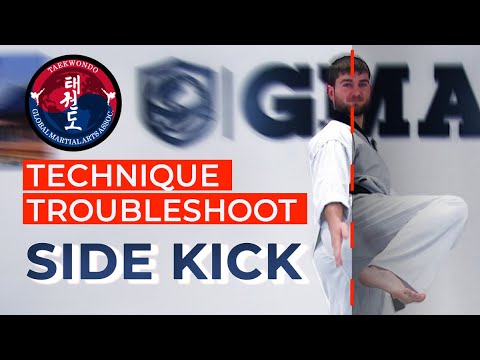
Taekwondo | SHORT LESSON: Side Kick (Technical Troubleshooting)

0
Standard Snapping Side Kick·Global Martial Arts University·Added by Admin

Follow along with Taekwondo Instructor Adam Gerrald as he discusses some of the "finer points" of the Taekwondo Side Kic

1 video

Learn This Technique

No instructional courses yet for this technique.

Sign in to suggest a course.

Ratings

Danger Rating

Risk of injury to the person this technique is applied to

6
High6/10

Linear thrust kick; generates highest force among basic kicks

Difficulty

Skill level needed to execute this technique reliably

Intermediate
Competition Legality

Whether this technique is allowed under major competition rule sets

Illegal
WBC/Boxing — All kicks prohibited in boxing {srcWBC Rules of Boxing}
Legal
Unified MMA — Legal striking technique
Unified Rules of MMA, August 2025PDF
Kyokushin — Legal at full power to body and head {srcIKO Kyokushin Tournament Rules}
WT — Legal, body kick 2 points, head kick 3 points, spinn...
WT Competition Rules 2024PDF
WAKO — Legal in Full Contact and Low Kick formats
WAKO Competition RulesPDF
K-1/GLORY — Legal {srcK-1/GLORY Kickboxing Rules}
IFMA — Legal — kicks are a core Muay Thai technique
IFMA Muay Thai RulesPDF

Training Notes

From fighting stance, bring the kicking knee up and across the body
Pivot the support foot so the heel faces the target, turning the body sideways
Snap the foot out laterally, striking with the blade of the foot (little-toe edge)
The lower leg extends and retracts in a whipping motion from the chambered knee
Keep the upper body leaned slightly away for counterbalance but not excessively
The snap should be sharp and immediate — strike and retract in one beat
Drill on the heavy bag at rib height: the bag should bounce from a sharp impact, not swing from a push

Common Mistakes

!Not pivoting the support foot, which prevents the body from turning sideways fully
!Extending the knee slowly, losing the whip-like snap that generates impact
!Hitting with the sole of the foot or toes instead of the blade edge
!Not chambering high enough — the snap starts from the chamber, so a low chamber means a weak kick
!Following through past the target instead of snapping back
!Dropping the hands during the sideways position
!Turning the back too far toward the opponent during the kick

Related Techniques

Counter Techniques

Setup Chain

1Stance and Rangeverify correct distance for the kick to land at full extension
2Chamber the Leglift the knee to prepare the kicking trajectory
3Execute the Kickextend the leg through the target with the appropriate striking surface
4Recoverretract the leg and return to fighting stance

Sources & References

Primary Source

Muay Thai: The Art of Fighting (Yod Ruerngsa, Khun Kao Charuad & James Cartmell, 2002)

1BookMuay Thai: The Art of Fighting (Kraitus, 2002)

Alias sources — [1] Karate-Do Kyohan (Funakoshi, 1935) [2] Dynamic Karate (Nakayama, 1966) [3] Kukkiwon Taekwondo Textbook (Kukkiwon, 2006)

2BookKarate-Do Kyohan (Funakoshi, 1935)

Effectiveness sources — [1] Comprehensive Asian Fighting Arts (Draeger & Smith, 1969)

Official karate technique names (和語/漢語)

4OtherJapanese Martial Arts Standard Terminology (武道用語)

Established Japanese martial arts naming convention — native Japanese term (和語/漢語)

5CitationMuay Thai: The Art of Fighting (Kraitus, 2002)

Alias sources — [1] Karate-Do Kyohan (Funakoshi, 1935) [2] Dynamic Karate (Nakayama, 1966) [3] Kukkiwon Taekwondo Textbook (Kukkiwon, 2006)

6CitationKarate-Do Kyohan (Funakoshi, 1935)

Effectiveness sources — [1] Comprehensive Asian Fighting Arts (Draeger & Smith, 1969)

Community

Athletics

Requires

hip abduction power, lateral hip flexibility, single-leg balance

Favours

flexible hips for high side kicks

Key muscles

gluteus medius, hip abductors, quadriceps, core

Frequently Asked Questions

How should I position my heel when chambering a side kick?

Your heel should be on your sideline or slightly in front of it during the chambered position. This reference point helps ensure proper alignment and sets you up for maximum power generation.

How do I add more power to my side kick?

Use a hip pop as you extend—this engages your glutes and adds twisting power to the kick. As you pop your hip, keep your shoulder and nose pointed directly at your target to maximize the rotational force.

Why should I keep my shoulder on the sideline during a side kick?

Keeping your shoulder on the sideline as you pop your hip allows you to add twisting power to the kick, making it significantly stronger. This alignment ensures you're using rotational force rather than just linear extension.

How does the Standard Snapping Side Kick work?

The Standard Snapping Side Kick is executed by chambering the knee to the chest, turning the hip over to align the foot laterally, and snapping the leg out to strike with the blade or heel of the foot before immediately retracting. The snap relies on rapid knee extension and hip rotation, and the kick is returned to the chamber position quickly to maintain balance and defensive readiness.

Where does the Standard Snapping Side Kick come from?

The standard snapping side kick is a fundamental karate technique (yoko geri keage) that has been part of the art's standard curriculum since Shotokan's formalisation in the early 20th century. It is regularly practised in kihon, kata, and kumite across multiple karate styles.

Is the Standard Snapping Side Kick legal in competition?

Unified MMA: legal — Legal striking technique; WBC/Boxing: banned — All kicks prohibited in boxing; WKF: legal — Legal, chudan (body) kick scores 2 points, jodan (head) kick scores 3 points; Kyokushin: legal — Legal at full power to body and head; WT: legal — Legal, body kick 2 points, head kick 3 points, spinning body 4 points, spinni…; WAKO: legal — Legal in Full Contact and Low Kick formats; K: legal — 1/GLORY — Legal; IFMA: legal — Legal — kicks are a core Muay Thai technique

How dangerous is the Standard Snapping Side Kick?

Danger rating 6/10. High — linear thrust kick; generates highest force among basic kicks

How do I set up the Standard Snapping Side Kick?

The standard setup chain: Stance and Range → Chamber the Leg → Execute the Kick → Recover.

How do I defend against the Standard Snapping Side Kick?

Standard counters include: Check (Shin Block) — raise the shin to intercept the kick before it lands / Catch and Sweep — catch the kicking leg and sweep the standing leg / Step Inside — close distance inside the kick's effective range to smother it.

What are the variants of the Standard Snapping Side Kick?

Common variants: Standard side kick (driving the heel or blade of the foot laterally with hip …); Checking side kick (low side kick targeting the knee to stop the opponent's a…); Spinning side kick (adding a spin for extra rotational power); Step-through side kick (stepping through for deeper penetration).

How effective is the Standard Snapping Side Kick in competition?

Used in competition.

What are common mistakes when doing the Standard Snapping Side Kick?

Top errors to watch for: Not pivoting the support foot, which prevents the body from turning sideways fully / Extending the knee slowly, losing the whip-like snap that generates impact / Hitting with the sole of the foot or toes instead of the blade edge / Not chambering high enough — the snap starts from the chamber, so a low chamber means a weak kick.

What are other names for the Standard Snapping Side Kick?

The Standard Snapping Side Kick is also known as Yoko-geri Keage (Kihon-gata), Standard Yoko Geri Keage, Standard Side Snap Kick, Snapping Yop Chagi.