Introduction
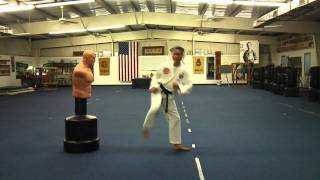
Troy Smith and Master Hojung Park demonstrate the flying sidekick at the U.S. Taekwondo Center in Monument. This technique comprises three essential components: the approach run, the jump, and the sidekick execution itself.
Foundational Sidekick Mechanics
The sidekick requires the practitioner to twist the body toward the target while maintaining forward-facing stance. The plant foot must rotate 180 degrees to facilitate proper hip engagement and power generation.
Leg Chamber and Foot Position
The kicking knee rises toward the chest with the foot held parallel to the ground at knee height, creating a tabletop-like position. The extended kick drives through the target using the bottom of the foot while the arms recoil for balance.
Progression to Jumping Sidekick
The jumping sidekick integrates forward body movement with the plant foot stepping back while rotating 180 degrees. The knee chambers and kick execute in a single, fluid motion without pause.
Flight Mechanics and Chambering
During the flying approach, the front leg lifts to generate height and momentum. In mid-air, the kicking leg chambers toward the body while both knees and ankles draw together, positioning the body for optimal power and control.
Execution and Landing
The kick extends with maintained balance and stability throughout the air phase. A secure, controlled landing completes the technique while preserving proper stance and readiness.
Seated Position Drill
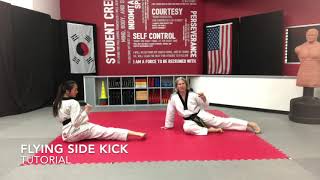
From a seated position with vertical spine alignment, the practitioner executes sidekicks with one hand lightly touching the ground for balance. The upper body remains closed and the kick travels purely lateral with proper arm recoil.
Wall-Assisted Practice
Using a wall for support, practitioners maintain upright posture and tabletop foot alignment while performing controlled sidekicks. This drill reinforces proper form before progressing to dynamic movements.
Target Approach Drill
The practitioner runs toward a target, jumps, and makes light contact while maintaining closed shoulders and aligned knees and ankles. This exercise develops approach timing without full impact execution.
Multi-Target Progression
Advanced practitioners execute flying sidekicks over multiple targets while maintaining proper form and executing smooth, controlled landings. This drill combines timing, precision, and landing stability into a comprehensive practice sequence.
video 2 Flying Sidekick
Key Takeaways
- •Introduction
- •Foundational Sidekick Mechanics
- •Leg Chamber and Foot Position
- •Progression to Jumping Sidekick
Frequently Asked Questions
What does this video teach about standard flying side kick?
This video covers introduction, foundational sidekick mechanics, leg chamber and foot position. It provides detailed instruction from US Taekwondo Center - World Headquarters.
How long does it take to learn standard flying side kick?
The basic mechanics can be understood in a single session, but developing reliable execution requires consistent drilling over weeks of practice. This 10-part breakdown helps structure your training by isolating each phase of the technique.
What are the key details for finishing standard flying side kick?
The practitioner runs toward a target, jumps, and makes light contact while maintaining closed shoulders and aligned knees and ankles. This exercise develops approach timing without full impact execution.