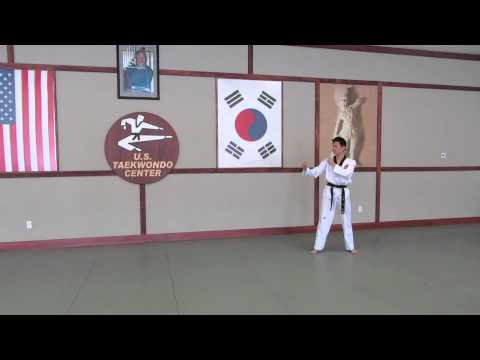
video 2 Flying Sidekick
0
Standard Flying Side Kick·US Taekwondo Center - World Headquarters·Added by Admin
Translation: standard flying side kick
The Standard Flying Side Kick is executed by running or stepping forward, leaping off the lead foot, chambering the kicking leg in flight, and thrusting the heel or blade of the foot laterally into the target at the apex of the jump. [1] The non-kicking leg tucks underneath the body during flight to maximise height and streamline the airborne position. [1],[2] This technique is the most commonly practised flying kick in taekwondo schools worldwide and is a standard requirement for black belt testing in many organisations. [2],[3]
The standard flying side kick is one of taekwondo's most recognisable techniques, featured in virtually every demonstration and promotional material for the art. [1] It has been a competition and belt-testing requirement in the World Taekwondo (WT) and International Taekwon-Do Federation (ITF) systems since the 1960s. [2],[3]
Standard flying side kick. [1]
From TKD/karate. [1]
Used in competition. [1]
No images yet for this technique.
Sign in to suggest an image.
No instructional courses yet for this technique.
Sign in to suggest a course.
Risk of injury to the person this technique is applied to
Airborne kicks maximize momentum; high injury risk to both fighters
Skill level needed to execute this technique reliably
Whether this technique is allowed under major competition rule sets
Karate-Do Kyohan: The Master Text (Gichin Funakoshi, 1935)
Alias sources — [1] Dynamic Karate (Nakayama, 1966) [2] Kukkiwon Taekwondo Textbook (Kukkiwon, 2006) [3] Best Karate Vol. 5 (Nakayama, 1979)
Effectiveness sources — [1] Comprehensive Asian Fighting Arts (Draeger & Smith, 1969)
Official karate technique names (和語/漢語)
Established Japanese martial arts naming convention — native Japanese term (和語/漢語)
Alias sources — [1] Dynamic Karate (Nakayama, 1966) [2] Kukkiwon Taekwondo Textbook (Kukkiwon, 2006) [3] Best Karate Vol. 5 (Nakayama, 1979)
Effectiveness sources — [1] Comprehensive Asian Fighting Arts (Draeger & Smith, 1969)
hip abduction power, lateral hip flexibility, single-leg balance
flexible hips for high side kicks
gluteus medius, hip abductors, quadriceps, core
The Standard Flying Side Kick is executed by running or stepping forward, leaping off the lead foot, chambering the kicking leg in flight, and thrusting the heel or blade of the foot laterally into the target at the apex of the jump. The non-kicking leg tucks underneath the body during flight to maximise height and streamline the airborne position.
The standard flying side kick is one of taekwondo's most recognisable techniques, featured in virtually every demonstration and promotional material for the art. It has been a competition and belt-testing requirement in the World Taekwondo (WT) and International Taekwon-Do Federation (ITF) systems since the 1960s.
Unified MMA: legal — Legal striking technique; WBC/Boxing: banned — All kicks prohibited in boxing; WKF: legal — Legal, chudan (body) kick scores 2 points, jodan (head) kick scores 3 points; Kyokushin: legal — Legal at full power to body and head; WT: legal — Legal, body kick 2 points, head kick 3 points, spinning body 4 points, spinni…; WAKO: legal — Legal in Full Contact and Low Kick formats; K: legal — 1/GLORY — Legal; IFMA: legal — Legal — kicks are a core Muay Thai technique
Danger rating 7/10. Very High — airborne kicks maximize momentum; high injury risk to both fighters
The standard setup chain: Stance and Range → Chamber the Leg → Execute the Kick → Recover.
Standard counters include: Check (Shin Block) — raise the shin to intercept the kick before it lands / Catch and Sweep — catch the kicking leg and sweep the standing leg / Step Inside — close distance inside the kick's effective range to smother it.
Common variants: Standard side kick (driving the heel or blade of the foot laterally with hip …); Checking side kick (low side kick targeting the knee to stop the opponent's a…); Spinning side kick (adding a spin for extra rotational power); Step-through side kick (stepping through for deeper penetration).
Used in competition.
Top errors to watch for: Not committing to the sideways body position in the air — half-turning produces a weak, angled kick / Extending the kick too early and being fully extended before reaching the target / Landing on the kicking foot first, which is unstable and prevents follow-up / Taking too many preparatory steps and telegraphing the jump.
The Standard Flying Side Kick is also known as Tobi Yoko-geri (Kihon-gata), Standard Tobi Yoko Geri, Standard Twi-eo Yop Chagi, Jumping Thrust Kick.