Foundation: Penetration Below the Knee
The low single leg attack requires penetration below the knee with sound technical positioning. Poor positioning allows opponents to circle around the shooter or score from a defensive posture, making technical proficiency essential before building match confidence.
Body Positioning: Splitting the Opponent
The instructor splits the opponent's body by positioning half his own body to the outside of the target leg. This external angle positioning creates optimal leverage for the penetrating attack on the far ankle.
Distance and Shot Timing
The low single leg is executed from distance, typically when the shooter can palm the opponent's head. Shooting from distance minimizes setup options and relies heavily on instinctive recognition of foot movement in response to feints and level changes.
Level Change and Ankle Reach
The shooter must change levels and penetrate straight forward rather than shooting downward. The attack focuses on reaching and catching the far ankle with the post hand while keeping the body back, allowing the opponent's movement to feed into the shot.
Knee Positioning and Head Placement
The lead-leg knee plants directly under the chest while the shooter's forehead contacts the inside of the opponent's knee. The forearm remains parallel to the opponent's foot with the elbow down, preventing the premature elevation that breaks down the technique.
Finishing Position and Head Control
The shooter maintains a low finish by using head pressure rather than attempting to sweep the ankle outward. The trail leg plants while posting hands stay active, driving the opponent down without lifting the head prematurely.
Adaptive Finishing: Reads and Secondary Attacks
The finish evolves based on opponent reaction—whether they belly out, stay tight, reach for legs, or attempt to slow momentum. Aggressive defensive scrambling from the opponent creates opportunities for turks, hat pins, and other advanced transitions.
Head Retention and Scramble Defense
The shooter keeps the head down throughout the finish until the takedown is secured, preventing scramble escapes. If the opponent wraps the waist or reaches for a leg, the shooter can elevate to seek pins and turns rather than settling for a two-point takedown.
Maximizing Point Value Through Positioning
Proper low single leg technique combined with aggressive finishing sequences allows shooters to convert two-point takedowns into five-point turns or pins. Opponent desperation in defending the initial shot creates the openings necessary for these high-value combinations.
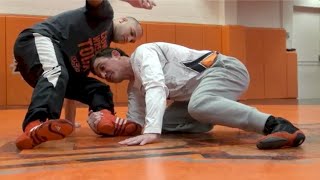
John Smith teaches his legendary low single | 6x World & Olympic Champion
Key Takeaways
- •Foundation: Penetration Below the Knee
- •Body Positioning: Splitting the Opponent
- •Distance and Shot Timing
- •Level Change and Ankle Reach
John Smith shows how to get technically sound at hitting the low single -the move he developed and perfected. Website: https://www.flowrestling.org Subscribe: http://bit.ly/2p4v31C Get the FloSports iOS app: http://bit.ly/FloWrestlingiOSApp_9 Follow FloWrestling Facebook: https://www.facebook.com/FloWrestling/ Twitter: https://twitter.com/flowrestling Instagram: https://www.instagram.com/flowrestling/
Related Techniques
Frequently Asked Questions
What does this video teach about ankle pick low single?
This video covers foundation: penetration below the knee, body positioning: splitting the opponent, distance and shot timing. It provides detailed instruction from FloWrestling.
How long does it take to learn ankle pick low single?
The basic mechanics can be understood in a single session, but developing reliable execution requires consistent drilling over weeks of practice. This 9-part breakdown helps structure your training by isolating each phase of the technique.
What are the key details for finishing ankle pick low single?
The shooter keeps the head down throughout the finish until the takedown is secured, preventing scramble escapes. If the opponent wraps the waist or reaches for a leg, the shooter can elevate to seek pins and turns rather than settling for a two-point takedown.
Related videos

Brock Hardy Low Single Leg Attacks | Technique Tuesday
FloWrestling
Sweep Single Takedown - Cary Kolat Wrestling Moves
Cary Kolat
John Smith teaches his legendary low single | 6x World & Olympic Champion
FloWrestling
Low single set ups from a clinch, golf swing details, head on the outside for single leg takedowns
Ramsey Dewey
2 EASY Single Leg FINISHES!
TeachMeGrappling Coach Brian