Introduction to Turtle Position Defense
The turtle position represents one of the most challenging defensive scenarios in grappling, occurring when an opponent has secured back mount control. Proper structural foundation is essential before applying any escape technique.
Establishing Defensive Structure
The defender must immediately establish a tight defensive posture by lowering the elbows inside the legs and creating an offset prayer hand position to form a protective barrier. The head should be tucked to prevent the opponent from securing hooks and executing a seat belt grip, both of which significantly compromise the defensive position.
Managing Established Hooks
Once the opponent secures hooks around the ribs, the defender must maintain an elevated defensive posture while preventing the seat belt grip. This high guard position buys time against the opponent's dominant position while the defender prepares to execute escape mechanics.
Mule Kick Escape with Angular Modification
Rather than executing a straight backward mule kick, the defender should angle the kick inward to minimize the opponent's ability to grip the quadriceps with their toes. This angled approach maintains the effectiveness of the escape while neutralizing the opponent's hook control.
Clearing the First Hook
As the defender's knee returns, they use their head as a base point while their hands sweep the opponent's heel backward to clear the first hook. Maintaining tight positioning immediately after clearing makes it difficult for the opponent to re-establish their hook.
Transitioning to Half Guard Position
The defender concentrates on the remaining hooked foot, using it as a transitional anchor point. By rotating the hips outward without lifting them and sliding the outside knee across, the defender transitions into a half guard position with an underhook, climbing the positional hierarchy.
Hip Rotation and Back Control
The defender's back must drive toward the ground throughout the transition to prevent the opponent from attacking the cup and establishing upper body control. As the hips rotate outward, the defender uses a fundamental stripping motion with the outside foot to complete the escape into half guard.
Blending Technique with Progressive Curriculum
This turtle escape transitions directly into the previous week's half guard sweep curriculum, allowing practitioners to layer techniques and develop continuous positional sequences. By drilling these connected movements together, students integrate multiple defensive and offensive concepts into cohesive grappling chains.
The Importance of Defensive Position Work
Mastering escapes from dominant positions like back mount requires consistent practice in uncomfortable situations where the defender is under pressure and compression. This defensive work develops the subtle hip adjustments and angular understanding necessary for successful grappling across all positions.
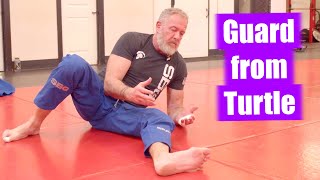
TURTLE TO HALF GUARD TRANSITION
Key Takeaways
- •Introduction to Turtle Position Defense
- •Establishing Defensive Structure
- •Managing Established Hooks
- •Mule Kick Escape with Angular Modification
This week, we deal with the dreaded back mount. Even worse, we look at it from the position of the turtle. This can be one of the most difficult positions in all of jiu jitsu. Here, we look at a slick transition to half guard that will advance you positional ladder standing and bring you right back to last week's lesson. For review, check out our video on the half guard from last week: https://www.youtube.com/watch?v=jD9hSAIWmwc Also, check out these related videos: https://www.youtube.com/watch?v=fdex6rpFkNc https://www.youtube.com/watch?v=KR5a_6T_N04 Check them out, like and subscribe! For more info about Alpha BJJ, check out the following: https://www.facebook.com/alphabjj http://alphajiujitsu.com Alpha BJJ 222 N. Benton St. Woodstock IL 815 345 4153
Frequently Asked Questions
What does this video teach about standard turtle to half guard?
This video covers introduction to turtle position defense, establishing defensive structure, managing established hooks. It provides detailed instruction from Alpha BJJ.
How long does it take to learn standard turtle to half guard?
The basic mechanics can be understood in a single session, but developing reliable execution requires consistent drilling over weeks of practice. This 9-part breakdown helps structure your training by isolating each phase of the technique.
What are the key details for finishing standard turtle to half guard?
This turtle escape transitions directly into the previous week's half guard sweep curriculum, allowing practitioners to layer techniques and develop continuous positional sequences. By drilling these connected movements together, students integrate multiple defensive and offensive concepts into cohesive grappling chains.
Related videos
Make Your Half Guard Unpassable
SBG PDX & Vancouver BJJ and MMA Videos
Escaping the turtle position in a fight or BJJ with a stand-up
Ben Egli
Sit Out escape from Turtle
Chosen Few BJJ
Fat Man Roll - Turtle Position Escape | Grappling Techniques
The Fight Centre - Brisbane
Guard Recovery - Getting To Turtle
SBG PDX & Vancouver BJJ and MMA Videos