TURTLE TO HALF GUARD TRANSITION
0
Standard Turtle To Half Guard·Alpha BJJ·Added by Admin
This week, we deal with the dreaded back mount. Even worse, we look at it from the position of the turtle. This can be…
Translation: standard turtle to half guard
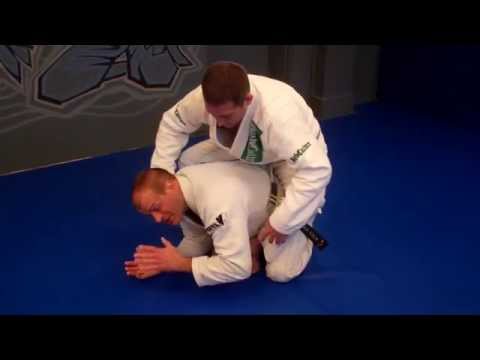
The Standard Turtle To Half Guard executes the transition by sitting the hips to one side, threading the inside leg between the opponent's legs to hook one leg, and establishing half guard with an immediate underhook on the same side. [1] The turtled fighter drops the hip to the mat, slides the inside leg between the opponent's legs, and locks up a half guard while simultaneously fighting for the underhook. [1],[2] The underhook is critical to making this transition offensive rather than merely defensive — with the underhook secured, the escaping fighter has immediate access to the old school sweep and other half guard attacks. [2],[3]
The standard turtle to half guard is the baseline version of this escape. [1]
A fundamental BJJ escape. [1]
Used in BJJ competition. [1]
No images yet for this technique.
Sign in to suggest an image.
This week, we deal with the dreaded back mount. Even worse, we look at it from the position of the turtle. This can be…
No instructional courses yet for this technique.
Sign in to suggest a course.
Risk of injury to the person this technique is applied to
Turtle escapes involve rolling and granby movements; neck strain risk
Skill level needed to execute this technique reliably
Whether this technique is allowed under major competition rule sets
Jiu-Jitsu University (Saulo Ribeiro, 2008)
Alias sources — [1] Jiu-Jitsu University (Saulo Ribeiro, 2008) [2] Brazilian Jiu-Jitsu: Theory and Technique (Renzo Gracie & Royler Gracie, 2001)
Effectiveness sources — [1] Jiu-Jitsu University (Ribeiro, 2008)
Mixed Japanese-Western terminology — combines traditional Japanese terms with katakana loanwords
Alias sources — [1] Jiu-Jitsu University (Saulo Ribeiro, 2008) [2] Brazilian Jiu-Jitsu: Theory and Technique (Renzo Gracie & Royler Gracie, 2001)
Effectiveness sources — [1] Jiu-Jitsu University (Ribeiro, 2008)
timing, hip power, off-balancing skill
strong hips and active legs for sweeping leverage
hip flexors, glutes, quadriceps, core rotators
Alpha BJJ emphasizes keeping your elbows tight inside your legs, forming an offset prayer position with your hands to create a wall, and tucking your head down to prevent your opponent from getting hooks in easily or securing a seat belt grip.
According to Alpha BJJ, if your opponent secures a seat belt grip while you have hooks in, it's a very bad position for you, so maintaining a tucked chin and solid walls is essential to deny this grip.
Alpha BJJ teaches kicking inward at an angle rather than straight back to minimize your opponent's ability to grab your quad with their toes, then using your head as a base to catch their heel and sweep it back to clear into half guard.
The Standard Turtle To Half Guard executes the transition by sitting the hips to one side, threading the inside leg between the opponent's legs to hook one leg, and establishing half guard with an immediate underhook on the same side. The turtled fighter drops the hip to the mat, slides the inside leg between the opponent's legs, and locks up a half guard while simultaneously fighting for the underhook.
The standard turtle to half guard transition is a fundamental BJJ escape taught as part of the comprehensive half guard game. Its integration with the underhook sweep system makes it a seamless transition from defence to offence.
Unified MMA: legal — Legal defensive technique; IBJJF: legal — Legal — escapes and sweeps are fundamental to BJJ, sweep from bottom scores 2…; IJF: legal — Legal; ADCC: legal — Legal, sweep scores 2 points (4 from mount/back); FIAS Sport Sambo: legal — Legal; FIAS Combat Sambo: legal — Legal
Danger rating 3/10. Moderate — turtle escapes involve rolling and granby movements; neck strain risk
The standard setup chain: Create Space → Disrupt Control → Execute Escape → Recover Position.
Standard counters include: Maintain Pressure — keep consistent weight distribution to limit escape space / Anticipate Direction — read escape attempt direction and block early / Transition — flow to a new position when the current one is threatened.
Common variants: Standard sweep (primary off-balancing and reversal technique from the guard); Combination sweep (chaining two sweep directions to catch the opponent's adj…); Counter sweep (sweeping as the opponent initiates a guard pass attempt); Competition sweep (optimised for point-scoring in tournament settings).
Used in BJJ competition.
Top errors to watch for: Not posting the hand — the post prevents you from collapsing during the sit-through / Threading the leg too shallow — catch the opponent's leg deeply for secure half guard / Sitting through to a flat back — maintain the seated/hip position for active half guard / Not catching the leg and ending in side control bottom — the leg catch is the critical element.
The Standard Turtle To Half Guard is also known as Sutandādo Kame kara Hāfu Gādo e, Basic Turtle To Half Guard, Standard Turtle Guard Recovery.