Addressing Size Disadvantage in Mount
The seated mount is a positional variation designed for grapplers facing larger opponents with greater body mass. Tight positional connections against substantially heavier opponents can backfire, as the pressure transfers bidirectionally and enables the bottom player to leverage their size advantage for reversals or escapes.
The Problem with Connection Against Larger Opponents
When establishing a traditional mounted position against a much larger opponent, the top grappler's base becomes unstable from aggressive bridging and turning attempts. Attempting to maintain connection through increased pressure paradoxically destabilizes the top player's posture and balance.
The Seated Mount Concept
The seated mount abandons tight connection in favor of a more mobile, reactive approach. Rather than maintaining constant knee pressure, the top player sits upright with knees controlling but not compressing, allowing greater freedom to adjust position as the bottom opponent moves.
Maintaining Control Through Movement Adaptation
From the seated position, the top player can follow the bottom opponent's escape attempts without committing to a fixed posture. If the bottom player turns or bridges aggressively, the top player remains free to step over, transition positions, or disengage entirely.
Knee Control Without Hand Dependency
Knee positioning serves as the primary control mechanism in the seated mount, reducing reliance on hand placement and arm traps. The top player can manipulate arm position and create submission opportunities through knee pressure alone while maintaining postural freedom.
Foot Placement and Reactive Adjustments
Positioning the toes directly beneath the body creates a stable base for rapid standing or sitting transitions. When the bottom player bridges explosively or turns, the top player can simply stand up, walk closer to the head, and reset the seated position rather than being displaced.
Transitioning to Submissions
From the seated mount, the top player can capitalize on escape attempts by quickly transitioning to back control, arm locks, or modified mount variations. Using knee pressure to pin the opponent's arm creates submission opportunities without requiring continuous upper body connection.
Anti-Connection Philosophy
The seated mount inverts conventional grappling wisdom by emphasizing positional freedom over connection. By remaining unattached and mobile, the top player converts the bottom opponent's natural escape attempts into submission openings, leveraging movement rather than static pressure.
The “Seated Mount”
Key Takeaways
- •Addressing Size Disadvantage in Mount
- •The Problem with Connection Against Larger Opponents
- •The Seated Mount Concept
- •Maintaining Control Through Movement Adaptation
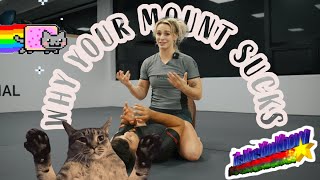
The “Seated Mount”. In this video I show a modified version of mount for BJJ when you are faced with a larger opponent. Often when mounting someone with a larger frame, it’s difficult to maintain mount. One lesson learned is that, although connection is a top principle in Brazilian Jiu-Jitsu, the opposite is equally important. When we connect to our opponents, they are connected to us as well. If they are larger and have more mass it can be difficult to control. Rather than control a single position, there is benefit to floating and using anti-connection. #bjj #jiujitsu #brazilianjiujitsu #judo #martialarts #mount #connection
Related Techniques
Frequently Asked Questions
What does this video teach about seated rear mount?
This video covers addressing size disadvantage in mount, the problem with connection against larger opponents, the seated mount concept. It provides detailed instruction from Robert Silas (Aiki_and_Jiu).
How long does it take to learn seated rear mount?
The basic mechanics can be understood in a single session, but developing reliable execution requires consistent drilling over weeks of practice. This 8-part breakdown helps structure your training by isolating each phase of the technique.
What are the key details for finishing seated rear mount?
From the seated mount, the top player can capitalize on escape attempts by quickly transitioning to back control, arm locks, or modified mount variations. Using knee pressure to pin the opponent's arm creates submission opportunities without requiring continuous upper body connection.