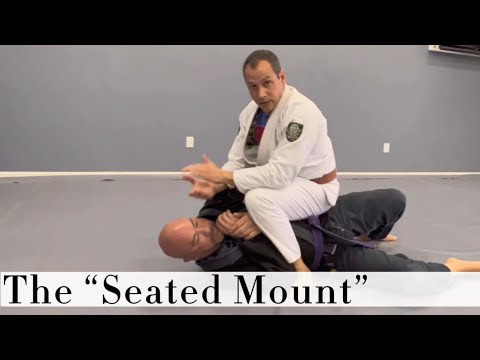
The “Seated Mount”
0
Seated Rear Mount·Robert Silas (Aiki_and_Jiu)
The “Seated Mount”. In this video I show a modified version of mount for BJJ when you are faced with a larger opponent. …
Translation: seated rear mount
The Seated Rear Mount subfamily covers the rear mount position where the controlling fighter is sitting upright behind the opponent, with the opponent in front and typically flattened or leaning forward. [1] The seated rear mount provides the controlling fighter with excellent posture and gravity-assisted control, making it particularly effective for ground-and-pound in MMA and for choke attacks in grappling. [1],[2] The seated position gives the controller the ability to use body weight and gravity to maintain the position. [2],[3]
The seated rear mount positions the attacker behind the seated opponent with hooks or body triangle, commonly reached after a guard pull or sweep. [1]
The seated rear mount is a variant developed in competitive BJJ. [1]
The seated rear mount is scored as back control in IBJJF competition. [1]
No images yet for this technique.
Sign in to suggest an image.
The “Seated Mount”. In this video I show a modified version of mount for BJJ when you are faced with a larger opponent. …
No instructional courses yet for this technique.
Sign in to suggest a course.
Risk of injury to the person this technique is applied to
Back control is dominant position; enables rear chokes (Danaher 2021)
Skill level needed to execute this technique reliably
Whether this technique is allowed under major competition rule sets
Mastering Jujitsu (Renzo Gracie & John Danaher, 2003)
Alias sources — [1] Jiu-Jitsu University (Ribeiro, 2008) [2] Mastering Jujitsu (Gracie & Danaher, 2003)
Effectiveness sources — [1] Jiu-Jitsu University (Ribeiro, 2008)
Standard Japanese martial arts terminology (kanji/hiragana)
Established Japanese martial arts naming convention — native Japanese term (和語/漢語)
Alias sources — [1] Jiu-Jitsu University (Ribeiro, 2008) [2] Mastering Jujitsu (Gracie & Danaher, 2003)
Effectiveness sources — [1] Jiu-Jitsu University (Ribeiro, 2008)
base stability, heavy hips, ride ability
heavier build with strong hips for pressure
hip adductors, core, glutes, quadriceps
Every move, in any martial art, shares a few universal traits. Mix and match below to pinpoint the right tool — or compare equivalents across styles.
Robert Silas recommends seated mount particularly against larger opponents, as it allows you to maintain balance and control without losing posture when they escape or turn. Unlike traditional mount where struggling can cause you to lose balance, seated mount lets you stay mobile and follow their movements.
Use your knees to control them while sitting upright on your toes, positioning your toes almost directly under your hips. Robert Silas describes this as similar to riding a bull—your opponent can bridge as hard as they want, but your knee control keeps you in position, and if they try to turn, you can easily step over and switch positions.
Robert Silas emphasizes an 'anti-connection' approach: keep yourself free to move while allowing your opponent freedom to move, and their own escape attempts will generate submission opportunities. You can use your knees to control their arms and body without relying solely on hand control.
The Seated Rear Mount subfamily covers the rear mount position where the controlling fighter is sitting upright behind the opponent, with the opponent in front and typically flattened or leaning forward. The seated rear mount provides the controlling fighter with excellent posture and gravity-assisted control, making it particularly effective for ground-and-pound in MMA and for choke attacks in grappling.
The seated rear mount is one of the two primary rear mount configurations in BJJ and MMA, favoured when the controlling fighter has an upright positional advantage. It is commonly achieved through back takes from turtle or standing positions.
IBJJF: legal — Legal, mount scores 4 points — highest-scoring position; IJF: legal — Legal, osaekomi (pin) — 10-19 seconds scores waza-ari, 20 seconds scores ippon; ADCC: legal — Legal, mount scores 2 points; Unified MMA: legal — Legal dominant position; UWW: legal — Legal, back exposure scores points, pin ends match by fall; FIAS Sport Sambo: legal — Legal, pin scores points
Danger rating 4/10. Moderate — back control is dominant position; enables rear chokes (Danaher 2021)
The standard setup chain: Pass the Guard → Settle Weight → Control Arms → Threaten Submissions.
Standard counters include: Bridge (Upa) — explosive hip elevation to off-balance the top player / Elbow-Knee Escape (Shrimp) — create space by driving elbow to knee and hip-escaping / Frame — establish forearm frames to prevent the top player from settling weight.
Common variants: Low mount (hips heavy on the opponent's belly, grapevines in for sta…); High mount (knees under the armpits, arms isolated for submissions); S-mount (one knee high under the armpit, other leg across for arm …); Technical mount (one leg hooked, one knee posted, modified for back-take t…).
The seated rear mount is scored as back control in IBJJF competition.
Top errors to watch for: Staying in the seated position too long without attacking or transitioning — the position is transitional / Not maintaining close hip connection — any gap allows the opponent to escape downward / Losing hooks when the opponent stands up — follow them to standing or transition your control / Not using the height advantage for attacks — the seated position offers good submission angles.
The Seated Rear Mount is also known as Zai Ushiro Kijōi, Seated Back Mount, Upright Rear Mount.