Crucifix as Modified Back Control
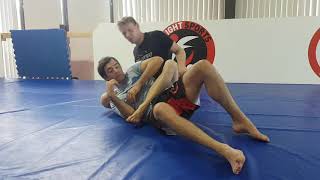
Crucifix control is a 90-degree rotational variation of standard back control. While traditional back control involves positioning directly behind the opponent with hooks and a seatbelt grip, crucifix maintains chest-on-back pressure and the same gripping framework but with the controlling player's body perpendicular to the opponent. Understanding this relationship clarifies both entry and exit transitions between the two positions.
Entry from Turtle Position
A primary entry to crucifix comes from attacking an opponent in turtle position. The controlling player positions their knee between the opponent's arm and leg, creating space by flaring the knee outward. From here, the controlling player can drag the opponent's hand backward and transition into crucifix control by using footwork rather than jumping or rolling.
Arm Positioning and Variations
Once in crucifix, the trapped arm can be positioned in two ways: with the hand facing forward for certain attacks, or rotated downstream (similar to a Kimura position) to limit escape options. The downstream position provides slightly better control and makes defensive movement more difficult for the opponent.
Establishing the Position
The most efficient method to establish crucifix from turtle involves moving the feet to the front of the opponent and using footwork to pull the opponent backward, avoiding unnecessary rolling movements. Once positioned, the controlling player secures a seatbelt grip while maintaining chest-to-back contact and triangulating the legs to lock down the position.
Collar Grip Deep Choke
The fundamental attack from crucifix involves securing a deep collar grip. The controlling player opens the opponent's collar with the hand underneath, passes it to the opposite hand, and briefly rotates to one side to achieve maximum depth before returning to their back. The hand opposite the grip locks behind the head, and the controlling player pulls their elbow straight down to the mat to apply the choke.
Weight Distribution and Arm Drag Defense
Proper weight distribution is critical to prevent arm drags. The controlling player should shift weight onto the shoulder on the same side as the gripping arm rather than loading pressure through the center of the opponent's body. This positioning prevents the opponent from collapsing and escaping via arm drag in that direction.
Arm Rotation and Transition
The controlling player can alter the opponent's arm position by stretching the right leg back to straighten the arm, then placing that leg behind the other foot to switch the arm orientation. This adjustment increases control and creates additional offensive opportunities from the crucifix position.
Multiple Finishing Techniques
Beyond the collar choke, crucifix allows for multiple finishing options including armbars, neck breaks, and various choke variations. The controlling player can also transition out of crucifix back to traditional back control by simply reorienting their body position to directly behind the opponent.
Crucifix Control
Key Takeaways
- •Crucifix as Modified Back Control
- •Entry from Turtle Position
- •Arm Positioning and Variations
- •Establishing the Position
A basic Intro to the Crucifix position
Related Techniques
Frequently Asked Questions
What does this video teach about crucifix back control?
This video covers crucifix as modified back control, entry from turtle position, arm positioning and variations. It provides detailed instruction from John Will.
How long does it take to learn crucifix back control?
The basic mechanics can be understood in a single session, but developing reliable execution requires consistent drilling over weeks of practice. This 8-part breakdown helps structure your training by isolating each phase of the technique.
What are the key details for finishing crucifix back control?
The controlling player can alter the opponent's arm position by stretching the right leg back to straighten the arm, then placing that leg behind the other foot to switch the arm orientation. This adjustment increases control and creates additional offensive opportunities from the crucifix position.
Related videos
Seatbelt/Kimura attacks and control from the back.
Royal Grappling Academy BJJ Dublin
Back Control SEATBELT and Hand Fighting!
TeachMeGrappling Coach Brian
ESCAPING BACK CONTROL BY BEATING THE TOP HOOK!
Nexus Jiu Jitsu
Gordon Ryan - How to properly use a body triangle
Less Impressed More Involved BJJ
Back Attacks - Part 7: Strong Side Tactics // Tom Halpin
Tom Halpin