Introduction to S-Mount Position
Bismarck Gomez, a Brazilian Jiu-Jitsu No-Gi World Champion, demonstrates the foundational S-mount position and its applications for submissions. The S-mount is an advanced top control position that transitions from mount and enables multiple submission opportunities. This instructional focuses on establishing proper positioning before executing submissions.
Establishing the S-Mount Base
From mount position, the instructor secures both hands on the opponent's chest using a palm-to-palm grip. The top leg's knee is then slid across the opponent's head while the bottom leg remains extended with the foot turned outward. This configuration creates the distinctive 'S' shape that gives the position its name and locks the opponent's arm.
S-Mount Armbar Finish
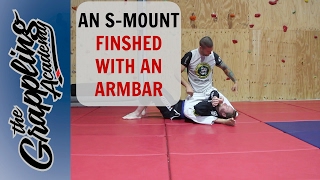
Once in the S-mount position, the instructor hugs the opponent's trapped arm while using the shin against the head for control. The position is secured by sitting on the opponent's chest and maintaining leg pressure. This setup creates the necessary leverage to execute a powerful armbar submission by extending the hips.
Transition to Arm Triangle Setup
From the S-mount, the instructor demonstrates transitioning to an arm triangle position by adjusting the leg hook. A second hook is established bone-to-bone against the opponent's body while maintaining chest pressure. The arm triangle requires precise positioning and grip placement to control the opponent's head and arm simultaneously.
Countering Arm Escapes
When the opponent attempts to escape the armbar or arm triangle by lifting the shoulder or defending the arm, the instructor demonstrates immediate counter-adjustments. By switching the leg position and transitioning to the opposite side, the instructor maintains control and creates new submission angles. This reactive footwork prevents the opponent from establishing defensive frames.
Transition to Neck Crank Variant
The instructor demonstrates switching from arm attacks to a neck control variation by repositioning the legs around the opponent's head. One leg passes over the head while the other secures a hook, creating a tight necklock position. This transition is valuable when the opponent defends the arm submissions by protecting and hiding the arm.
Final S-Mount Sequence Drill
A complete repetition demonstrates the full sequence: establishing S-mount with dual hooks, securing the arm triangle or armbar, countering escapes with leg transitions, and finishing with chest pressure and hip extension. The instructor emphasizes maintaining control throughout transitions and protecting the submission grip during opponent defense attempts. This comprehensive sequence showcases the versatility of the S-mount position in modern no-gi grappling.
How to "S-MOUNT" (Plus 4 BJJ Submissions)
Key Takeaways
- •Introduction to S-Mount Position
- •Establishing the S-Mount Base
- •S-Mount Armbar Finish
- •Transition to Arm Triangle Setup
While at Evolve MMA in Singapore, I met up with no-gi Brazilian Jiu-Jitsu World Champion: Bismarck Gomes. In this #BJJ tutorial, Bismarck shows 4 submissions from s-mount, including 2 armbar variations, an omoplata, and a triangle choke. Evolve MMA►https://evolve-mma.com/instructors/bismarck-gomes/ Bismarck's IG►https://www.instagram.com/bismarck_ivan/?hl=en SUBSCRIBE TO GET MORE #FIGHTTIPS►http://bit.ly/1APnzvw FOLLOW: Facebook | http://bit.ly/fightTIPSFacebook Twitter | http://bit.ly/fightTIPSTwitter Instagram | http://bit.ly/fightTIPSInstagram
Related Techniques
Frequently Asked Questions
What does this video teach about s-mount armbar?
This video covers introduction to s-mount position, establishing the s-mount base, s-mount armbar finish. It provides detailed instruction from fightTIPS.
How long does it take to learn s-mount armbar?
The basic mechanics can be understood in a single session, but developing reliable execution requires consistent drilling over weeks of practice. This 7-part breakdown helps structure your training by isolating each phase of the technique.
What are the key details for finishing s-mount armbar?
The instructor demonstrates switching from arm attacks to a neck control variation by repositioning the legs around the opponent's head. One leg passes over the head while the other secures a hook, creating a tight necklock position. This transition is valuable when the opponent defends the arm submissions by protecting and hiding the arm.