Introduction to Back Mount Submissions
Ramsay Dewey introduces the comprehensive guide to back mount submissions beyond the rear naked choke. While the RNC remains fundamental, numerous high-percentage alternatives exist when the opponent defends or positions themselves unfavorably.
Back Mount Triangle and Leg Lock Entries
By trapping the opponent's arm and scooping the body, the instructor establishes back mount triangles as a primary submission vector. From this position, knee bars and toe holds become available when the opponent begins bucking or squirming.
Arm Bar from Seatbelt Control
When the opponent hand-fights to strip the choking grip, the instructor transitions to a figure-four grip and repositions the legs to execute a high-percentage arm bar. This counter-submission requires precise hip positioning and head control to prevent escape.
Back Mount Triangle When Opponent Tucks Chin
When the opponent lowers their head beneath the instructor's chin to defend the rear naked choke, climbing into a back mount triangle becomes the optimal response. From this position, the opponent faces submission to either the triangle, toe hold, knee bar, or arm bar.
Grapevine Control and Spinal Submissions
Transitioning to back mount grapevine on a single leg when hooks are lost opens access to twister neck and spinal locks, banana splits, and calf cranks. These submissions capitalize on the opponent's extended leg position.
Back Take from Turtle Position and Arm Bar Setup
When taking the back from turtle position, the instructor demonstrates multiple arm bar setups using shin placement across the opponent's back. Proper positioning of the head and legs determines successful completion of the submission.
Safety Considerations and Controlled Back Riding
The instructor emphasizes the critical safety principle of maintaining control in back mount by keeping the opponent's hips elevated and sprawled flat. Allowing the opponent to roll or bridge with elevated hips creates dangerous situations that can result in serious cervical spine injury.
Cross-Face Pressure and Positional Control
Rather than relying solely on submissions, the back mount allows for devastating cross-face pressure that exposes the opponent's face for strikes. Maintaining hip control while alternating cross-face angles from above and below the chin prevents defensive repositioning.
Comprehensive Submission Menu from Back Mount
The back mount provides access to arm bars, triangles, wrist locks, toe holds, knee bars, twisters, calf cranks, and neck cranks. The instructor demonstrates that understanding position transitions allows seamless flow between submission categories based on opponent resistance.
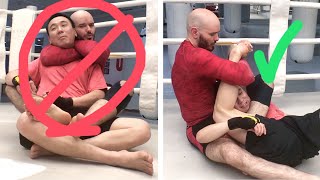
16 backmount submissions besides the RNC
Key Takeaways
- •Introduction to Back Mount Submissions
- •Back Mount Triangle and Leg Lock Entries
- •Arm Bar from Seatbelt Control
- •Back Mount Triangle When Opponent Tucks Chin
What submissions can you do from back mount besides the rear naked choke? Here are 16 of them, including triangles, arm bars, shoulder locks, toe holds, calf cranks, spladles, knee bars, neck cranks, the twister, the banana split, and one of the most dominant ground and pound finishing positions in the sport of MMA. Up your submission grappling skills with more options. Shanghai based MMA coach and Kunlun Fight Combat League ringside commentator Ramsey Dewey answers technique questions from the viewers. If you want a technical breakdown of Mixed Martial Arts techniques, let me know in the comments below!
Related Techniques
Frequently Asked Questions
What does this video teach about rear neck crank from back (no hooks)?
This video covers introduction to back mount submissions, back mount triangle and leg lock entries, arm bar from seatbelt control. It provides detailed instruction from Ramsey Dewey.
How long does it take to learn rear neck crank from back (no hooks)?
The basic mechanics can be understood in a single session, but developing reliable execution requires consistent drilling over weeks of practice. This 9-part breakdown helps structure your training by isolating each phase of the technique.
What are the key details for finishing rear neck crank from back (no hooks)?
Rather than relying solely on submissions, the back mount allows for devastating cross-face pressure that exposes the opponent's face for strikes. Maintaining hip control while alternating cross-face angles from above and below the chin prevents defensive repositioning.
Related videos
MMA BJJ Neck Crank Armbar by Avellan! FFA Technique
Freestyle Fighting Academy

Avellan Shows Bas Rutten Neck Crank for BJJ and MMA
Freestyle Fighting Academy
16 backmount submissions besides the RNC
Ramsey Dewey

How to counter Can Opener neck crank from closed guard for BJJ
Brazilian Jiu-Jitsu & Submission Grappling
BODY TRIANGLE SUBMISSION!!
Invisible Jiu Jitsu