Introduction and Setup
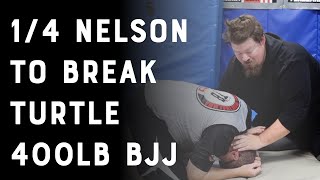
Nathan Levinson demonstrates the front headlock progression from turtle position. The opponent is positioned on all fours as the instructor establishes the initial front headlock grip.
Front Headlock Positioning
The instructor's shoulder must be driven deep into the back of the neck, not high on the head, to prevent the opponent from advancing. The chin is gripped simultaneously with the same arm, creating a two-point control system that stops movement in both directions.
Hip Pressure and Hand Placement
The hips elevate while the same-side hip screws inward for maximum pressure. The opposite hand secures behind the opponent's arm, pulling everything inward to create a crushing effect as if driving the head toward the knees.
Transition to Three-Quarter Nelson
From the front headlock, the top hand rotates around the head and feeds under the opponent's armpit to the far shoulder. The thumb aligns along the jawline while the back of the hand contacts the head, allowing the instructor to grip and pull the opponent tight against the chest.
Three-Quarter Nelson Breakdown
The shoulder drives deep underneath the opponent's armpit while the elbows pinch together, preventing the opponent from lifting their head. Continuous pressure forces the opponent onto their back until fatigue sets in.
Setup for the D'arce Choke
The hand transitions to the back of the head, digging through to lock the arms. The instructor walks the hand up the back of the head to set the initial D'arce position.
Body Positioning for the Choke
The body must round slightly toward the opponent's head to ensure the arm comes in perpendicular to the neck. If the arm crosses the chest instead, the choke will be ineffective.
D'arce Choke Finish
The arm digs deep, approaches the neck at 90 degrees, and jams into the side of the neck. The instructor grips the tricep with the opposite hand, then walks the hand up to tighten the choke while flexing the bicep like a rear naked choke.
Common Mistakes and Corrections
The most frequent error is squeezing the wrist toward the body instead of targeting the front of the neck. The proper finish involves pushing the bicep outward and raising the elbow slightly to cut off blood flow at the front of the neck.
Complete Sequence Demonstration
The instructor performs the entire combination from initial front headlock through three-quarter Nelson to D'arce choke finish in one continuous flow. This sequence is effective from takedowns, scrambles, or when the opponent rises to their knees.
BJJ No Gi Front Headlock into 3/4 Nelson and D'arce Choke Tutorial
Key Takeaways
- •Introduction and Setup
- •Front Headlock Positioning
- •Hip Pressure and Hand Placement
- •Transition to Three-Quarter Nelson
Nathan Leverton, Head Coach of Leicester Shootfighters is filmed here by the Warrior Collective giving a step by step tutorial on how to transition from a front headlock into a 3/4 nelson and then finish with a D'arce choke for No Gi BJJ/Submission Grappling. www.warriorcollective.com www.leicestermma.co.uk
Related Techniques
Frequently Asked Questions
What does this video teach about nelson from front headlock?
This video covers introduction and setup, front headlock positioning, hip pressure and hand placement. It provides detailed instruction from Stuart Tomlinson.
How long does it take to learn nelson from front headlock?
The basic mechanics can be understood in a single session, but developing reliable execution requires consistent drilling over weeks of practice. This 10-part breakdown helps structure your training by isolating each phase of the technique.
What are the key details for finishing nelson from front headlock?
The most frequent error is squeezing the wrist toward the body instead of targeting the front of the neck. The proper finish involves pushing the bicep outward and raising the elbow slightly to cut off blood flow at the front of the neck.