Initial Position and Control
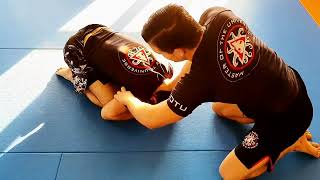
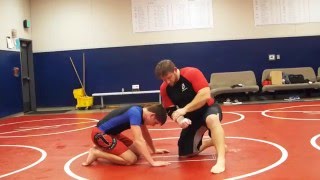
Begin from turtle position with controlled grip similar to a headlock. Maintain pressure on the opponent's leg to establish baseline control and prevent escape attempts. This foundational positioning is essential before advancing to the choke.
Hand Placement and Arm Positioning
The top hand should penetrate as deeply as possible toward the opponent's shoulder. Simultaneously, the outside hand seeks forward elbow control by reaching toward the opponent's arm. As the opponent extends their position, these coordinated hand placements create the setup for the submission.
Recognizing the Finishing Moment
When the opponent overextends their position, immediately reach for their arm with your outside hand. If the opponent exposes too much space despite arm positioning, transition to a neck choke similar to a knife choke. This decision-making prevents wasted energy and capitalizes on opponent mistakes.
Grip Transition and Hip Movement
Once both arms are secured, rotate toward the side where the opponent's arm is trapped or compromised. Drive your hips and torso against the opponent's head while maintaining a tight grip without losing position. This generates mechanical pressure that forces the submission.
Controlling the Escape and Preventing Rollover
Keep the opponent's arms pinned and prevent them from opening their elbows. Maintain a strong base with your legs to prevent the opponent from rolling over or reversing position. Constant pressure and positional control are critical to finishing the choke effectively.
Reading Opponent Balance and Adjusting
Identify which side the opponent places their weight and counter by rolling toward the opposite side. If the opponent keeps their hand position on one side, direct your pressure to the other. This strategic adjustment neutralizes common defensive responses.
Head Positioning and Roll Prevention
Position your head underneath the opponent's body before they can roll away. Getting your arm under them early prevents the opponent from rotating under your head and escaping. This timing is essential for maintaining control during the transition.
Finishing with Continuous Pressure
Squeeze maximally while keeping the opponent's elbows together to prevent defensive framing. Maintain pressure on the neck and jaw to complete the submission. Consistency and relentless pressure ultimately force the opponent to submit.
Marcelo Garcia - Anaconda Choke With 3 Variations
Key Takeaways
- •Initial Position and Control
- •Hand Placement and Arm Positioning
- •Recognizing the Finishing Moment
- •Grip Transition and Hip Movement
Like Our Videos or Subscribe to Our Channel to See New Demonstrations and Techniques. 3 Part Technique — Marcelo Garcia's style of BJJ is immensely unique in many different aspects of the traditional art form, but no one example sets him apart from the rest more than his controversial stance on the omission of certain attribute-based submissions (i.a. The Arm Triangle) from his competition game. Instead, Marcelo wisely chooses to spend his finite training time as efficiently as possible by discarding all techniques whose successful application relies upon phenotypical advantage, and he only trains moves into his repertoire that work irrespective of size or strength. The sole tenet of BJJ is that the knowledge of bio mechanical leverage can allow for a small, weak person to defeat a larger, stronger person in unarmed combat. Surely, the possession of such physical traits such as long limb length, flexibility, and heavy musculature can multiply one's leverage in a fight considerably, but the point isn't about the size of your lever, it's about where best to place your fulcrum. Nearly all of the movements that Marcelo personally uses in his competition game are techniques that have been consistently proven to work against opponents of any size, with or without the aid of the gi. The Arm Triangle Choke (viz. Anaconda, D'Arce, Katagatame, RAT) is a technique that ceases to work effectively against an adversary who i) has superior strength, ii) has a large girth, and iii) provides technical resistance. Though it is not impossible to finish the choke despite this seemingly insurmountable combination, your chance of success dramatically approaches nil if your opponent correctly defends your attack via these physical advantages. Although the Arm Triangle is far from Marcelo's specialty, he has finally decided to teach his class one particular variation of the choke (The Anaconda) to the best of his ability, in lieu of the aforementioned perspective, for 2 reasons: a) it is important for his students to develop an awareness of the danger inherent from a specialist in this attack, and b) there is no reason not to try the submission if your opponent is blatantly, carelessly, or inadvertently giving it to you. Marcelo demonstrates 3 scenarios in which he would be so inclined to attempt the Arm Triangle Choke: 1) While holding the Front Headlock, if your opponent overextends his arm to reach for a takedown, sink in the choke and roll him onto his side, clocking your belly into the back of his neck until you can catch his legs with yours. 2) If he steps up with his foot to posts against your initial roll, flip him onto his opposite side and once again capture his legs for the final squeeze. 3) If you encounter difficulty enclosing the Triangle around his Head & Arm, apply pressure down onto his elbow with a Gable-gripped forearm and your topside knee. Marcelo Garcia in Action has over 12000 videos of demonstration in both Gi and No Gi grappling. Marcelo Garcia is known as one of the top grapplers in the world with many accomplishments. This is a sample video from http://www.mginaction.com/
Related Techniques
Frequently Asked Questions
What does this video teach about anaconda choke from turtle?
This video covers initial position and control, hand placement and arm positioning, recognizing the finishing moment. It provides detailed instruction from MGInActionVideos.
How long does it take to learn anaconda choke from turtle?
The basic mechanics can be understood in a single session, but developing reliable execution requires consistent drilling over weeks of practice. This 8-part breakdown helps structure your training by isolating each phase of the technique.
What are the key details for finishing anaconda choke from turtle?
Position your head underneath the opponent's body before they can roll away. Getting your arm under them early prevents the opponent from rotating under your head and escaping. This timing is essential for maintaining control during the transition.