Introduction to Lama Pai Chain Punching
This instructional guide examines Lin Wan Chung Choy, the Lama Pai chain punching technique. The instructor will demonstrate its execution in classical form, padwork integration for MMA training, and real-world application in professional competition.
Distinguishing Lama Pai from Wing Chun Chain Punching
While Wing Chun employs chain punching with vertical alignment, Lama Pai differs fundamentally in its angular trajectory. Lama Pai punches cross the opponent's centerline at a boxer's cross angle, combining lateral movement with forward momentum rather than maintaining squared positioning.
Biomechanics and Movement Pattern
The technique employs opposite hand-foot coordination similar to a running motion, creating continuous forward propulsion. This alternating rhythm generates uninterrupted driving force through sequential strikes rather than discrete, separated movements.
Combat Application and Strategic Purpose
Lama Pai chain punching serves as a follow-up technique deployed after initial contact stuns the opponent. The method drives defenders backward toward barriers, into fence positions, or toward knockout opportunities—applicable in MMA, sport fighting, and self-defense scenarios.
Orthodox Stance Execution
From orthodox positioning, the instructor initiates the sequence by shifting the rear leg to transition into south pole stance. The opening strike begins as a lead-hand jab that immediately converts to a rear-hand cross, with weight transfer amplifying force delivery.
Padwork Progression and Timing Cues
During pad training, the defender signals vulnerability by retreating onto their heels with pads positioned defensively. Upon recognizing this positioning, the striker immediately charges forward, executing the first jab followed by step-through continuation without interruption of forward energy.
South Pole Stance Variation
In classical south pole stance application, the technique emphasizes the dominant cross down a direct centerline. The non-dominant hand serves a controlling and bridging function while the dominant cross carries primary striking force following the initial penetration.
MMA Integration and Combat Readiness
Fighters incorporating this technique into regular padwork develop precise timing for recognizing knockout opportunities. Identifying opponent vulnerability and responding with immediate chain punching sequences develops the instinctive decision-making necessary for high-pressure combat situations.
Professional Application Example
Elite UFC competitors execute this technique with explosive efficiency, combining speed and precision. The sequence of alternating hands and forward momentum demonstrates the technique's lethal potential when applied against compromised opponents at professional competition levels.
Hap Gar Chain Punching
Key Takeaways
- •Introduction to Lama Pai Chain Punching
- •Distinguishing Lama Pai from Wing Chun Chain Punching
- •Biomechanics and Movement Pattern
- •Combat Application and Strategic Purpose
This is an explanation of the Hap Gar Technique 'Lin wan Chyun Choi' (Chain Piercing Punches) and how to train them for Self Defence or MMA.
Related Techniques
Frequently Asked Questions
What does this video teach about lama pai backfist?
This video covers introduction to lama pai chain punching, distinguishing lama pai from wing chun chain punching, biomechanics and movement pattern. It provides detailed instruction from Rising Crane.
How long does it take to learn lama pai backfist?
The basic mechanics can be understood in a single session, but developing reliable execution requires consistent drilling over weeks of practice. This 9-part breakdown helps structure your training by isolating each phase of the technique.
What are the key details for finishing lama pai backfist?
Fighters incorporating this technique into regular padwork develop precise timing for recognizing knockout opportunities. Identifying opponent vulnerability and responding with immediate chain punching sequences develops the instinctive decision-making necessary for high-pressure combat situations.
Related videos
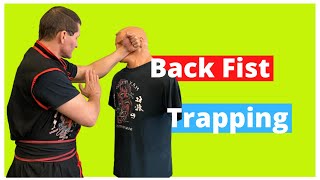
Backfist a devasting strike: Simple Trapping Techniques
DaiLung

Double backfist
DaiLung

learning kung fu at small space / tiger claw , creative kung fu / 虎拳
LAS VEGAS MODERN KUNG FU SCHOOL

FU-JOW PAI, TIGER CLAW SALUTATION PART 1, BREAKDOWN 1
Digital Tiger Claw

Combative Technique - The Tigers Claw
Working with Warriors Podcast