Kung Fu Combo - Crane Pull and Attack
0
Crane Beak Strike·Sifu Kuttel
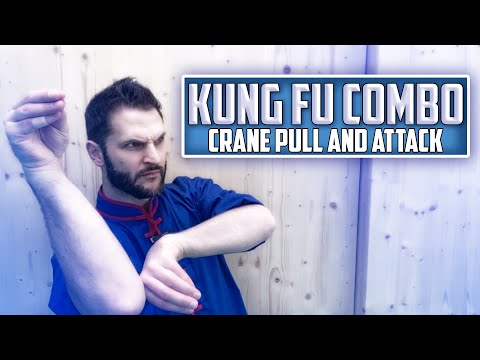
In this video we look at a very useful way to strike with the crane beak, then hook to pull our opponent in and strike a…
Translation: Hok (鶴) = crane, Jui (嘴) = beak/mouth — the bunched fingertips resemble the pointed beak of a crane, used for pecking strikes to vulnerable anatomical targets
The Crane Beak Strike bunches all five fingertips together into a single pointed formation — like the beak of a crane — and drives this concentrated point into vulnerable anatomical targets such as the throat, eyes, temple, solar plexus, and nerve clusters between the ribs. [1] The hand shape is formed by bringing the thumb and all four fingertips together so they touch at a single point, creating a formation that resembles a bird's beak when viewed from the side. [1],[2] Unlike the Phoenix Eye Fist (which uses a single knuckle), the Crane Beak uses the soft tissue of the fingertips, making it more versatile but requiring different conditioning: the fingertips must be strengthened through progressive exercises to prevent them from collapsing on impact. [1] The Crane Beak appears across multiple Chinese martial arts systems that incorporate crane-style techniques, most prominently in Fujian White Crane (Bai He Quan), Hop-Gar (which includes Tibetan Crane elements), and Wing Chun (which derives partly from Yongchun White Crane). [1],[2] In Japanese karate, the equivalent hand formation is called washide (鷲手, eagle hand) or kakuto (鶴頭, crane head) and appears in several traditional kata. [3] The Crane Beak serves a dual function in traditional kung fu: as an offensive weapon (striking with the pointed fingertips) and as a defensive/trapping tool (the beak formation can hook and redirect an opponent's limbs by catching them in the curved finger formation). [1],[2] The technique represents the crane's fighting philosophy: precision over power, targeting vital points rather than delivering concussive force, and using the smallest possible weapon to attack the smallest possible target. [1]
The Crane Beak is one of the defining hand formations of Southern Chinese crane-style kung fu, with roots tracing to the Fujian White Crane system (Bai He Quan) developed by Fang Qiniang in the 17th century. [2] According to tradition, Fang Qiniang, a young woman from Fujian province, observed a crane fighting (or defending itself from a snake/predator) and was inspired by the bird's precision strikes, evasive body movement, and use of its beak and claws as weapons. [2] She developed a fighting system based on these observations, which became Fujian White Crane — one of the most influential Southern Chinese martial arts. [2] The Crane Beak hand formation was transmitted from Fujian to Okinawa through trade and cultural exchange between Fujian province and the Ryukyu Islands, where it became part of Okinawan te and eventually appeared in Japanese karate as washide. [3] In the Hop-Gar tradition, the Crane Beak was part of the Tibetan Lama fighting methods that merged with Southern Chinese systems when Lama monks settled in Guangdong. [1] David Chin documents the Crane Beak within the Hop-Gar curriculum alongside the Tiger Claw and Iron Palm, noting that each hand formation serves a distinct tactical purpose: the Tiger Claw for raking and grabbing, the Iron Palm for concussive striking, and the Crane Beak for precision vital-point attacks. [1]
The Crane Beak's effectiveness is entirely dependent on targeting accuracy: a precisely placed Crane Beak to the throat produces immediate physiological effects (choking, gagging, laryngospasm) that are disproportionate to the force applied, while a Crane Beak that misses its target by a few centimetres is essentially useless. [1],[2] This makes the technique a specialist weapon for practitioners who have invested significant training time in precision — it rewards skill over athleticism. [1] The hooking/trapping function of the Crane Beak (using the curved formation to redirect the opponent's limbs) is more immediately practical than the striking function, as it does not require the same level of precision and can be used in a wider range of situations. [1] In the context of the Five Animals of Chinese martial arts, the crane represents the principle of precision and economy: the smallest weapon to the smallest target, using the least force for the maximum effect. [2]
Not applicable in modern sport competition (primary targets are illegal). The Crane Beak is preserved in traditional forms (kata) across multiple martial arts systems. The hooking/trapping function is used in Wing Chun chi sao (sticky hands) training and competition.
No images yet for this technique.
Sign in to suggest an image.
In this video we look at a very useful way to strike with the crane beak, then hook to pull our opponent in and strike a…
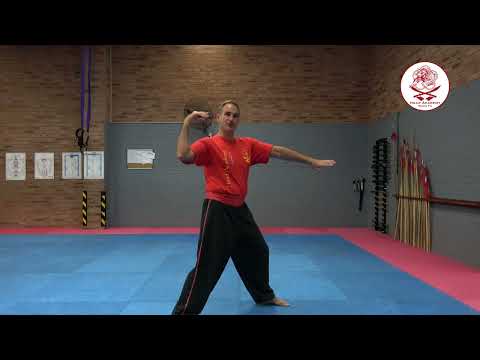
Head Academy Jow Gar Kung Fu Cranes Beak Strike. One of the 5 animal styles of Jow Gar the Crane has a variety of techni…
In this video we look at Crane style kung fu techniques that involve the crane's beak strike, the crane neck strike, and…
The crane beak strike is a focused open-hand technique employing all five fingers distributed equally in a circular formation to concentrate force onto a small striking surface, as taught across instructional sources. Head Academy Kung Fu emphasizes the foundational hand shape through the 'picking up spaghetti' visualization drill, while Sifu Kuttel reinforces the importance of fingertip and wrist conditioning as prerequisites, requiring incremental light training over extended periods rather than forceful impact work. Both instructors identify soft anatomical targets—eyes, throat, temple, groin, and behind the ear—as appropriate application areas, with Head Academy noting the concentration of kinetic energy through a small contact point creates a disproportionately painful strike. Mechanically, Head Academy Kung Fu describes the strike as utilizing a whipping action with kinetic energy flowing through shoulder, elbow, wrist, and fingers sequentially, similar to a throwing motion. Sifu Kuttel contextualizes the crane beak within broader training philosophy, emphasizing that accuracy and precision define crane style, and that the technique's practical application depends on situational context—unsuitable for padded glove competition but valuable in self-defense scenarios without protective equipment. Both sources agree that the technique requires significant conditioning development and cannot be rushed. Sifu Kuttel additionally demonstrates how crane beak movements can be conceptually adapted to conventional fist techniques for modern combat sports applications.
Synthesized from 3 instructors
No instructional courses yet for this technique.
Sign in to suggest a course.
Risk of injury to the person this technique is applied to
The Crane Beak to the throat can cause tracheal compression, laryngeal fracture, and airway compromise — potentially lethal at full force. To the eyes, it can cause corneal abrasion, globe rupture, or permanent vision damage. To the temple, the concentrated fingertips can cause concussion with less overall force than a fist punch. The technique specifically targets the body's most vulnerable soft tissue areas. [1,2]
Skill level needed to execute this technique reliably
Whether this technique is allowed under major competition rule sets
Hop-Gar Kung Fu (Chin & Staples)
description: [1] Chin & Staples, [2] Yang 1996
Official karate technique names (和語/漢語)
Established Japanese martial arts naming convention — native Japanese term (和語/漢語)
description: [1] Chin & Staples, [2] Yang 1996
Requires progressive fingertip conditioning (without conditioning, the fingers will be injured on impact)
Exceptional precision for targeting small anatomical points
Fine motor control for forming and maintaining the beak shape under combat stress
Knowledge of anatomical vulnerability points (the technique requires knowing WHERE to strike)
Does NOT require exceptional strength — precision is the key attribute
Crane techniques appear in 497 passages across 100 books — extensively documented across Chinese and Japanese martial arts. The crane beak converges all five fingertips to a point — derived from White Crane kung fu (Bai He Quan) which influenced the development of Okinawan karate. (100 books; Chinese martial arts texts; McCarthy, Bubishi)
You need to work on fingertip conditioning, wrist flexibility, and wrist conditioning. Sifu Kuttel emphasizes that this requires incremental training—start with varied light strikes and lots of repetition, then gradually add intensity over time rather than striking hard immediately.
According to Head Academy Kung Fu, all five fingers should be equally distributed around in a circle. A helpful mental image is to imagine picking up a single piece of spaghetti with the fingertips—open your fingers and draw them closed together on that target.
Head Academy Kung Fu explains that the elbow, shoulder, and wrist create a flicking action where all the kinetic energy concentrates through a small point at the fingertips, similar to how you'd flick a ball and point your fingers in the direction you want it to go.
Sifu Kuttel notes that if you want to apply crane beak concepts to the ring, you can adapt it with fists by thinking about how your hand position would be in a glove to cover and throw a punch.
The Crane Beak Strike bunches all five fingertips together into a single pointed formation — like the beak of a crane — and drives this concentrated point into vulnerable anatomical targets such as the throat, eyes, temple, solar plexus, and nerve clusters between the ribs. The hand shape is formed by bringing the thumb and all four fingertips together so they touch at a single point, creating a formation that resembles a bird's beak when viewed from the side.
The Crane Beak is one of the defining hand formations of Southern Chinese crane-style kung fu, with roots tracing to the Fujian White Crane system (Bai He Quan) developed by Fang Qiniang in the 17th century. According to tradition, Fang Qiniang, a young woman from Fujian province, observed a crane fighting (or defending itself from a snake/predator) and was inspired by the bird's precision strikes, evasive body movement, and use of its beak and claws as weapons.
Unified MMA: legal — Legal (palm strikes, slaps permitted); WBC/Boxing: banned — Only closed-fist punches permitted; WKF: restricted — Varies by technique — some open-hand strikes legal in kata, generally restric…; Kyokushin: banned — Only closed-fist strikes to body permitted; WT: banned — Prohibited; ITF: restricted — Some knife hand techniques legal; WAKO: banned — Closed fist only; K: banned — 1/GLORY — Closed fist only; IFMA: legal — Legal — palm strikes permitted in Muay Thai
Danger rating 8/10. The Crane Beak to the throat can cause tracheal compression, laryngeal fracture, and airway compromise — potentially lethal at full force. To the eyes, it can cause corneal abrasion, globe rupture, or permanent vision damage. To the temple, the concentrated fingertips can cause concussion with less overall force than a fist punch. The technique specifically targets the body's most vulnerable soft tissue areas.
The standard setup chain: Close distance → Clear the opponent's guard (trap, deflect, or strike to create openings) → Form the Crane Beak during the final phase of the approach → Target identified (throat, eyes, temple, nerve point) → Drive the bunched fingertips into the target with precise alignment → Penetrate the soft tissue → Opponent reacts to physiological effect → Follow up with additional strikes or control techniques.
Standard counters include: Distance management — the Crane Beak has the same range as a standard punch; staying beyond that distance negates it / High guard — keeping both hands high protects the throat and eyes (the primary targets) / Head movement — a moving head makes the precision targeting required for the Crane Beak extremely difficult / Forearm blocks — intercepting the incoming Crane Beak with a forearm block stops the fingertips from reaching soft ti….
Common variants: Straight Crane Beak (direct forward strike to the throat or solar plexus); Pecking Crane Beak (a rapid, short-range 'pecking' motion (like a crane pecki…); Hooking Crane Beak (using the curved formation to hook and redirect the oppon…); Whipping Crane Beak (the hand whips forward from a relaxed position, adding sp…); Upward Crane Beak (driving upward under the chin or into the soft tissue ben…); Double Crane Beak (both hands in beak formation, striking simultaneously to …).
Not applicable in modern sport competition (primary targets are illegal). The Crane Beak is preserved in traditional forms (kata) across multiple martial arts systems.
Top errors to watch for: Fingertips not bunched tightly enough — if the fingertips spread on impact rather than maintaining the point, the for… / Striking hard bone targets — the Crane Beak is designed for SOFT TISSUE only (throat, eyes, solar plexus, nerve point… / Insufficient conditioning — using the Crane Beak without progressive fingertip conditioning leads to jammed, sprained… / Not aligning the wrist — as with all precision strikes, the wrist must be perfectly aligned with the forearm to preve….
The Crane Beak Strike is also known as Hok Jui Da (Cantonese: 鶴嘴, hok6 zeoi2), Hok Jui, Crane's Beak, Crane Beak Fist, Washide (Japanese: 鷲手, eagle hand).