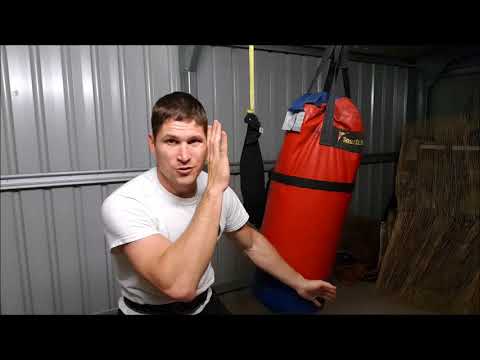
Basic martial arts, Iron bridge/ iron arm and iron palm conditioning drill.
0
Iron Palm Strike·Iron Body Martial Arts
Basic martial arts, Iron bridge/ iron arm and iron palm conditioning drill. This is done on a normal boxing bag as a wa…
Translation: Iron sand palm — tieh (iron) sha (sand) chang (palm), referring to the traditional conditioning method of striking iron sand bags to harden the palm
The Iron Palm Strike (鐵砂掌, Tieh Sha Chang) is a Chinese martial arts palm strike that uses internally cultivated chi (qi) energy directed through a conditioned palm rather than relying on muscular force, producing a penetrating impact that appears effortless but can cause devastating internal injury. [1] The technique is distinguished from ordinary palm strikes by the training method used to develop it: the practitioner conditions the palm over months or years by repeatedly striking bags filled with iron sand (later progressing to steel shot and iron pellets), combined with the application of traditional dit da jow (iron-hitting wine) herbal liniment to heal and strengthen the tissue. [1],[2] The strike itself is delivered with a completely relaxed arm — no muscular tension is visible or felt by the practitioner — with the Chi (vital energy), stored in the lower tan-tien cavity approximately three inches below the navel, drawn through specific breathing and visualisation techniques into the palm at the moment of impact. [1] In the Hop-Gar (Tibetan White Crane) tradition documented by David Chin, the iron palm practitioner's strike shows no muscular effort or tension, yet produces effects disproportionate to the visible force — including delayed-onset internal injuries that manifest hours or days after the strike. [1] The iron palm represents the convergence of three Chinese martial arts disciplines: the physical conditioning of the hand (external training), the cultivation and direction of Chi (internal training), and the knowledge of vulnerable anatomical targets (dim mak/pressure point theory). [1],[2] While modern sports science has not validated the Chi energy model, the conditioning component is well-documented: repeated controlled impact causes bone remodelling (Wolff's Law), increased bone density, callus formation, and desensitisation of pain receptors, producing a legitimately harder and more damage-resistant striking surface. [3]
The Iron Palm tradition has roots stretching back hundreds of years in Chinese martial arts, with the earliest documented systems emerging from the Shaolin Temple and various Southern Chinese family styles. [1],[2] In the Hop-Gar tradition, the technique was transmitted from Tibetan lama monks who brought their fighting methods to Southern China, where they merged with local Cantonese kung fu systems. [1] The conditioning method using iron sand bags and dit da jow herbal medicine represents a sophisticated integration of martial training and traditional Chinese medicine that predates modern sports science by centuries. [2] Grandmaster Ng Yim-Ming (Harry Ng), to whom David Chin's book is dedicated, was one of the last acknowledged masters of the complete iron palm system in the Hop-Gar lineage. [1] In modern times, the iron palm has been demonstrated publicly by masters such as Gu Ruzhang (顧汝章), who reportedly broke stacked bricks with his palm, and various demonstrations at martial arts exhibitions. [2]
The conditioning component of the iron palm is scientifically verifiable: repeated controlled stress on bone causes adaptive remodelling (Wolff's Law), increasing bone density and structural strength, creating a legitimately harder striking surface. [3] The Chi energy model has not been validated by modern science, but the relaxation-based striking method is consistent with sports science understanding of efficient force transmission through kinetic chains. [3] Whether or not Chi exists as described in traditional Chinese medicine, the iron palm training produces measurably harder hands and a striking technique that emphasises whole-body power rather than arm strength. [1],[3]
Traditional martial arts — limited modern competition application. Notable demonstrations include Gu Ruzhang's public brick-breaking exhibitions in the 1930s. The iron palm conditioning method is used by modern MMA fighters and Sanda competitors for hand conditioning, though typically without the Chi cultivation component.
No images yet for this technique.
Sign in to suggest an image.
Basic martial arts, Iron bridge/ iron arm and iron palm conditioning drill. This is done on a normal boxing bag as a wa…
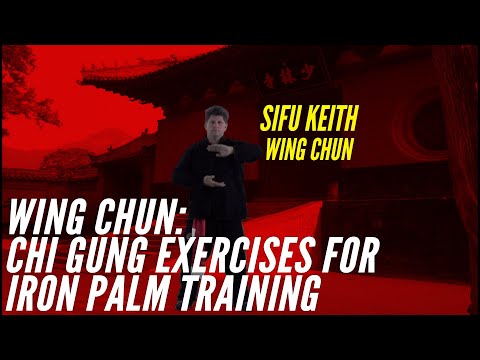
Wing Chun: Chi Gung Exercises for Iron Palm Training In todays video we analyze Wing Chun. Wing Chun in it's simplicity…
Iron palm training encompasses both physical conditioning of striking surfaces and internal energy development practices. Iron Body Martial Arts (IBMA) emphasizes progressive physical conditioning, beginning with gentle bone-striking exercises using the forearm bones—the outside surfaces used for chopping, blocking, and binding movements similar to Wing Chun applications. Practitioners start with light contact on heavy bags, boxing bags, or sandbags to condition the bones through repetitive striking without excessive force that risks injury to the open hand. IBMA's approach progresses through multiple striking surfaces: forearm bones struck with centrifugal force from hip rotation, open-palm static strikes targeting vital areas like the kidney and liver, and variations including hammer fists and phoenix-eye fists. The methodology emphasizes relaxation, proper alignment, and building confidence in open-hand striking before advancing to harder contact surfaces. Sifu Keith's Wing Chun approach complements this with qigong and meditation practices designed to enhance iron palm development through internal energy cultivation. His system includes pressing palms exercises, seven-point energy meditation (visualizing breath movement through anatomical points from perineum to crown), embracing-the-tree standing meditation, and lower Dantian meditation to develop power, focus, and breathing control. Both instructors agree that iron palm training requires dedicated, progressive conditioning, though IBMA prioritizes external mechanical development while Sifu Keith integrates internal energy practices as foundational to technique mastery.
Synthesized from 2 instructors
No instructional courses yet for this technique.
Sign in to suggest a course.
Risk of injury to the person this technique is applied to
A fully conditioned iron palm strike to the temple, throat, or floating ribs can cause concussion, tracheal fracture, rib fracture, or internal organ damage (liver/spleen rupture). [1] Traditional Chinese martial arts literature also describes delayed-effect iron palm strikes (dim mak) that cause internal injury manifesting hours or days later, though this claim has not been scientifically validated. [1,2]
Skill level needed to execute this technique reliably
Whether this technique is allowed under major competition rule sets
Hop-Gar Kung Fu (Chin & Staples)
description: [1] Chin & Staples Hop-Gar, [2] Yang 1992 White Crane
Official karate technique names (和語/漢語)
Established Japanese martial arts naming convention — native Japanese term (和語/漢語)
description: [1] Chin & Staples Hop-Gar, [2] Yang 1992 White Crane
The iron palm is DEVELOPED through training, not dependent on natural physical attributes — practitioners of any body type can develop it with consistent practice
Requires patience (3-7 year training timeline)
Strong commitment to daily conditioning practice
Access to traditional dit da jow herbal liniment (essential for safe conditioning)
The internal (Chi) component requires meditation practice and qigong training
Iron palm appears in 69 passages across 20 books. Bare Knuckle Boxers Champion documents: 'This method of conditioning is also found in iron palm training in Asia... Apply a solution to the skin to thicken it, then soften the skin with some form of lotion.' Iron palm is a conditioning-based striking art — years of hand hardening produce devastating open-palm strikes. (20 books; Bare Knuckle Boxers Champion; Chinese martial arts texts)
Focus on conditioning the outside of both forearm bones, as emphasized in Iron Body Martial Arts conditioning drills.
Chopping strikes are not very effective on boxing bags, so consider using hammer fist or phoenix eye fist techniques on your heavy bag instead.
According to Sifu Keith's Wing Chun training, you should hold the meditation position for five minutes.
The Iron Palm Strike (鐵砂掌, Tieh Sha Chang) is a Chinese martial arts palm strike that uses internally cultivated chi (qi) energy directed through a conditioned palm rather than relying on muscular force, producing a penetrating impact that appears effortless but can cause devastating internal injury. The technique is distinguished from ordinary palm strikes by the training method used to develop it: the practitioner conditions the palm over months or years by repeatedly striking bags filled with iron sand (later progressing to steel shot and iron pellets), combined with the application of traditional dit da jow (iron-hitting wine) herbal liniment to heal and strengthen the tissue.
The Iron Palm tradition has roots stretching back hundreds of years in Chinese martial arts, with the earliest documented systems emerging from the Shaolin Temple and various Southern Chinese family styles. In the Hop-Gar tradition, the technique was transmitted from Tibetan lama monks who brought their fighting methods to Southern China, where they merged with local Cantonese kung fu systems.
Unified MMA: legal — Legal (palm strikes, slaps permitted); WBC/Boxing: banned — Only closed-fist punches permitted; WKF: restricted — Varies by technique — some open-hand strikes legal in kata, generally restric…; Kyokushin: banned — Only closed-fist strikes to body permitted; WT: banned — Prohibited; ITF: restricted — Some knife hand techniques legal; WAKO: banned — Closed fist only; K: banned — 1/GLORY — Closed fist only; IFMA: legal — Legal — palm strikes permitted in Muay Thai
Danger rating 9/10. A fully conditioned iron palm strike to the temple, throat, or floating ribs can cause concussion, tracheal fracture, rib fracture, or internal organ damage (liver/spleen rupture). Traditional Chinese martial arts literature also describes delayed-effect iron palm strikes (dim mak) that cause internal injury manifesting hours or days later, though this claim has not been scientifically validated.
The standard setup chain: Trapping the opponent's guard → Clearing the defensive hands → Delivering the iron palm to an exposed vital target (temple, throat, floating ribs, solar plexus) → The relaxed arm snaps the palm forward without muscular tension → Chi directed from tan-tien through the arm at the moment of impact → Follow-up strikes or takedown as the opponent reacts to the impact.
Standard counters include: Distance management — staying beyond palm-strike range negates the technique / Blocking the palm — standard forearm blocks can redirect the strike / Evasion — the iron palm, like all strikes, must connect to be effective / Body armour — modern protective equipment reduces impact.
Common variants: Forward iron palm (straight forward strike to the sternum or face); Downward iron palm (dropping palm strike onto the collarbone or crown of the …); Upward iron palm (rising palm strike to the chin (similar to a palm-heel up…); Slapping iron palm (lateral slapping motion to the ear (can cause eardrum rup…); Double iron palm (simultaneous two-handed palm strike to both ears or sides…); Vibrating palm (震掌, Zhen Zhang) (an advanced variant where the palm vibrates at impact, cl…).
Traditional martial arts — limited modern competition application. Notable demonstrations include Gu Ruzhang's public brick-breaking exhibitions in the 1930s.
Top errors to watch for: Training without dit da jow — conditioning the hands without the herbal liniment causes arthritis, bone spurs, and pe… / Striking too hard too early — the conditioning must be GRADUAL over months and years; attempting to strike hard surfa… / Tensing the arm during the strike — the power of the iron palm comes from relaxation and Chi direction; muscular tens… / Neglecting the internal training — conditioning the hand alone without Chi cultivation produces a hard hand but not a….
The Iron Palm Strike is also known as Tieh Sha Chang (Chinese: 鐵砂掌), Tieh Sha Chang, Iron Sand Palm, Tit Sa Jeung (Cantonese), Iron Hand.