Foundational Elements of the Front Kick
The front kick is the fundamental striking technique in kickboxing, requiring mastery of five core elements: distance management, footwork for both legs, proper height selection, chamber mechanics, and weight transfer. Each component must be practiced methodically to develop an effective and versatile kick.
Distance Management
Proper distance is critical for successful front kick execution. The optimal striking range is just outside the jab distance—extend your lead arm as a reference point. If the target is within arm's reach, it is too close for a front kick; conversely, standing too far back prevents effective contact.
Chamber and Pivot Mechanics
The chamber phase begins by lifting the knee while simultaneously pivoting the standing foot on its ball. This pivot shifts weight distribution and generates additional power and distance. The ability to chamber and re-chamber without committing to the extension provides tactical flexibility when the opponent moves unexpectedly.
Extension and Strike Mechanics
Extension occurs as a straightforward thrust from the chambered position, using the ball of the foot as the striking surface—never the heel. A slight backward lean during extension increases power and distance while simultaneously moving the hands further from the target's counter-striking range.
Front Leg vs. Back Leg Execution
The back leg front kick has greater reach due to increased distance between the striker's hips and target. The front leg front kick requires a shuffle step—drawing the rear foot forward to close the distance gap—before extension. This footwork adjustment allows the front leg to achieve full striking range.
Offensive and Defensive Applications
Offensive front kicks employ forward movement to close distance and initiate strikes. Defensive front kicks are executed from a stationary position, timing strikes as the opponent or heavy bag moves toward the striker. The defensive application is particularly valuable during heavy bag training to control bag movement without breaking rhythm.
Striking Heights: Low
The low front kick targets the thigh area just above the knee, avoiding direct joint contact. This height is used to disrupt an opponent's balance and movement without requiring significant knee elevation. Low kicks serve as valuable diversification within combinations.
Striking Heights: Mid and High
The mid-level front kick targets the torso and is the most frequently used height in kickboxing. Head-level front kicks require lifting the knee higher and creating an arcing line from hip to knee. Increased backward lean is essential for head-height kicks to maintain safe hand positioning and generate adequate power.
How To Throw A Front Kick | Striking Basics Series | Kickboxing
Key Takeaways
- •Foundational Elements of the Front Kick
- •Distance Management
- •Chamber and Pivot Mechanics
- •Extension and Strike Mechanics
The Striking Basics series is all about the fundamentals for kickboxing beginners. Gabriel Varga and Hayabusa developed this series to provide value to all fitness combat practitioners regardless if you have aspirations to compete or if you never want to step into a ring or octagon. We cover striking basics such as the Jab, cross, Hook, Breathing, kicks and more. If you’re a coach or want to a training partner that want to inspire more people to have stronger fundamentals than share this series. ➤ Gabriel Varga is wearing: ● Hayabusa Lightweight Shorts http://fal.cn/r1S0 ● Hayabusa Rash Guard http://fal.cn/icYE ➤ Follow Hayabusa: Instagram.com/hayabusacombat facebook.com/HayabusaMMA Twitter.com/hayabusacombat www.hayabusafight.com #Kickboxing #MMA #Boxing #GabrielVarga
Related Techniques
Frequently Asked Questions
What does this video teach about hopping front kick?
This video covers foundational elements of the front kick, distance management, chamber and pivot mechanics. It provides detailed instruction from Hayabusa.
How long does it take to learn hopping front kick?
The basic mechanics can be understood in a single session, but developing reliable execution requires consistent drilling over weeks of practice. This 8-part breakdown helps structure your training by isolating each phase of the technique.
What are the key details for finishing hopping front kick?
The low front kick targets the thigh area just above the knee, avoiding direct joint contact. This height is used to disrupt an opponent's balance and movement without requiring significant knee elevation. Low kicks serve as valuable diversification within combinations.
Related videos
Eagle Claw Kung Fu Ying Jow Pai Front Kick and Jump Front Kick Partner Kick #1
Six Harmonies United
Front Snap Kick Training Tips for Beginners
Akiko Yoshii-Johnson
How to do a Front Snap Kick
Excellence Martial Arts
Front Snap Kick Tutorial
Beyond Taekwondo
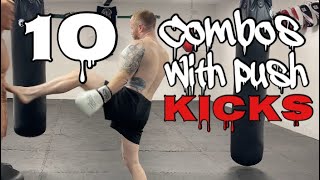
10 Combos with a PUSH KICK or TEEP #pushkick #teep
The Will To Fight