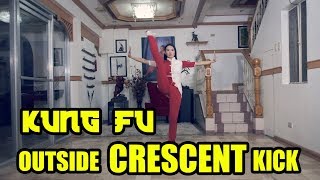
Introduction to the Inside Crescent Kick
The inside crescent kick, known as li he tui in Mandarin, is a fundamental kung fu technique. This kick traces a semicircle from outside to inside, distinguishing it from the outside crescent kick. Practitioners should have prior experience with basic stretches and foundational crescent kick mechanics.
Starting Stance and Posture
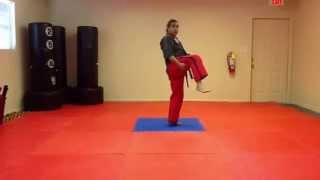
Begin with feet together, maintaining an upright posture with stomach drawn in and chest lifted. The arms are raised to shoulder height with hands in palm form, and the gaze remains fixed straight ahead. This neutral stance provides the foundation for proper kick execution.
Kicking Mechanics
Step forward with one foot while keeping the upper body stationary. The kicking leg swings from the outside inward, drawing a large semicircle in front of the body. At the moment of impact, the foot is flexed while the supporting leg remains flat on the ground.
Footwork: Front View
From the frontal perspective, step the left foot forward and execute a right-leg inside crescent kick. Return to standing position by rotating the feet 45 degrees inward and lowering the kicking leg. Repeat the sequence with the opposite leg.
Footwork: Side View
The side view demonstrates the complete arc of the kick's trajectory. The body remains parallel throughout the movement, with the leg creating a smooth semicircular path. Proper foot positioning during the return to stance ensures balance and control.
Proper Technique Checkpoints
The kicking foot must trace a semicircle from outside to inside with a flexed ankle. The supporting leg stays flat, the knee of the kicking leg remains straight, and the upper body remains vertical and motionless. Eyes focus forward throughout, and the transition back to stance involves a 45-degree foot rotation.
Balance Training with Wall Support
Practitioners who struggle with balance should practice using a wall or railing for stability. Position the body parallel to the support surface and execute the kick while maintaining contact. This modification allows for form refinement before advancing to unsupported execution.
Progression and Practice Approach
Practitioners should not rush to achieve height; kicking as high as possible while maintaining proper form is acceptable. Emphasis on relaxation and controlled breathing improves both speed and execution quality. Repeated viewing and practice at individual pace ensures progressive improvement over time.
KUNG FU INSIDE CRESCENT KICK
Key Takeaways
- •Introduction to the Inside Crescent Kick
- •Starting Stance and Posture
- •Kicking Mechanics
- •Footwork: Front View
#kungfu #kick #insidecrescentkick There is another type of kick that is fundamental in doing Kung Fu. By doing the different kicks, one is able to stretch the leg muscles and improve on Kung Fu knowledge and skills. In this video, learn another crescent kick; this time, it’s the Kung Fu Inside Crescent Kick. Let us practice this Kung Fu kick together! KUNG FU WALL STRETCH: https://www.youtube.com/watch?v=Gb1vTaIKclE Special Thanks to the following: 1MORE UFC Gym Gold's Gym Fujifilm World Balance Production Team Saegen Entertainment ★ SUBSCRIBE ★ www.youtube.com/c/janicehung ★ CONTACT US ★ Email: [email protected] Call: +639178258099 ★ SOCIAL MEDIA ★ Facebook: http://facebook.com/JaniceHungTV Twitter: http://twitter.com/janicehung Instagram: http://instagram.com/janicehungwushu
Related Techniques
Frequently Asked Questions
What does this video teach about 360 spin crescent kick?
This video covers introduction to the inside crescent kick, starting stance and posture, kicking mechanics. It provides detailed instruction from Janice Hung.
How long does it take to learn 360 spin crescent kick?
The basic mechanics can be understood in a single session, but developing reliable execution requires consistent drilling over weeks of practice. This 8-part breakdown helps structure your training by isolating each phase of the technique.
What are the key details for finishing 360 spin crescent kick?
Practitioners who struggle with balance should practice using a wall or railing for stability. Position the body parallel to the support surface and execute the kick while maintaining contact. This modification allows for form refinement before advancing to unsupported execution.