Understanding Mount Escape Urgency
The mounted position presents numerous offensive opportunities for the top player, making rapid escape essential for the bottom practitioner. Minimizing time spent underneath requires systematic organization of both the lower and upper body before attempting any escape sequence.
Leg Organization: Creating Space
The first critical step is freeing the legs by driving both heels toward the ceiling while maintaining tight contact between the heels and torso. Any gap between the heels and body allows the opponent to re-establish hooks, forcing the escape sequence to restart from the beginning.
Breaking Crossed Leg Hooks
When the opponent crosses their legs to maintain control, the bottom player must step over the top with one leg and strip the hooks apart by striking the opponent's Achilles tendon. Once the hooks are broken, the practitioner returns to the organized leg position with heels tight to the body.
Framing Mechanics and Hand Positioning
Proper framing requires one arm across the opponent's body to prevent them from settling their hips. The critical detail is that the hand connected to the elbow touching the mat must be the one gripping—reversing this grip removes ground support and collapses the frame under body weight.
Knee Slide Mechanics
When sliding the knee becomes difficult due to opponent pressure, bridging and elbow pressure into the opponent's knee can help establish space. However, sometimes the opponent eliminates this space entirely, requiring adjustment to the escape technique.
Creating the Tunnel
If the initial knee slide fails, the practitioner must invert their knees by pointing them toward the mat rather than the ceiling. This knee inversion simultaneously elevates the hips higher and creates a larger 'tunnel' underneath the body for the knee to escape through.
Tunnel Escape Execution
With the tunnel created through knee inversion and elevated hips, the practitioner can smoothly slide their knee through and transition directly to a leg lock position. This sequence moves the athlete from the disadvantageous bottom position to a dominant top position in one continuous motion.
Professional Application
Elite practitioners like BJ Penn demonstrate the tunnel escape by completely inverting their foot position, with the sole of the foot pointing downward rather than upward. This full commitment to knee inversion generates maximum hip elevation and creates the necessary space for efficient escape.
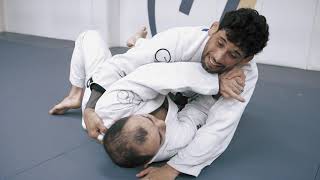
Powerful BJJ Mount Escape (Tunnel Escape)- Firas Zahabi
Key Takeaways
- •Understanding Mount Escape Urgency
- •Leg Organization: Creating Space
- •Breaking Crossed Leg Hooks
- •Framing Mechanics and Hand Positioning
In Brazilian Jiu-Jitsu the bottom position can quickly turn offensive. In this video I opted to escape to a leg lock situation but you can just as easily escape back to full guard. I prefer the leg lock attacks since I feel it is a superior position to Guard. I like to attack with leg lock that will either end the match or allow me to achieve top control. When stuck in the mount position you better know your escapes well if you want to escape fast. A good and powerful escape will get you back in the game. Take to long to escape and risk defeat. There are many ways to escape the bottom position, in this video I demonstrate how to use the elbow escape vs an opponent who is trapping you legs with his legs and is sprawling low into mount.
Related Techniques
Frequently Asked Questions
What does this video teach about the tunnel escape?
This video covers understanding mount escape urgency, leg organization: creating space, breaking crossed leg hooks. It provides detailed instruction from Tristar Gym.
How long does it take to learn the tunnel escape?
The basic mechanics can be understood in a single session, but developing reliable execution requires consistent drilling over weeks of practice. This 8-part breakdown helps structure your training by isolating each phase of the technique.
What are the key details for finishing the tunnel escape?
With the tunnel created through knee inversion and elevated hips, the practitioner can smoothly slide their knee through and transition directly to a leg lock position. This sequence moves the athlete from the disadvantageous bottom position to a dominant top position in one continuous motion.
Related videos
Mount Survival And Escape Guide
The Grappling Academy
Granny Game Main Tunnel Escape - Fastest Strategy Guide (easy and Quick Method)
suman maharana
10th Planet Counters: Einstein's Triangle Escape
Alder Hampel
How to Escape the Back EVERY TIME | Jiu Jitsu Back Escape System
Matt Arroyo Jiu Jitsu
Marcelo Garcia: Escaping Side Control
Marcelo Garcia Jiu-Jitsu