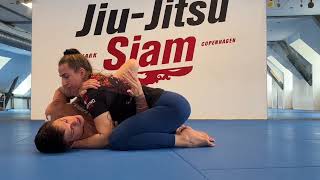
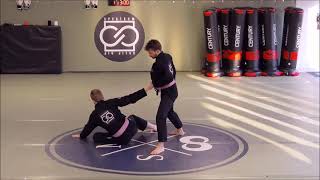
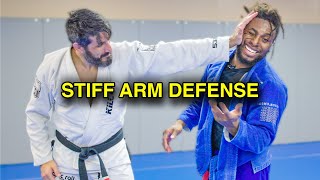
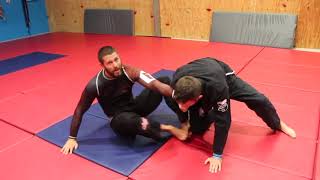
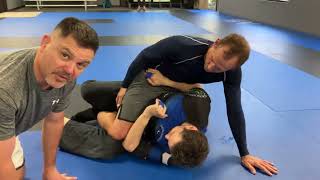
Introduction to Foundational Mount Escapes
The three mount escapes presented here form the essential foundation for beginner Brazilian Jiu-Jitsu practitioners. While these techniques require significant skill refinement to execute against experienced opponents, they provide the most direct and reliable escape routes when rolling with other beginners. Mastery of these three methods will substantially improve mount escape success rates.
Bridge and Roll: Arm Trapping Options
The bridge and roll escape begins with securing the opponent's arm on one side of their body through one of three primary trapping methods: pinning the hand down while collecting the elbow on the back, trapping with both hands, or using an overhook if the opponent has established a head tie. The non-trapping hand should remain tight to the body to maintain structural integrity and prevent exposure on the opposite side.
Bridge and Roll: Foot Positioning and Leg Trap
Effective foot positioning requires shifting the hips laterally before rotating the knees inward and drawing the heels toward the buttocks. This repositioning prevents the opponent from maintaining a low base that would render the foot trap ineffective. The leg trap needs only sufficient duration to generate initial momentum toward the top position.
Bridge and Roll: Execution and Hip Drive
The bridge and roll should be executed as a single fluid motion rather than sequential movements, significantly increasing success rate. The practitioner must look back over the shoulder while driving the hips upward at a backward angle, not laterally. Synchronizing the bridge with the rotational movement creates the momentum necessary to complete the escape.
Knee-Elbow Escape: Frame Establishment
The knee-elbow escape is initiated when the opponent's weight is distributed over the chest and they are attacking the hand. The defending player must immediately shift their upper body inward and tuck the elbow to establish a frame on the opponent's opposite hip while maintaining an interior frame on the near side. This positioning prevents arm exposure and maintains structural control.
Knee-Elbow Escape: Hip Movement and Leg Flattening
Rather than pushing the opponent away, the defender creates pressure that elevates the opponent's weight, making their leg more vulnerable. The defender then shifts their hips away repeatedly to create space and flatten their leg between the opponent's legs, positioning themselves to insert their foot under the opponent's ankle. This positioning is essential before initiating the escape mechanics.
Knee-Elbow Escape: Completion and Transition
The knee-elbow escape is completed by drawing the knee and elbow back together while maintaining pressure, dropping the opponent into half guard. The defender should already have an underhook prepared on the half guard side, immediately transitioning to the opposite hip to secure the position and prevent counterattacks.
Hip Bump (Kipping) Escape: Frame and Posture
The hip bump escape maintains the same survival posture as previous escapes: a frame across the far hip combined with an interior elbow frame. The underhook must remain hidden from the opponent to prevent manipulation into an arm triangle or other submission. This positioning provides both structural security and offensive readiness.
Hip Bump Escape: Mechanics and Guard Recovery
The escape is initiated with an upward bump from the bottom knee while the practitioner simultaneously rolls backward over the shoulder and pulls the top knee inward, recovering to guard position. The second leg can then facilitate either a butterfly hook entry for double underhooks or a transition into leg lock attacks, depending on the space created.
The First 3 Mount Escapes You Need To Know in BJJ
Key Takeaways
- •Introduction to Foundational Mount Escapes
- •Bridge and Roll: Arm Trapping Options
- •Bridge and Roll: Foot Positioning and Leg Trap
- •Bridge and Roll: Execution and Hip Drive
When you first start Jiu Jitsu, you're gonna be getting stuck in the bottom of mount. A lot. Even by people who aren't very good yet lol Take these 3 simple movements and add them to your game so you can give yourself a better chance of getting back to a winning position. If you need more in depth instruction and coaching, on this topic or any other in BJJ, from myself and a team of killer black belts visit https://bit.ly/3PqO348 Join this channel to get access to Members Only Perks such as: - Members Only Chat - Exclusive Members Only Videos - Custom Badges and Emojis and more! https://www.youtube.com/channel/UCr7VU0Cnef4AhQk7Pe_9nTA/join
Frequently Asked Questions
What does this video teach about standard knee-elbow frame?
This video covers introduction to foundational mount escapes, bridge and roll: arm trapping options, bridge and roll: foot positioning and leg trap. It provides detailed instruction from Brandon Mccaghren.
How long does it take to learn standard knee-elbow frame?
The basic mechanics can be understood in a single session, but developing reliable execution requires consistent drilling over weeks of practice. This 9-part breakdown helps structure your training by isolating each phase of the technique.
What are the key details for finishing standard knee-elbow frame?
The hip bump escape maintains the same survival posture as previous escapes: a frame across the far hip combined with an interior elbow frame. The underhook must remain hidden from the opponent to prevent manipulation into an arm triangle or other submission. This positioning provides both structural security and offensive readiness.