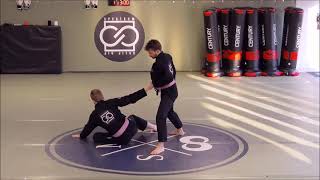
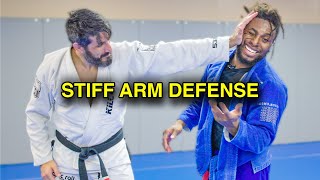
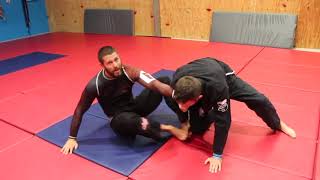
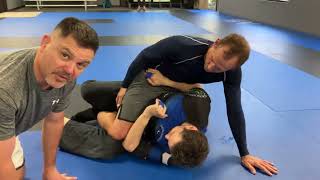
Foundation: The Knee-Elbow Frame Concept
The Standard Knee-Elbow Frame is the foundational escape from side control, utilizing hip escapes to create a protective V-shape by connecting the elbow and knee. This technique forms the basis for guard recovery and prevents the opponent from re-establishing dominant positioning. Mastering this escape is essential before progressing to more advanced side control defense.
First Frame: Hip Positioning
The initial frame must be established on the opponent's hip using the forearm, not the hand. This frame prevents the opponent from controlling the defender's hips and is non-negotiable for successful escape execution. Even when the opponent's hips are tied, bridging slightly while sliding the elbow into position creates the necessary space to proceed.
Second Frame: Neck Control and Elbow Flare
The second frame is positioned in front of the opponent's neck, with fingers buried at the clavicle bone. By flaring the elbow outward rather than pushing with the hands, the defender creates crucial space and reduces chest-to-chest pressure. This controlled expansion is more effective than aggressive pushing and allows the defender to transition to the next phase.
Hip Escape Mechanics and Foot Placement
The defender plants the outside foot on the mat, positioned outside the hip rather than inside, to maximize range of motion during the hip escape. Progressive weight shifting moves the body from flat on the back to positioned on a single shoulder and hip. The foot placement directly below the hip allows for efficient lateral movement while maintaining structural stability.
Knee-Elbow Connection and Guard Position
Once on the side, the defender slides the knee inward to connect with the elbow, creating the protective V-shaped side guard position. This connection, with the body weight distributed across one shoulder and one hip, makes it extremely difficult for the opponent to re-establish side control. From this secured position, the defender can transition to half guard, closed guard, or other guard variations.
Advanced Technique: Bridging Against Tight Crossface
When facing a skilled opponent who maintains a low head position and tight crossface, the defender executes a bridge directed toward the corner while extending the arm. This lateral bridge creates space and repositions the opponent's head, allowing the forearm to slide into the neck frame. The bridge must be timed with arm extension to maximize head displacement before transitioning to the standard hip escape.
Managing Continued Pressure and Arm Swimming
If the opponent maintains control during the hip escape transition, the defender can swim the inside arm across their own face to create additional space and open up the position. This arm movement should be executed only after the body has rotated significantly onto the side to maximize effectiveness. The swimming motion provides an alternative pressure release when standard framing becomes insufficient.
Critical Error: Completing Guard Recovery
A common mistake is throwing the outside leg backward without establishing proper inside leg positioning, allowing the opponent to simply pass again. The defender must transfer weight and control through the inside knee before extracting the trapped leg. Only after securing the inside leg in a half guard, closed guard, K-guard, or foot-on-hip position can the escape be considered complete.
Foot Positioning for Maximum Hip Escape Range
The stepping foot must be positioned outside the hip, close to the buttock, to achieve maximum lateral movement during the escape sequence. Stepping inside the hip significantly reduces available range and limits the effectiveness of the hip escape. Proper foot placement is the mechanical foundation that enables efficient body repositioning from a flat position to the side guard frame.
Side Guard as Late-Stage Guard Retention
The side guard position functions identically to late-stage guard retention when an opponent begins passing—the same elbow-to-knee frame provides structural defense against weight and passing attempts. This defensive framework allows even significantly smaller defenders to withstand substantial pressure and facilitate recovery to an advantageous position. Understanding this principle reinforces the universal application of the knee-elbow frame across multiple defensive scenarios.
The FIRST side control escape EVERYONE Should Master
Key Takeaways
- •Foundation: The Knee-Elbow Frame Concept
- •First Frame: Hip Positioning
- •Second Frame: Neck Control and Elbow Flare
- •Hip Escape Mechanics and Foot Placement
In this video, I cover the fundamental elbow escape, which is the foundation of escaping a standard side control. I go over basic frames, how to hip escape properly and how to configure your legs once you have created space from the bottom. **I'm sorry about the weird background noise. I will make sure to double-check the audio the next time I record**
Frequently Asked Questions
What does this video teach about standard knee-elbow frame?
This video covers foundation: the knee-elbow frame concept, first frame: hip positioning, second frame: neck control and elbow flare. It provides detailed instruction from Mads H. BJJ.
How long does it take to learn standard knee-elbow frame?
The basic mechanics can be understood in a single session, but developing reliable execution requires consistent drilling over weeks of practice. This 10-part breakdown helps structure your training by isolating each phase of the technique.
What are the key details for finishing standard knee-elbow frame?
The stepping foot must be positioned outside the hip, close to the buttock, to achieve maximum lateral movement during the escape sequence. Stepping inside the hip significantly reduces available range and limits the effectiveness of the hip escape. Proper foot placement is the mechanical foundation that enables efficient body repositioning from a flat position to the side guard frame.