Strike & defenceLocksClose rangeFighting multiple people
Distance
CloseMiddleLong
Body target
Upper bodyMiddle bodyLower body
Overview
The Standard Knee-Elbow Frame brings the inside knee up to meet the elbow on the same side, with the forearm blocking across the opponent's shoulder or chest while the knee blocks the hip line. [1] This creates a diagonal barrier from shoulder to hip that the opponent cannot easily penetrate. [1],[2] The standard knee-elbow frame is the default defensive position when the guard is under pressure, and recovering this connection is the first priority when the guard is being passed. [2],[3]
The standard knee-elbow frame is taught as perhaps the single most important defensive concept in BJJ guard retention. [1] Top-level BJJ competitors consistently demonstrate that maintaining knee-elbow connection is the foundation upon which all other guard retention techniques are built. [2],[3]
Country of origin· shown in random order
🇧🇷BrazilBJJ, MMA
🇯🇵JapanBJJ, Judo
🇺🇸USAMMA
Effectiveness
The knee-elbow connection is one of the most important guard retention principles in BJJ, creating a closed structure that prevents the passer from inserting their body between the defender's elbow and knee. [1] When the elbow and knee are connected on the same side, the guard becomes extremely difficult to pass through direct pressure. [2]
Lineage
The knee-elbow frame is a guard retention concept emphasised in modern BJJ instruction, particularly by Saulo Ribeiro in Jiu-Jitsu University (2008) and by the Mendes brothers' guard retention system. [1]
Competition Record
The knee-elbow frame is a standard BJJ defensive technique. [1]
Images
No images yet for this technique.
Sign in to suggest an image.
Biomechanical Mechanism
Primary Action — Intercepting an incoming strike using a rigid arm, forearm, or shin structure to absorb or redirect force
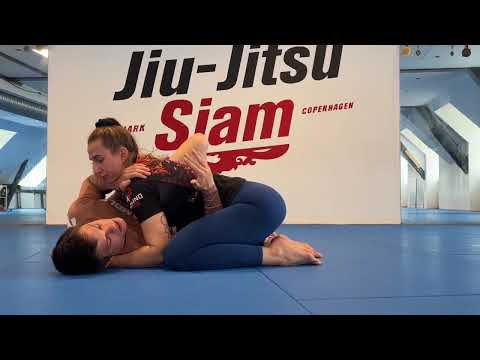
When you first start Jiu Jitsu, you're gonna be getting stuck in the bottom of mount. A lot. Even by people who aren't v…
1 / 2
3 videos
What Instructors Say
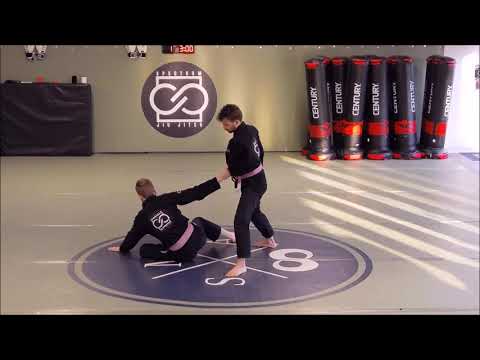
The standard knee-elbow frame is a foundational defensive structure in Brazilian Jiu-Jitsu that maintains a closed space between the defender's knees and elbows to prevent guard passage or positional advancement. Spectrum Jiu Jitsu emphasizes this as a conceptual "door" that the passer must open to infiltrate the guard, achieved by keeping hands hooked in front of the knees rather than behind them, preventing the creation of a single rigid lever. The knee-elbow connection drill teaches muscle memory by having the bottom player maintain this closed position while the top player executes Toriando movements, requiring the defender to follow with subtle rotations and keep hands ready to block without overextending. Mads H. BJJ applies this principle to side control escapes, where connecting the elbow and knee creates a V-shaped structure (side guard) that prevents re-passage once the defender has bridged and hip-escaped to their side. Brandon Mccaghren references the knee-elbow escape from mount, where the defender flattens a leg between the passer's legs and pulls the knee and elbow back together to achieve half guard. All three instructors agree that maintaining this connection requires avoiding a flat-on-the-back position, managing hip angle with proper "headlights" (directional awareness), and coordinating upper and lower body frames. Key differences include Spectrum's emphasis on sleeve grip leverage control during passage defense, Mads H. BJJ's focus on the structural V-shape as a late-stage guard retention position, and Brandon Mccaghren's application as an escape mechanism from mounted pressure.
Synthesized from 3 instructors
SPECTRUM JIU JITSU — Spectrum | BJJ Fundamentals - Knee Elbow Connection and Lever Based Retention: Defines knee-elbow connection as a closed "door" between knees and elbows; teaches the cannonball drill for maintaining this connection; explains hand placement in front of knees and the importance of avoiding fused knees; introduces lever control using sleeve grips to defend the Toriando pass by creating internal shoulder rotation and stiff-arm frames.
Mads H. BJJ — The FIRST side control escape EVERYONE Should Master: Applies knee-elbow connection to side control escapes via hip escapes; describes the final V-shaped side guard position where the knee connects to the elbow; emphasizes the importance of stepping the foot outside the hip for range during hip escapes and ensuring the foot remains higher than the knee for proper positioning.
Brandon Mccaghren — The First 3 Mount Escapes You Need To Know in BJJ: Presents the knee-elbow escape as a mount escape technique where the defender flattens a leg between the opponent's legs, creates frames on the hips, and pulls the knee and elbow back together to transition to half guard with an underhook.
Learn This Technique
No instructional courses yet for this technique.
Sign in to suggest a course.
Ratings
Danger Rating
Risk of injury to the person this technique is applied to
2
Low2/10
Guard retention uses frames and hip movement; minimal direct injury risk
Difficulty
Skill level needed to execute this technique reliably
Intermediate
Competition Legality
Whether this technique is allowed under major competition rule sets
1Anticipate the Attack — read the opponent's intention through body cues
2Execute Defence — apply the specific defensive technique with proper timing
3Recover Stance — return to a balanced fighting position immediately
4Counter or Disengage — capitalize on the opening or create safe distance
Sources & References
Primary Source
Karate-Do Kyohan: The Master Text (Gichin Funakoshi, 1935)
1BookJiu-Jitsu University (Ribeiro, 2008)
Alias sources — [1] Jiu-Jitsu University (Ribeiro, 2008) [2] Fundamentals of Brazilian Jiu-Jitsu (Danaher, 2012) [3] Brazilian Jiu-Jitsu: Theory and Technique (Gracie, 2001)
2BookMastering Jujitsu (Gracie & Danaher, 2003)
Effectiveness sources — [1] Jiu-Jitsu University (Ribeiro, 2008) [2] Fundamentals of Brazilian Jiu-Jitsu (Danaher, 2012)
3OtherJapanese Combat Sports Katakana Convention
Standard katakana transliteration of Western martial arts terminology (外来語) — used in Japanese MMA, boxing, and BJJ communities
4CitationJiu-Jitsu University (Ribeiro, 2008)
Alias sources — [1] Jiu-Jitsu University (Ribeiro, 2008) [2] Fundamentals of Brazilian Jiu-Jitsu (Danaher, 2012) [3] Brazilian Jiu-Jitsu: Theory and Technique (Gracie, 2001)
Why shouldn't I put my knees together when maintaining guard retention?
Putting your knees together creates one solid lever that an opponent can easily manipulate to pass your guard. Instead, keep your knees and elbows tight together with your hands in front of your knees to maintain a proper knee-elbow connection.
How do I use the knee-elbow frame to defend against a guard pass?
Once you recognize which side your opponent is passing toward, stomp that foot to the mat and extend that leg out to create a frame, which can break the grip and deny your opponent lever access to complete the pass.
What is the correct hand position for the knee-elbow connection?
Keep your hands in front of your knees so that your knees and elbows are tight together; having your hands behind your knees ruins the connection and makes your legs vulnerable to being turned into levers.
Why should I get my hips to an angle when playing guard?
If you stay flat on your back, your opponent can more easily convert your legs into levers and pass your guard. Getting to an angle helps you maintain better guard retention.
How does the Standard Knee-Elbow Frame work?
The Standard Knee-Elbow Frame brings the inside knee up to meet the elbow on the same side, with the forearm blocking across the opponent's shoulder or chest while the knee blocks the hip line. This creates a diagonal barrier from shoulder to hip that the opponent cannot easily penetrate.
Where does the Standard Knee-Elbow Frame come from?
The standard knee-elbow frame is taught as perhaps the single most important defensive concept in BJJ guard retention. Top-level BJJ competitors consistently demonstrate that maintaining knee-elbow connection is the foundation upon which all other guard retention techniques are built.
Is the Standard Knee-Elbow Frame legal in competition?
Unified MMA: legal — Legal defensive technique; IBJJF: legal — Legal — defensive techniques are fundamental to grappling; IJF: legal — Legal defensive action; ADCC: legal — Legal; UWW: legal — Legal defensive technique; FIAS Sport Sambo: legal — Legal
How dangerous is the Standard Knee-Elbow Frame?
Danger rating 2/10. Low — guard retention uses frames and hip movement; minimal direct injury risk
How do I set up the Standard Knee-Elbow Frame?
The standard setup chain: Anticipate the Attack → Execute Defence → Recover Stance → Counter or Disengage.
How do I defend against the Standard Knee-Elbow Frame?
Standard counters include: Timing — attack when the defence is recovering or between movements / Feint — use deception to create openings in the defensive structure / Angle Change — attack from an unexpected angle that the defence does not cover.
What are the variants of the Standard Knee-Elbow Frame?
Common variants: High block (forearm raised above the head to protect against overhead…); Low block (forearm driven downward to deflect kicks or body strikes); Cross block (forearm crosses the body to protect the opposite side); Double forearm block (both forearms together for maximum coverage).
How effective is the Standard Knee-Elbow Frame in competition?
The knee-elbow frame is a standard BJJ defensive technique.
What are common mistakes when doing the Standard Knee-Elbow Frame?
Top errors to watch for: Lying flat and reaching for the knee-elbow connection — turn to your side first, then connect / Keeping the top leg straight instead of bringing the knee up — the knee must actively drive toward the elbow / Not using the bottom arm for additional framing — the bottom arm frames while the top side creates the knee-elbow shield / Opening the knee-elbow to attempt a sweep when the timing is wrong — maintain the frame until you're secure.
What are other names for the Standard Knee-Elbow Frame?
The Standard Knee-Elbow Frame is also known as Sutandādo Nī Erubō Furēmu, Basic Knee-Elbow Frame, Knee-Elbow Connection, Inside Knee Frame.