Jodan no kamae Kendo Techniques — KAMINARIKAN
0
Jodan No Kamae·KAMINARIKAN
This video was shot on October 6, 2017. Takenouchi Shohei [kendo rokudan renshi; both chudan and jōdan player] introduce…
上段の構え
TraditionalTranslation: Upper-Level Stance
Jōdan-no-kamae (high guard) raises the sword overhead with the arms extended, threatening an immediate downward cut to any target. [1] Jōdan is the most aggressive of the five standard kamae, projecting dominance and forcing the opponent to respect the imminent overhead strike. [1],[2] In kendō, jōdan players (jōdansha) are a distinctive and respected minority who sacrifice the defensive security of chūdan for overwhelming offensive pressure, using the height advantage to power devastating men and kote strikes. [2],[3]
Jodan no kamae (upper guard) positions the shinai above the head, ready for powerful downward cuts. [1] It is an aggressive stance that threatens overwhelming men and kote attacks, but leaves the torso (do) and wrists exposed. [2] Jodan is considered a high-risk, high-reward kamae that pressures the opponent psychologically. [2]
Jodan derives from the classical kenjutsu in-no-kamae and fire-stance concepts found in Niten Ichi-ryu (Miyamoto Musashi's school) and other koryu traditions. [1]
Jōdan no kamae (high guard) is a specialised aggressive stance in kendo competition, used by select competitors who favour powerful downward men strikes. Notable jōdan specialists have won at All Japan Kendo Championship level. [1]
No images yet for this technique.
Sign in to suggest an image.
This video was shot on October 6, 2017. Takenouchi Shohei [kendo rokudan renshi; both chudan and jōdan player] introduce…
Sensei Norcross answers different reasons for holding the katana in a high posture. Background Music: Island Adventure …
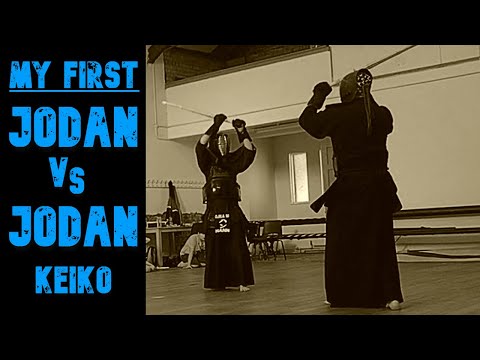
#kendo #jodan #keiko My first Keiko with another Jodan ( Kendo Training ) I was recently treated to an opportunity to…
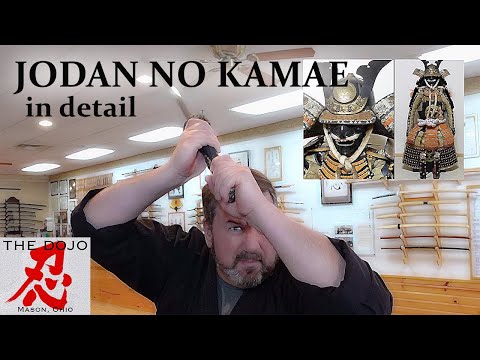
Jodan no kamae, also called dai jodan (great high posture) or hi no kamae (fire posture), is a high overhead sword stance fundamental to kenjutsu and kendo. According to The Dojo Martial Arts Mason Ohio, the specific positioning varies significantly based on historical period, armor configuration, and tactical context. The instructor notes that holding the sword at an angle—approximately 45 to 60 degrees rather than fully vertical—obscures the blade's length from opponents, providing strategic advantage. Positioning the guard (suba) near the head lowers the stance slightly and reduces visibility, while overhead positioning allows the helmet to assist in accelerating forward movement. Historical factors heavily influence variation: samurai with large crests (maidate) on helmets or flags (sashimono) on their backs would position jodan lower and to the side to avoid interference. The Swordsman describes two modern interpretations: a more classical approach with the blade at roughly 45 degrees, left hand two fists in front of the left eye, and greater hip rotation; and a contemporary style with flatter blade angle, squarer hips, and less height. The Swordsman emphasizes that jodan practitioners must resist defensive blocking habits, instead cutting through or cutting down (oroshi) to maintain offensive intent. Both instructors stress that proper jodan training requires studying one's teacher directly, as the nuances depend on personal style, body mechanics, and the specific martial lineage being studied.
Synthesized from 2 instructors
No instructional courses yet for this technique.
Sign in to suggest a course.
Risk of injury to the person this technique is applied to
Edged weapons cause fatal lacerations; historical battlefield mortality rates >30% (Amberger 1999)
Skill level needed to execute this technique reliably
Whether this technique is allowed under major competition rule sets
The Book of Five Rings (Miyamoto Musashi, 1645)
Alias sources — [1] Japanese Swordsmanship (Warner & Draeger, 1982) [2] The Book of Five Rings (Musashi, trans. Harris, 1974) [3] The Book of Five Rings (Musashi, trans. Harris, 1974)
Effectiveness sources — [1] All Japan Kendo Federation, Kendo Official Manual (AJKF) [2] Warner, G. & Draeger, D., Japanese Swordsmanship: Technique and Practice (Weatherhill, 1982)
Established Japanese martial arts naming convention — native Japanese term (和語/漢語)
Alias sources — [1] Japanese Swordsmanship (Warner & Draeger, 1982) [2] The Book of Five Rings (Musashi, trans. Harris, 1974) [3] The Book of Five Rings (Musashi, trans. Harris, 1974)
Effectiveness sources — [1] All Japan Kendo Federation, Kendo Official Manual (AJKF) [2] Warner, G. & Draeger, D., Japanese Swordsmanship: Technique and Practice (Weatherhill, 1982)
wrist control for edge alignment, grip endurance, footwork precision
quick wrists, strong forearms, good posture
forearm extensors/flexors, deltoids, core, calves
You should resist the urge to block or drop your hands defensively. Instead, prepare to cut through or cut down on the attack, or break their technique with an offensive counter-cut rather than getting defensive and covering.
The transcript indicates this is a fundamental positional question in Jodan no Kamae instruction, though the specific mechanical reasoning for the 90-degree angle is not fully detailed in the available excerpts.
Yes—if you're not yet very skilled at Jodan, sparring against another Jodan practitioner can become scrappy. Consistent practice and keiko (training) with other Jodan practitioners is important for developing solid technique.
Jōdan-no-kamae (high guard) raises the sword overhead with the arms extended, threatening an immediate downward cut to any target. Jōdan is the most aggressive of the five standard kamae, projecting dominance and forcing the opponent to respect the imminent overhead strike.
Jōdan-no-kamae corresponds to the element of fire or heaven in classical koryū systems, representing the most yang and aggressive of the five guards. Kendō's modern jōdan tradition was strongly influenced by post-war kendōka who demonstrated its effectiveness in competition.
FIK Kendo: legal — Legal, valid strike requires correct form (datotsu-bu), spirit (kiai), and fo…
Danger rating 9/10. Extreme — edged weapons cause fatal lacerations; historical battlefield mortality rates >30% (Amberger 1999)
The standard setup chain: Assume Guard (Kamae/Hut) → Measure Distance (Ma-ai) → Initiate Cut/Thrust → Follow Through (Zanshin).
Standard counters include: Parry (Absetzen) — deflect the incoming blade with a counter-displacement / Void (Step Back) — withdraw from measure to avoid the cutting arc / Counter-Cut (Nachreisen) — strike into the opponent's opening during their attack.
Common variants: Standard cut (primary cutting angle from the ready stance); Thrust (tsuki) (straight thrust targeting the throat, chest, or face); Rising cut (kiri-age) (upward diagonal cut from low to high); Diagonal cut (kesa-giri) (downward diagonal cut following the kimono line).
Jōdan no kamae (high guard) is a specialised aggressive stance in kendo competition, used by select competitors who favour powerful downward men strikes. Notable jōdan specialists have won at All Japan Kendo Championship level.
Top errors to watch for: Holding the sword too far back — the blade should be slightly behind the head, not wound back excessively / Raising the sword without lowering the hips — proper Jodan uses a strong, grounded stance / Holding Jodan without attacking — the stance is loaded for attack; holding it passively invites counter-attacks / Not protecting the exposed kote — the wrists are vulnerable in Jodan; awareness of this weakness is essential.
The Jodan No Kamae is also known as Upper Guard, High Stance, Fire Guard.