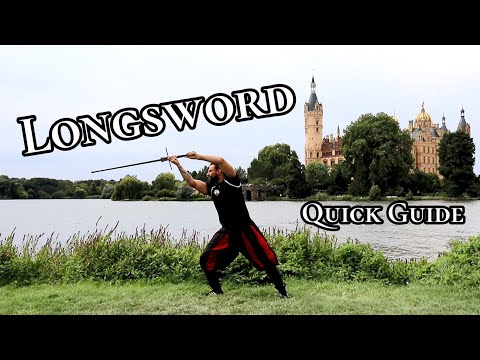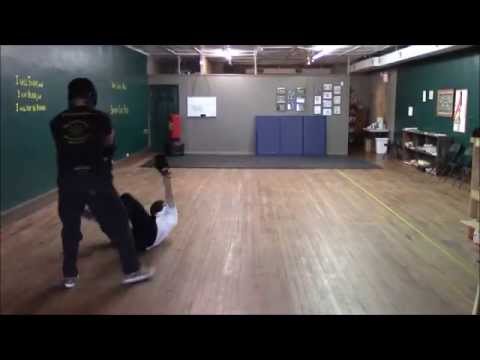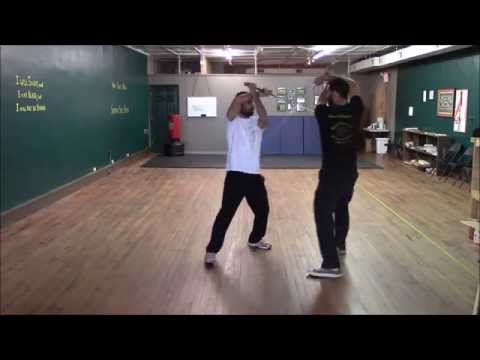
Zwerchhau, Basics and Counters: Longsword Lesson 9
0
Zwerchhau·Sword Carolina
The Zwerchhau is perhaps the most highly recommended technique in Liechtenauer's art. We offer here our understanding o…
Translation: zwerchhau (cross cut)
The Zwerchhau (cross cut or thwart cut) is a horizontal cut delivered with the short edge (false edge) by rotating the hands so the hilt rises and the blade travels horizontally across the opponent's head or body. [1] The Zwerchhau is the master cut that specifically counters attacks from Vom Tag (high guard) and overhead positions, as the horizontal trajectory naturally passes beneath a descending blade while simultaneously striking the opponent's temple. [1],[2] The Zwerchhau also serves as a powerful entry into grappling range because of its body rotation and forward step. [2],[3]
The Zwerchhau (Cross Cut or Thwart Cut) is a horizontal cut delivered with the short (back) edge, rotating the hands so the flat of the blade covers the fencer's head while cutting horizontally to the opponent's temple. [1] It is unique among the master cuts because it simultaneously attacks and defends — the blade's position creates a roof-like cover protecting the fencer's head while the short edge strikes the opponent's. [2] Liechtenauer's tradition states the Zwerchhau 'breaks' Vom Tag and the Ochs guard. [3]
The Zwerchhau is attested in all major Liechtenauer-tradition manuscripts from the 14th–16th centuries, including the glosses of Ringeck, von Danzig, and the Codex Döbringer (MS 3227a). [1] Joachim Meyer's Gründtliche Beschreibung der Kunst des Fechtens (1570) provides the most detailed illustrations and tactical context for the Zwerchhau. [2]
The Zwerchhau is commonly attempted in HEMA longsword competition, though its technical difficulty (short-edge rotation, timing) makes successful execution at tournament speed challenging; it is frequently seen as a counter to opponents who telegraph cuts from Vom Tag. [1]
No images yet for this technique.
Sign in to suggest an image.
The Zwerchhau is perhaps the most highly recommended technique in Liechtenauer's art. We offer here our understanding o…
Knowing the guards in the long sword, knowing which techniques and concepts to apply from each posture, and being able t…
Some more techniques related to the Zwerchhau, leaning heavily on the so-called von Danzig text. It is our hope that yo…
The Zwerchhau (cross strike) is described across sources as one of the most useful, fastest, and versatile strikes in longsword fencing. Sword Carolina instructors Aaron Shober and Josh Lucas establish that the technique typically initiates from a thumb-on guard, executing a high horizontal cut across the body aimed at the opponent's head or body while keeping the hilt positioned defensively in front of the head. The strike can employ either the long edge (attacking from the left side toward the opponent's right) or short edge (from right to left), with the sword's flats held vertically and edges to the side. A key advantage is the ability to throw multiple successive Zwerchhau cuts while maintaining defensive coverage. When the initial cut is blocked, the defender can wrap around the opponent's sword for a second-intent cut, or step back and pivot to redirect the attack. Sword Carolina emphasizes keeping hands high and forward rather than wrapping fully behind the head, ensuring continuous defensive posture. The technique also transitions into specialized applications: from a bind position, the Zwerchhau can set up slices to the opponent's neck or arm, potentially followed by throws using footwork and body weight. Counters to the Zwerchhau include cutting the incoming strike to the neck, laying the long edge against it to create a ninety-degree angle, performing a Duplerin to the opponent's head from the bind, or executing a short Zwerchhau to the neck from an extended plow guard. Björn Rüther's framework on guards confirms that the Zwerchhau can be executed from the upper guard and other primary positions, reinforcing its foundational importance in medieval longsword systems.
Synthesized from 3 instructors
No instructional courses yet for this technique.
Sign in to suggest a course.
Risk of injury to the person this technique is applied to
Edged weapons cause fatal lacerations; historical battlefield mortality rates >30% (Amberger 1999)
Skill level needed to execute this technique reliably
Whether this technique is allowed under major competition rule sets
The Art of Combat (Joachim Meyer, 1570)
Alias sources — [1] Sigmund Ringeck's Knightly Arts of Combat [2] Sigmund Ringeck's Knightly Arts of Combat [3] Sigmund Ringeck's Knightly Arts of Combat
Effectiveness sources — [1] Forgeng, J., The Art of Combat (Palgrave Macmillan, 2003) [2] Tobler, C., Fighting with the German Longsword (Freelance Academy Press, 2004) [3] Tobler, C., In Saint George's Name (Freelance Academy Press, 2010)
Standard katakana transliteration of Western martial arts terminology (外来語) — used in Japanese MMA, boxing, and BJJ communities
Alias sources — [1] Sigmund Ringeck's Knightly Arts of Combat [2] Sigmund Ringeck's Knightly Arts of Combat [3] Sigmund Ringeck's Knightly Arts of Combat
Effectiveness sources — [1] Forgeng, J., The Art of Combat (Palgrave Macmillan, 2003) [2] Tobler, C., Fighting with the German Longsword (Freelance Academy Press, 2004) [3] Tobler, C., In Saint George's Name (Freelance Academy Press, 2010)
wrist control for edge alignment, grip endurance, footwork precision
quick wrists, strong forearms, good posture
forearm extensors/flexors, deltoids, core, calves
The Zwerchhau is a high horizontal cut across your body aimed at the opponent's head or body, executed with the hilt held in front of your head for defense while also collecting any cuts from above. You keep your edges to the side and flats vertically, moving the cut right in front of you rather than exaggerating the arc around your body.
Keep your hands in front of you at all times during the Zwerchhau, maintaining your sword high to stay covered behind it. Use good footwork and lean behind your sword for coverage, and avoid wrapping the sword fully back behind your head as beginners often do.
A better defense against the Zwerchhau is to either cut against it with an Oberhau or lay onto it with your long edge, rather than trying to block in a basic ox guard which can be bypassed since the swords are parallel. If the Zwerchhau is defended in a bind, you can follow up with a Muterin and thrust depending on how the bind develops.
If you throw a Zwerchhau as the initial attack and it is defended, you have two follow-up options depending on how the bind develops. If you gain the weak of your opponent's sword, you can immediately perform a Muterin and thrust down.
The Zwerchhau (cross cut or thwart cut) is a horizontal cut delivered with the short edge (false edge) by rotating the hands so the hilt rises and the blade travels horizontally across the opponent's head or body. The Zwerchhau is the master cut that specifically counters attacks from Vom Tag (high guard) and overhead positions, as the horizontal trajectory naturally passes beneath a descending blade while simultaneously striking the opponent's temple.
The Zwerchhau is one of Liechtenauer's five master cuts, described by the glossators as the specific counter to the Oberhau and attacks from above. Ringeck and von Danzig both emphasise the Zwerchhau's unique ability to simultaneously defend and attack on the horizontal plane.
Traditional martial arts: legal — Practiced in traditional kata/forms and weapon-specific competition under var…; IWUF: legal — Legal in wushu taolu if applicable; HEMA: legal — Legal in applicable historical weapon categories
Danger rating 9/10. Extreme — edged weapons cause fatal lacerations; historical battlefield mortality rates >30% (Amberger 1999)
The standard setup chain: Ready Position → Distance Control → Execute Technique → Return to Guard.
Standard counters include: Parry (Absetzen) — deflect the incoming blade with a counter-displacement / Void (Step Back) — withdraw from measure to avoid the cutting arc / Counter-Cut (Nachreisen) — strike into the opponent's opening during their attack.
Common variants: Standard cut (primary cutting angle from the ready stance); Thrust (tsuki) (straight thrust targeting the throat, chest, or face); Rising cut (kiri-age) (upward diagonal cut from low to high); Diagonal cut (kesa-giri) (downward diagonal cut following the kimono line).
The Zwerchhau is commonly attempted in HEMA longsword competition, though its technical difficulty (short-edge rotation, timing) makes successful execution at tournament speed challenging; it is frequently seen as a counter to opponents who telegraph cuts from Vom Tag.
Top errors to watch for: Using the long edge for the Zwerchhau — the short edge (true edge up) is the cutting surface for this technique / Not protecting the head during the Zwerchhau — the crossguard and body position must cover the head during the cut / Cutting too high or too low — the horizontal path should target the opponent's head or upper body / Not transitioning to Ochs after the Zwerchhau — the natural end position is Ochs; use it for the follow-up thrust.
The Zwerchhau is also known as Tsuvueruhihau, Cross Cut, Thwart Cut, Zwerch-Haw.