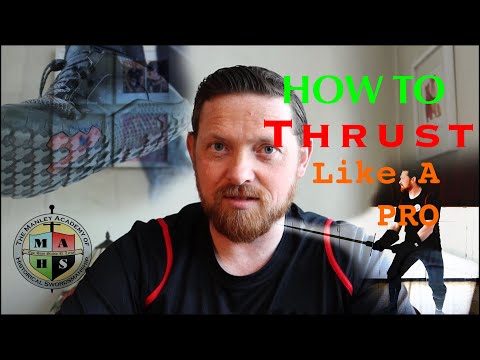
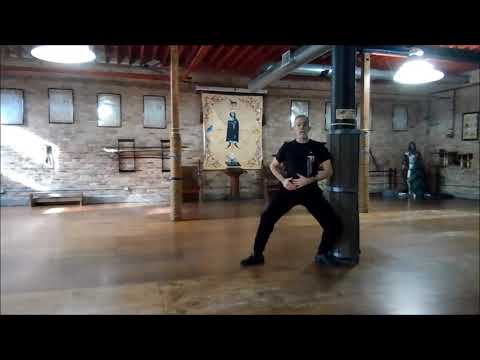
![Jedok Geom Part 6 - Jinjun Saljukse, Lunge and Kill Stance [jedok geom series]](https://img.youtube.com/vi/8F9SzQ6332Y/hqdefault.jpg)
Jedok Geom Part 6 - Jinjun Saljukse, Lunge and Kill Stance [jedok geom series]
0
Lunge·Just a Bug
Welcome to the Jedok geom series where I break down the Admiral's sword form and show you the stances and my interpretat…
Translation: Lunge — from the French fente (split/gap), referring to the wide split stance created when the front foot advances while the rear foot stays planted
The Lunge is the fundamental attacking movement in Western fencing, combining a full arm extension with a powerful forward drive of the body to deliver a thrust across a distance greater than the fencer's normal reach. [1] The fencer extends the sword arm completely (establishing 'right of way' in foil and sabre), then drives the front foot forward approximately two to three feet by explosively straightening the rear leg, while the rear foot remains planted as an anchor — the result is a deep split stance with the sword point arriving at the opponent's target before the body stops moving. [1],[2] The lunge is the culmination of approximately three centuries of fencing evolution: before the lunge was codified, sword combat relied primarily on cuts and passing steps (where both feet move forward). [2],[3] The development of the lunge, attributed to Italian masters of the late 16th century (most commonly credited to Nicoletto Giganti, whose 1606 treatise Scola, overo Teatro describes a recognisable lunging action), represented a paradigm shift from cutting to thrusting — the realisation that a thrust delivered with a lunge reaches the opponent faster than any cut, because the point travels in a straight line (the shortest distance between two points). [2],[3] This single technical innovation — extending the arm and driving the body forward in one explosive action — transformed European swordsmanship from a medieval cutting art into the refined thrusting science that eventually became modern sport fencing. [2],[3] In modern competitive fencing, the lunge remains the primary method of scoring touches in all three weapons (foil, épée, sabre), with elite fencers capable of launching a lunge covering 6-8 feet in under 0.3 seconds. [1],[4]
The lunge was developed during the transition from medieval cut-and-thrust swordsmanship to the Renaissance thrusting science of the rapier. [2],[3] While the exact origin is debated, Nicoletto Giganti's 1606 treatise Scola, overo Teatro is the earliest widely-accepted documentation of a recognisable lunging action, though earlier Italian masters including Camillo Agrippa (1553) and Ridolfo Capo Ferro (1610) contributed to the development of the thrusting attack. [3] The French school of fencing, developed from the 17th century onward, refined the lunge into its modern form — the full arm extension preceding the leg drive, the planted rear foot, and the upright torso — principles that remain unchanged in the 21st century. [1],[2],[3] Pollock, Grove, and Prevost wrote in their 1902 treatise on fencing that 'it took them about two centuries and three-quarters' to develop the lunge into its current form, emphasising that the technique's simplicity conceals centuries of refinement. [1] The lunge is universally recognised as one of the most important technical innovations in the history of martial arts — it transformed European swordsmanship from a chaotic melee skill into a precise, geometrical science. [2],[3]
The lunge is the most efficient method of delivering a thrust in any weapon-based martial art, because it maximises reach (adding approximately 3-4 feet beyond the fencer's standing extension) while maintaining a stable base for recovery. [1],[2] In competitive fencing, approximately 70% of all scoring touches in foil and épée are delivered via lunge or advance-lunge. [4] The technique's effectiveness stems from its speed: an elite fencer's lunge can cover 6-8 feet in under 0.3 seconds, which is faster than the average human reaction time of 0.15-0.25 seconds — meaning a well-timed lunge arrives before the opponent can physically react to parry it. [4] The lunge's historical effectiveness is attested by its dominance: once the thrust-with-lunge was developed, cutting styles of swordsmanship gradually became obsolete across Europe. [2],[3]
The lunge is the foundational attacking action in all competitive fencing. Approximately 70% of touches in Olympic foil and épée are scored via lunge or advance-lunge. Every Olympic fencing gold medallist in history has relied on the lunge as their primary scoring method. The technique has remained essentially unchanged for over 400 years — a testament to its biomechanical optimality.
No images yet for this technique.
Sign in to suggest an image.
Welcome to the Jedok geom series where I break down the Admiral's sword form and show you the stances and my interpretat…
This is a guide on How To Lunge in Sword Fighting/Historical Fencing. Also top Tips for improving feet and knee Durabil…
The lunge is a fundamental offensive footwork technique in blade work that combines lower-body mechanics with forward commitment to extend reach and deliver force. Sword Academy emphasizes the biomechanical foundations: the lunge requires charging the rear leg through hip withdrawal, then straightening the front leg while bending the rear leg to generate explosive power. Landing mechanics are critical—practitioners should contact the ground with the ball of the foot first, maintaining pressure there to create spring and stability while avoiding heel-first landing that risks injury. Chicago Swordplay Guild isolates two core components: extension (upper body and hips moving forward) and commitment (weight transfer and rear-leg drive), noting that proper extension precedes the power phase. Both Western instructors stress maintaining slight separation between front and rear feet to prevent falling forward, and that knees may safely track over toes when proper structure is maintained. Just a Bug introduces the lunge within Korean sword tradition (jinjun saojukse), describing it as either a short skipping step for added cut power or a longer gap-closing movement, emphasizing that feet should glide rather than jump or stomp to maximize forward mass transfer. Across all three traditions, the lunge functions both as a distance-closing tactic and as a power-generation mechanism that subordinates arm strength to body-weight transfer.
Synthesized from 3 instructors
No instructional courses yet for this technique.
Sign in to suggest a course.
Risk of injury to the person this technique is applied to
In modern sport fencing with protective equipment (mask, jacket, plastron, glove), the lunge is safe — the flexible blade bends on contact and the blunted point (button) does not penetrate. In historical context with sharp weapons, the lunge was the single most lethal action in swordsmanship — a thrust to the torso with a sharp blade driven by a full lunge is a killing blow. In HEMA with steel trainers, the lunge can cause bruising and occasional injury despite protective gear.
Skill level needed to execute this technique reliably
Whether this technique is allowed under major competition rule sets
Fencing (Pollock, Grove & Prevost, 1902)
description: [1] Pollock 1902, [2] Castle 1885, [3] Giganti 1606
Standard katakana transliteration of Western martial arts terminology (外来語) — used in Japanese MMA, boxing, and BJJ communities
description: [1] Pollock 1902, [2] Castle 1885, [3] Giganti 1606
Requires good quadriceps and calf strength in the rear leg (the primary power source)
Hip flexibility for the deep split stance
Ankle mobility to maintain the rear foot flat during the drive
Good balance and proprioception
Upper body control to keep the torso upright
The lunge can be adapted for all body types — taller fencers have a reach advantage, but shorter fencers can compensate with faster leg speed
The lunge is the fundamental attacking movement in fencing — the front foot extends forward while the rear foot stays planted, driving the weapon point toward the target. Documented extensively in Biomechanics of Human Motion (2nd Ed.) alongside the flèche and flunge as the three primary approaching movements. (Biomechanics of Human Motion; fencing manuals)
Your entire body weight behind the lunge is what generates power, not just arm strength or a large movement. As Just a Bug explains in their Jedok Geom series, 'no matter how strong your arms are and how big of a swing you do, it will never compare to your entire body weight behind that cut powering it.'
The lunge is best used when an opportunity presents itself, such as when your opponent's sword is just past you after their strike, allowing you to use it as a quick gap closer. It can also be used whenever you need power, though there are other techniques available for different situations.
Land on the ball of your foot, not the heel—landing with your heel creates injuries and bad practice. Keep a slight separation between your front and rear legs to avoid falling, and maintain a slight bend in your front knee rather than locking it out completely.
Wear flat shoes—as flat as possible—such as minimal or barefoot shoes that allow you to feel the ground through your toes, ball of your foot, and heel. This ground connection is important for proper foot structure and control.
The Lunge is the fundamental attacking movement in Western fencing, combining a full arm extension with a powerful forward drive of the body to deliver a thrust across a distance greater than the fencer's normal reach. The fencer extends the sword arm completely (establishing 'right of way' in foil and sabre), then drives the front foot forward approximately two to three feet by explosively straightening the rear leg, while the rear foot remains planted as an anchor — the result is a deep split stance with the sword point arriving at the opponent's target before the body stops moving.
The lunge was developed during the transition from medieval cut-and-thrust swordsmanship to the Renaissance thrusting science of the rapier. While the exact origin is debated, Nicoletto Giganti's 1606 treatise Scola, overo Teatro is the earliest widely-accepted documentation of a recognisable lunging action, though earlier Italian masters including Camillo Agrippa (1553) and Ridolfo Capo Ferro (1610) contributed to the development of the thrusting attack.
FIE: legal — Legal fencing technique — governed by FIE rules for foil, épée, and sabre; HEMA: legal — Legal in historical fencing competition
Danger rating 3/10. In modern sport fencing with protective equipment (mask, jacket, plastron, glove), the lunge is safe — the flexible blade bends on contact and the blunted point (button) does not penetrate. In historical context with sharp weapons, the lunge was the single most lethal action in swordsmanship — a thrust to the torso with a sharp blade driven by a full lunge is a killing blow. In HEMA with steel trainers, the lunge can cause bruising and occasional injury despite protective gear.
The standard setup chain: Establish distance (advance to within lunge range) → Test with feints or blade actions (beat, press, engage) → Identify the opponent's defensive tendency (which parry they favour) → Prepare the attacking line (direct attack or indirect via disengage/coupé) → Extend the arm fully toward the target → DRIVE the front foot forward by straightening the rear leg → Point arrives at the target → Touch scored → If parried → Recover to en garde or continue with remise/redoublement.
Standard counters include: Parry — deflecting the incoming blade with a parry in the correct line (quarte, sixte, etc.) is the primary defence / Retreat — stepping backward takes the target out of the lunge's range / Counter-attack (stop thrust) — delivering a thrust into the opponent's lunge before it arrives (requires superior tim… / Distance — maintaining a distance where the opponent's lunge falls short.
Common variants: Short lunge (a controlled lunge with minimal forward drive, used at cl…); Deep lunge (maximum forward extension for reaching a retreating opponent); Advance-lunge (an advance step immediately followed by a lunge, covering…); Fleche (running attack) (abandoning the planted rear foot and running past the opp…); Balestra-lunge (a forward jump immediately followed by a lunge); Reprise lunge (a second lunge delivered immediately after recovering fro…); Low lunge (lunging with the body lower than normal, often to attack …).
The lunge is the foundational attacking action in all competitive fencing. Approximately 70% of touches in Olympic foil and épée are scored via lunge or advance-lunge.
Top errors to watch for: Moving the leg before extending the arm — the most fundamental error in fencing; the arm extension establishes the at… / Lifting the rear heel — if the rear foot lifts off the floor, the anchor is lost, the drive loses power, and the fenc… / Leaning the torso forward — the torso should remain upright during the lunge; leaning forward shifts the centre of gr… / Front knee extending past the ankle — this places excessive stress on the knee ligaments and can cause injury over time.
The Lunge is also known as Ranji (from French: fente), Fente, Fencing Lunge, Stoccata (Italian), Affondo (Italian).