Weapons | Black Belt Training | Kali - Basic Striking Techniques
0
Bo Thrust·Premier Martial Arts
Weapons, Black Belt Training, Kali Striking Techniques, http://www.premiermartialarts.com
Translation: Staff Thrust
Direct thrusting attack using the tip of the bo, driven forward in a straight line to the target.
The bo thrust (bo tsuki) is a linear spearing action that exploits the staff's length to strike at maximum range, a technique with parallels in both Japanese sojutsu (spear art) and Chinese gun-shu (staff art). [1] In Okinawan kobudo, thrusting techniques appear in kata such as Shushi no Kon, targeting the solar plexus, throat, and face. [2] Draeger notes that the thrusting action of the bo draws directly from earlier spear-fighting methodology, with the staff effectively serving as a blunt-ended spear. [1]
Bō thrusts use the staff's end to deliver powerful linear strikes to the solar plexus, throat, or face, combining the weapon's reach with penetrating force. [1]
Thrusting with the bō was developed in both Chinese and Okinawan staff traditions, with Chinese influence particularly strong in Okinawan bōjutsu. [1]
Bō thrusts are performed in kobudō kata competition and demonstrated at embu events. [1]
No images yet for this technique.
Sign in to suggest an image.
Weapons, Black Belt Training, Kali Striking Techniques, http://www.premiermartialarts.com
Get the NEW Kali Apex training course here: https://www.kalicenter.training/ And Join the APEX Members for continued tra…
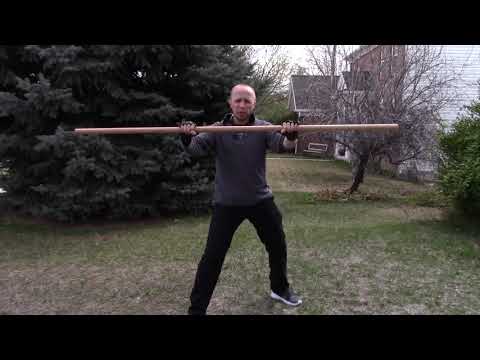
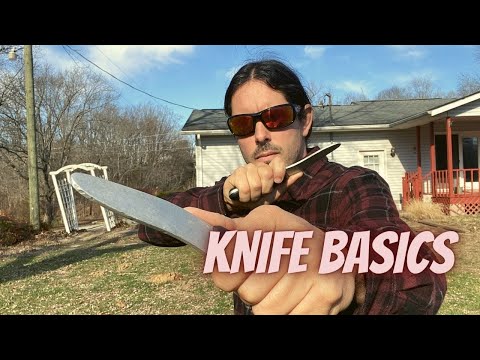
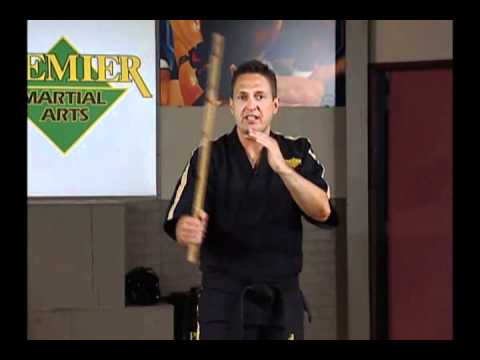
The bo thrust is a fundamental stabbing technique in staff-based martial arts that emphasizes the penetrating attack as a primary tactic. According to Kali Center, the thrust differs from slashing in its capacity for deep organ and skeletal damage, making it the priority technique taught before secondary methods. The basic thrust execution involves three directional variants: the center-line thrust (targeting the groin, abdomen, neck, or face along the body's midline), the backhand thrust (accessing the lungs, armpits, neck, and eyes on one side), and the forehand thrust (mirroring targets on the opposite side). Kali Center emphasizes simple jabbing mechanics with full retraction after each strike, requiring practitioners to develop bilateral coordination through isolated single-hand drills before progressing to alternating hand combinations and flowing double-weapon sequences. Critical safety consideration involves weapon path awareness—ensuring the staff or blade never intersects the practitioner's own body during execution, particularly when combining multiple thrusts. Skyline Drama and Premier Martial Arts both reinforce fundamental grip mechanics and stance principles applicable to staff work, though they emphasize broader striking forms (figure-eights and horizontal attacks) rather than dedicated thrust methodology. The thrust technique develops through progressive drilling: basic three-direction repetition, single-hand isolation, bilateral alternation, and finally flowing weave patterns that chain both hands together while maintaining blade consciousness and anatomical safety.
Synthesized from 3 instructors
No instructional courses yet for this technique.
Sign in to suggest a course.
Risk of injury to the person this technique is applied to
Staff/bo/jo weapons generate significant blunt force; fracture risk
Skill level needed to execute this technique reliably
Whether this technique is allowed under major competition rule sets
The Essence of Okinawan Karate-Do (Shoshin Nagamine, 1976)
Alias sources — [1] Kobudo: Okinawan Weapons (Demura, 1976) [2] Comprehensive Asian Fighting Arts (Draeger & Smith, 1969) [3] Comprehensive Asian Fighting Arts (Draeger & Smith, 1969)
History sources — [1] Draeger, D., Classical Bujutsu (Weatherhill, 1973) [2] Bishop, M., Okinawan Kobudo (Tuttle, 1999)
Established Japanese martial arts naming convention — native Japanese term (和語/漢語)
Alias sources — [1] Kobudo: Okinawan Weapons (Demura, 1976) [2] Comprehensive Asian Fighting Arts (Draeger & Smith, 1969) [3] Comprehensive Asian Fighting Arts (Draeger & Smith, 1969)
History sources — [1] Draeger, D., Classical Bujutsu (Weatherhill, 1973) [2] Bishop, M., Okinawan Kobudo (Tuttle, 1999)
wrist snap speed, sliding grip coordination, hip rotation
long reach and strong wrists for staff manipulation
forearms, wrist rotators, core rotators, shoulders
According to Kali Center instructors, you must ensure the blade or weapon never intersects another part of your body during thrusts, as this is how accidents and self-inflicted cuts occur during training. Even when wearing protective gear, maintaining proper weapon path is critical to safe practice.
Kali Center recommends starting with about 10-20 repetitions per side on your dominant hand, then matching that on your non-dominant side, and finally alternating between both sides to build bilateral coordination. Even when drilling basic fundamentals, instructors continue to refine these movements throughout their training career.
According to Kali Center instruction, as you thrust the blade forward, it must clear your own body—you cannot keep the blade in a straight line from hand to target if that path crosses your arm or hand. You must go very slowly at first to ensure the blade stays clear of your own body throughout the movement.
Direct thrusting attack using the tip of the bo, driven forward in a straight line to the target.
The bo thrust (bo tsuki) is a linear spearing action that exploits the staff's length to strike at maximum range, a technique with parallels in both Japanese sojutsu (spear art) and Chinese gun-shu (staff art). In Okinawan kobudo, thrusting techniques appear in kata such as Shushi no Kon, targeting the solar plexus, throat, and face.
FIE: legal — Legal thrusting technique — primary scoring method in foil and épée; FIK Kendo: legal — Tsuki (throat thrust) is a valid target; HEMA: legal — Legal in applicable weapon categories
Danger rating 7/10. Very High — staff/bo/jo weapons generate significant blunt force; fracture risk
The standard setup chain: Ready Position → Distance Control → Execute Technique → Return to Guard.
Standard counters include: Beat Parry — deflect the blade with a sharp lateral beat before it reaches target / Displacement — move the body off the line while threatening with the point / Counter-Thrust — extend into the attacker's line during their advance.
Common variants: Overhead strike (bringing the staff down from above in a vertical arc); Lateral strike (horizontal sweep targeting the ribs or head); Thrust (straight thrust with the end of the staff); Butt-end strike (striking with the rear end of the staff at close range).
Bō thrusts are performed in kobudō kata competition and demonstrated at embu events.
Top errors to watch for: Pushing slowly instead of thrusting sharply — the thrust must be explosive; a slow push is easily deflected / Over-extending the body — maintain balance; the arms extend but the body stays centred over the feet / Not retracting immediately — the extended staff is vulnerable to being trapped or redirected; snap it back / Telegraphing with the shoulders — the thrust should initiate from the arms without a visible body preparation.
The Bo Thrust is also known as Bo Tsuki, Staff Thrust, Bojutsu Tsuki.