The Bo - Sliding secret strike
0
Bo Strike·The Dojo Martial Arts - Budo Taijutsu, Mason, Ohio
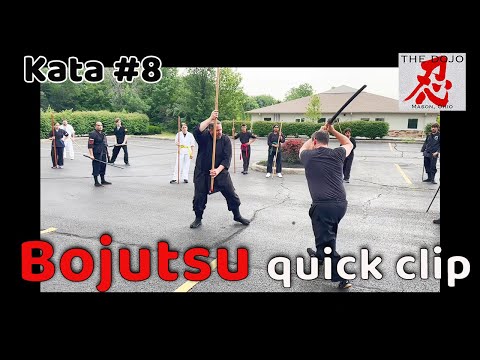
Kukishin Ryu Bojutsu Kata #8 Henka. Weapons class quick clips Master Budo Instructor - Todd Ryotoshi Norcross (9th Dan,…
Translation: Staff Strikes
Offensive striking techniques with the long staff, using both ends of the weapon in rotational and direct attacks.
Striking techniques (uchi-waza) form the offensive core of bojutsu and are documented in the earliest Okinawan kobudo kata. [1] The bo's length — typically six shaku (approximately 182 cm) — enables powerful two-handed strikes that generate substantial force through leverage and rotational mechanics. [2] Historical accounts describe Okinawan villagers using bo strikes to defend against armed bandits and, during the Satsuma occupation (post-1609), against samurai swordsmen, a context that demanded techniques capable of overcoming bladed weapons. [1],[3]
Bō strikes use the long staff's reach and leverage to deliver powerful blows from multiple angles, striking with both ends and the centre of the weapon. [1]
Bō techniques are competed in karate/kobudō tournaments sanctioned by organisations like the World Karate Federation (kata divisions) and demonstrated at Okinawan kobudō events. [1]
No images yet for this technique.
Sign in to suggest an image.
Kukishin Ryu Bojutsu Kata #8 Henka. Weapons class quick clips Master Budo Instructor - Todd Ryotoshi Norcross (9th Dan,…
No instructional courses yet for this technique.
Sign in to suggest a course.
Risk of injury to the person this technique is applied to
Staff/bo/jo weapons generate significant blunt force; fracture risk
Skill level needed to execute this technique reliably
Whether this technique is allowed under major competition rule sets
The Essence of Okinawan Karate-Do (Shoshin Nagamine, 1976)
Alias sources — [1] Kobudo: Okinawan Weapons (Demura, 1976) [2] Comprehensive Asian Fighting Arts (Draeger & Smith, 1969) [3] Comprehensive Asian Fighting Arts (Draeger & Smith, 1969)
History sources — [1] Bishop, M., Okinawan Kobudo (Tuttle, 1999) [2] Draeger, D., Classical Bujutsu (Weatherhill, 1973) [3] Draeger, D. & Smith, R., Comprehensive Asian Fighting Arts (Kodansha, 1969)
Established Japanese martial arts naming convention — native Japanese term (和語/漢語)
Alias sources — [1] Kobudo: Okinawan Weapons (Demura, 1976) [2] Comprehensive Asian Fighting Arts (Draeger & Smith, 1969) [3] Comprehensive Asian Fighting Arts (Draeger & Smith, 1969)
History sources — [1] Bishop, M., Okinawan Kobudo (Tuttle, 1999) [2] Draeger, D., Classical Bujutsu (Weatherhill, 1973) [3] Draeger, D. & Smith, R., Comprehensive Asian Fighting Arts (Kodansha, 1969)
wrist snap speed, sliding grip coordination, hip rotation
long reach and strong wrists for staff manipulation
forearms, wrist rotators, core rotators, shoulders
Every move, in any martial art, shares a few universal traits. Mix and match below to pinpoint the right tool — or compare equivalents across styles.
Direct thrusting attack using the tip of the bo, driven forward in a straight line to the target.
Horizontal or sweeping strike delivered from the side, targeting the ribs, head, or legs.
Vertical downward strike delivered by raising the bo overhead and driving it straight down onto the target.
Offensive striking techniques with the long staff, using both ends of the weapon in rotational and direct attacks.
Striking techniques (uchi-waza) form the offensive core of bojutsu and are documented in the earliest Okinawan kobudo kata. The bo's length — typically six shaku (approximately 182 cm) — enables powerful two-handed strikes that generate substantial force through leverage and rotational mechanics.
FIE Sabre: legal — Legal cutting technique to upper body target area; FIK Kendo: legal — Legal if targeting valid area with correct form; WEKAF: legal — Legal striking technique; HEMA: legal — Legal in applicable weapon categories
Danger rating 7/10. Very High — staff/bo/jo weapons generate significant blunt force; fracture risk
The standard setup chain: Grip and Stance → Chamber → Strike → Recovery.
Standard counters include: Guard Position — return to a defensive ready stance / Distance Management — control the measure to avoid being in range / Counter-Attack — strike during the opponent's recovery or between movements.
Common variants: Overhead strike (bringing the staff down from above in a vertical arc); Lateral strike (horizontal sweep targeting the ribs or head); Thrust (straight thrust with the end of the staff); Butt-end strike (striking with the rear end of the staff at close range).
Bō techniques are competed in karate/kobudō tournaments sanctioned by organisations like the World Karate Federation (kata divisions) and demonstrated at Okinawan kobudō events.
Top errors to watch for: Using arm strength alone — bo power comes from hip rotation and core engagement; arm-only strikes lack force / Striking with only one end — both ends are weapons; failure to use both wastes the staff's unique advantage / Over-committing to strikes — extending too far disrupts balance and makes recovery slow / Not using the staff's rotational momentum — the spinning staff builds speed naturally; fighting the rotation wastes e….
The Bo Strike is also known as Bo Uchi, Staff Strike, Bojutsu Uchi.