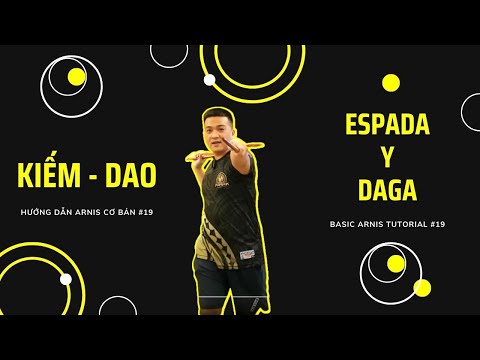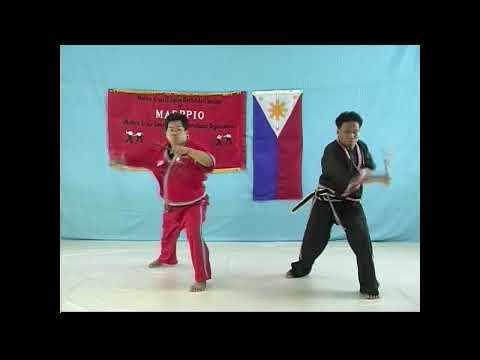
Espada Y Daga | Volume 8
0
Standard Espada Y Daga·Remy P. Presas
Espada Y Daga Volume 8 MARPPIO Series with Dr. Remy Presas Jr.
Translation: standard espada y daga
The Standard Espada Y Daga subfamily covers the fundamental techniques and drills of the sword-and-dagger combination, including the basic guard positions, coordination patterns between the long and short weapons, and the partner drills that develop the ability to use both weapons simultaneously. [1] Standard espada y daga training teaches the practitioner to coordinate two weapons of different lengths — the long weapon strikes, blocks, and controls distance while the short weapon checks, traps, and counters at close range. [1],[2] The drills develop the independent hand coordination necessary for effective dual-weapon fighting, where each hand must perform different actions simultaneously. [2],[3]
Standard espada y daga techniques are taught across most major Filipino martial arts systems, representing a fundamental weapons combination that every advanced practitioner is expected to master. [1] The methodology has been refined through centuries of transmission in Cebu, Manila, and other centres of Filipino martial arts. [2],[3]
Espada y daga combines a long weapon for offence and range with a short weapon for close-range defence and counter-attack, providing comprehensive coverage at all distances. [1]
Espada y daga was influenced by Spanish colonial fencing (espada y daga literally means 'sword and dagger') combined with indigenous Filipino dual-weapon traditions. [1]
Espada y daga is a competition division in WEKAF and other FMA tournament formats. [1]
No images yet for this technique.
Sign in to suggest an image.
Espada Y Daga Volume 8 MARPPIO Series with Dr. Remy Presas Jr.
Fanpage: https://www.facebook.com/Arnis.vn Group: https://www.facebook.com/groups/arnisvietnam FB: https://www.facebook.…
No instructional courses yet for this technique.
Sign in to suggest a course.
Risk of injury to the person this technique is applied to
Arnis/Escrima/Kali stick and blade techniques; designed for close-range lethality
Skill level needed to execute this technique reliably
Whether this technique is allowed under major competition rule sets
The Filipino Martial Arts (Dan Inosanto, 1980)
Alias sources — [1] Filipino Martial Arts (Wiley, 1994) [2] Filipino Martial Arts (Wiley, 1994) [3] Filipino Martial Arts (Wiley, 1994)
Effectiveness sources — [1] Filipino Martial Arts (Wiley, 1997)
Standard katakana transliteration of Western martial arts terminology (外来語) — used in Japanese MMA, boxing, and BJJ communities
Alias sources — [1] Filipino Martial Arts (Wiley, 1994) [2] Filipino Martial Arts (Wiley, 1994) [3] Filipino Martial Arts (Wiley, 1994)
Effectiveness sources — [1] Filipino Martial Arts (Wiley, 1997)
wrist control for edge alignment, grip endurance, footwork precision
quick wrists, strong forearms, good posture
forearm extensors/flexors, deltoids, core, calves
Every move, in any martial art, shares a few universal traits. Mix and match below to pinpoint the right tool — or compare equivalents across styles.
The Standard Espada Y Daga subfamily covers the fundamental techniques and drills of the sword-and-dagger combination, including the basic guard positions, coordination patterns between the long and short weapons, and the partner drills that develop the ability to use both weapons simultaneously. Standard espada y daga training teaches the practitioner to coordinate two weapons of different lengths — the long weapon strikes, blocks, and controls distance while the short weapon checks, traps, and counters at close range.
Standard espada y daga techniques are taught across most major Filipino martial arts systems, representing a fundamental weapons combination that every advanced practitioner is expected to master. The methodology has been refined through centuries of transmission in Cebu, Manila, and other centres of Filipino martial arts.
WEKAF: legal — Legal in padded stick competition; HEMA: legal — Legal in applicable weapon categories
Danger rating 8/10. Very High — Arnis/Escrima/Kali stick and blade techniques; designed for close-range lethality
The standard setup chain: Assume Guard (Kamae/Hut) → Measure Distance (Ma-ai) → Initiate Cut/Thrust → Follow Through (Zanshin).
Standard counters include: Parry (Absetzen) — deflect the incoming blade with a counter-displacement / Void (Step Back) — withdraw from measure to avoid the cutting arc / Counter-Cut (Nachreisen) — strike into the opponent's opening during their attack.
Common variants: Standard cut (primary cutting angle from the ready stance); Thrust (tsuki) (straight thrust targeting the throat, chest, or face); Rising cut (kiri-age) (upward diagonal cut from low to high); Diagonal cut (kesa-giri) (downward diagonal cut following the kimono line).
Espada y daga is a competition division in WEKAF and other FMA tournament formats.
Top errors to watch for: Keeping both weapons at the same distance from the opponent — the stick should be forward for range, the dagger close… / Not using the dagger for checking — the dagger's spine (back edge) is used to check and redirect, not just for cutting / Losing track of which weapon is doing what — each hand has a specific job at each range; confusion leads to gaps / Not practising the range transition — moving from stick range to dagger range must be trained specifically.
The Standard Espada Y Daga is also known as Sutandādo Esupada i Daga, Espada Y Daga Technique, Sword and Dagger Method, Olisi Y Baraw Drill.