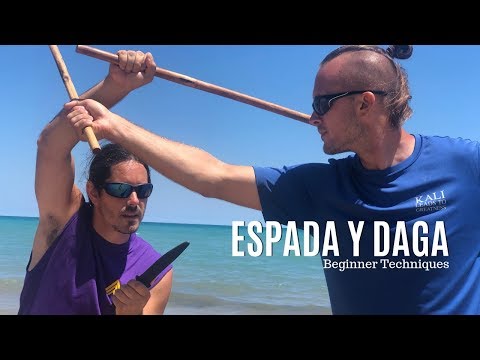
ESPADA Y DAGA BASIC TECHNIQUES | ESCRIMA STICK
0
Stick And Dagger — Espada Y Daga·Kali Center
Training Espada Y Daga is a great way to accelerate your skill and understanding of Kali. Train with me at my online aca…
Translation: stick and dagger — espada y daga
The Stick And Dagger (Espada Y Daga) family covers techniques using a long weapon (stick or sword) in the dominant hand and a short weapon (dagger or short stick) in the other hand, which is one of the most tactically versatile weapon configurations in Filipino martial arts. [1] Espada y daga (Spanish for 'sword and dagger') assigns distinct roles to each weapon: the long weapon provides range, power, and primary offence, while the short weapon handles close-range defence, trapping, checking, and close-quarters counter-attack. [1],[2] The combination creates a comprehensive fighting system where the practitioner can engage at multiple ranges simultaneously — the long weapon threatens at distance while the dagger controls the close range. [2],[3]
Espada y daga was influenced by both indigenous Filipino dual-weapon traditions and the Spanish rapier-and-dagger (espada y daga) fighting system brought by Spanish colonisers beginning in the 16th century. [1] The Filipino adaptation incorporated local blade types and fighting principles, creating a hybrid system that combined European and indigenous Southeast Asian weapon methodology. [2],[3]
Espada y daga (sword/stick and dagger) is considered one of the most advanced and tactically rich FMA training methods because it requires coordinating two weapons of different lengths and functions simultaneously — the long weapon (espada) for range attacks and the short weapon (daga) for close-range trapping, checking, and thrusting. [1]
Espada y daga training is documented in virtually all traditional FMA systems and reflects the historical reality of Filipino warriors carrying a primary weapon (bolo, kampilan) paired with a short blade (daga, balisong). [1] The Spanish influence is evident in the nomenclature, suggesting cross-pollination during the colonial period. [2]
Espada y daga is competed in FMA tournaments as a specialty division, featuring a long weapon (stick/sword) and a short weapon (dagger/knife) simultaneously. [1]
No images yet for this technique.
Sign in to suggest an image.
Training Espada Y Daga is a great way to accelerate your skill and understanding of Kali. Train with me at my online aca…
No instructional courses yet for this technique.
Sign in to suggest a course.
Risk of injury to the person this technique is applied to
Arnis/Escrima/Kali stick and blade techniques; designed for close-range lethality
Skill level needed to execute this technique reliably
Whether this technique is allowed under major competition rule sets
Bubishi: The Classic Manual of Combat (Patrick McCarthy, 2008)
Alias sources — [1] Filipino Martial Arts (Wiley, 1994) [2] Filipino Martial Arts (Wiley, 1994) [3] Filipino Martial Arts (Wiley, 1994)
Effectiveness sources — [1] Wiley, M., Filipino Martial Arts (Charles E. Tuttle, 1994)
Standard katakana transliteration of Western martial arts terminology (外来語) — used in Japanese MMA, boxing, and BJJ communities
Alias sources — [1] Filipino Martial Arts (Wiley, 1994) [2] Filipino Martial Arts (Wiley, 1994) [3] Filipino Martial Arts (Wiley, 1994)
Effectiveness sources — [1] Wiley, M., Filipino Martial Arts (Charles E. Tuttle, 1994)
wrist control for edge alignment, grip endurance, footwork precision
quick wrists, strong forearms, good posture
forearm extensors/flexors, deltoids, core, calves
Every move, in any martial art, shares a few universal traits. Mix and match below to pinpoint the right tool — or compare equivalents across styles.
Espada y daga (sword and dagger) is the Filipino adaptation of the Spanish colonial sword-and-dagger fighting system. The long weapon (stick/sword) attacks while the short weapon (dagger/knife) defends and counter-attacks at close range. (Wiley, Filipino Martial Arts; FMA history)
The Stick And Dagger (Espada Y Daga) family covers techniques using a long weapon (stick or sword) in the dominant hand and a short weapon (dagger or short stick) in the other hand, which is one of the most tactically versatile weapon configurations in Filipino martial arts. Espada y daga (Spanish for 'sword and dagger') assigns distinct roles to each weapon: the long weapon provides range, power, and primary offence, while the short weapon handles close-range defence, trapping, checking, and close-quarters counter-attack.
Espada y daga was influenced by both indigenous Filipino dual-weapon traditions and the Spanish rapier-and-dagger (espada y daga) fighting system brought by Spanish colonisers beginning in the 16th century. The Filipino adaptation incorporated local blade types and fighting principles, creating a hybrid system that combined European and indigenous Southeast Asian weapon methodology.
WEKAF: legal — Legal in padded stick competition; HEMA: legal — Legal in applicable weapon categories
Danger rating 8/10. Very High — Arnis/Escrima/Kali stick and blade techniques; designed for close-range lethality
The standard setup chain: Assume Guard (Kamae/Hut) → Measure Distance (Ma-ai) → Initiate Cut/Thrust → Follow Through (Zanshin).
Standard counters include: Parry (Absetzen) — deflect the incoming blade with a counter-displacement / Void (Step Back) — withdraw from measure to avoid the cutting arc / Counter-Cut (Nachreisen) — strike into the opponent's opening during their attack.
Common variants: Standard cut (primary cutting angle from the ready stance); Thrust (tsuki) (straight thrust targeting the throat, chest, or face); Rising cut (kiri-age) (upward diagonal cut from low to high); Diagonal cut (kesa-giri) (downward diagonal cut following the kimono line).
Espada y daga is competed in FMA tournaments as a specialty division, featuring a long weapon (stick/sword) and a short weapon (dagger/knife) simultaneously.
Top errors to watch for: Treating the dagger as secondary — the dagger is the primary defensive and close-range offensive tool; neglecting it … / Using both weapons at the same range — the stick and dagger have distinct optimal ranges; maintain the range appropri… / Not training the dagger hand for checking and trapping — the dagger hand's checking function is as important as its c… / Forgetting to use the stick when the dagger is engaged — both weapons should work simultaneously, not alternately.
The Stick And Dagger — Espada Y Daga is also known as Esupada i Daga, Espada Y Daga, Sword And Dagger, Olisi Y Baraw.