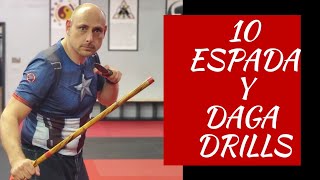
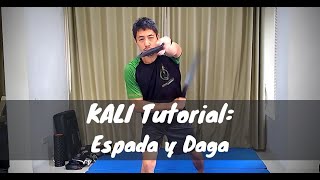
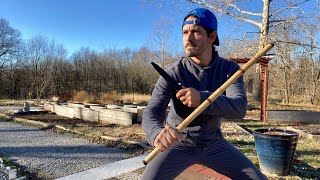
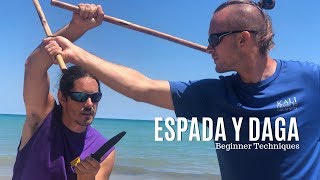
Course Overview and Courtesy Protocol
The instructor outlines the complete curriculum for Espada y Daga training, which includes striking techniques, blocking applications, gridwork, practical applications, and disarming methods. A courtesy bow specific to Espada y Daga is demonstrated, consistent with protocols established for single stick, double stick, and other weapon systems in the lineage.
Six Primary Strike Targets
The Espada y Daga is held in chest-ready position while six directional strikes are introduced. The targets progress systematically: opponent's left hand pole, right hand pole, left floating ribs, right floating ribs, left chest, and center line to the ground.
Striking Combinations with Daga Thrust
Each of the six strikes is executed in sequence, followed immediately by a dagger thrust to the opponent's chest. The drill is performed from forward stance and back stance, with the practitioner withdrawing to ready position after each combination.
Footwork Integration and Video Switching
The practitioner incorporates foot positioning changes after each strike and dagger thrust, advancing or retreating to maintain proper distance. This footwork—called video switching—ensures directional flow and generates momentum through lower body mechanics.
Accelerated Combination Drilling
The six strikes are compressed into a three-count rhythm, combining all movements into a faster continuous sequence. This acceleration drill develops timing and reduces the interval between individual techniques.
Blocking Mechanics with Daga Support
The dagger supports the espada by reinforcing blocks rather than functioning independently. Blocks are executed outside the centerline with lateral body movement to protect against incoming strikes that would penetrate if blocked too close to the body.
Body Shifting During Defense
The defender shifts the rear foot across the body while blocking, integrating footwork into defensive positioning. This simultaneous foot movement increases safety by redirecting the incoming strike's path away from vital targets.
Chest-Level Dagger Placement and Transition
In block three, the dagger is positioned at chest level to prepare for stopping or thrusting techniques rather than being lowered. Keeping the dagger elevated maintains offensive readiness while preventing the defender from turning their head downward, which could expose them to follow-up strikes.
Overhead Defense with Counter-Offensive Integration
The instructor demonstrates blocks five and six, which incorporate overhead dagger movements for both defensive and offensive purposes. These techniques allow the practitioner to deflect incoming strikes while simultaneously creating opportunities to deliver countering attacks.
Espada Y Daga | Volume 8
Key Takeaways
- •Course Overview and Courtesy Protocol
- •Six Primary Strike Targets
- •Striking Combinations with Daga Thrust
- •Footwork Integration and Video Switching
Espada Y Daga Volume 8 MARPPIO Series with Dr. Remy Presas Jr.
Frequently Asked Questions
What does this video teach about standard espada y daga?
This video covers course overview and courtesy protocol, six primary strike targets, striking combinations with daga thrust. It provides detailed instruction from Remy P. Presas.
How long does it take to learn standard espada y daga?
The basic mechanics can be understood in a single session, but developing reliable execution requires consistent drilling over weeks of practice. This 9-part breakdown helps structure your training by isolating each phase of the technique.
What are the key details for finishing standard espada y daga?
In block three, the dagger is positioned at chest level to prepare for stopping or thrusting techniques rather than being lowered. Keeping the dagger elevated maintains offensive readiness while preventing the defender from turning their head downward, which could expose them to follow-up strikes.