Make Any Flow Drill 100x Better | Filipino Martial Arts | Arnis | Kali | Eskrima
0
Standard Flow Drill·Paulo Rubio
Flow drills are useless, right? Wrong! You might have just have fallen into the all-too-common trap of wanting to look …
Translation: standard flow drill
The Standard Flow Drill establishes the basic continuous partner drill in doble baston, where both practitioners cycle through a set pattern of alternating high and low strikes with corresponding blocks, maintaining a constant rhythm that can be progressively sped up as skill develops. [1] The drill typically follows a repeating pattern: practitioner A strikes high-left, B blocks and counters high-right, A blocks and counters low-left, and so on in a continuous cycle. [1],[2] The standard flow drill is the entry-level continuous training exercise that develops the fundamental coordination and reaction patterns needed for more advanced double-stick work. [2],[3]
The standard flow drill is the foundational partner exercise in doble baston training, used across virtually all Filipino martial arts systems as the introductory method for developing double-stick skills. [1] Its simplicity and scalability make it the universal starting point for doble baston practice. [2],[3]
The standard flow drill is the foundational partner drill in FMA, training continuous attack-defence patterns at increasing speed. [1]
Standard flow drills are taught in virtually all FMA systems as a core training methodology. [1]
Standard flow drill technique is demonstrated at FMA events and applied in sparring competition. [1]
No images yet for this technique.
Sign in to suggest an image.
Flow drills are useless, right? Wrong! You might have just have fallen into the all-too-common trap of wanting to look …
In this video I will be teaching you the most common Sinawali drill in the Filipino Martial Arts. The Heaven, Standard, …
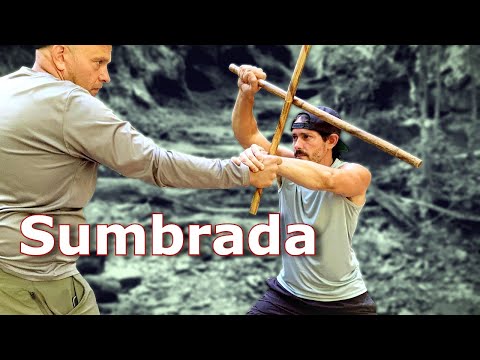
Sumbrada Drill is a fundamental training exercise in Filipino Martial Arts. This drill is a partner-based practice that …
The Standard Flow Drill, known variously as Sombrata (five-count), Sinawali (six-count variations), or Sabayan, is a foundational partner drill in Filipino martial arts taught across multiple schools with consistent core principles but variable naming conventions. Kali Center emphasizes the five-count Sombrata structure: angle one strike with inside four-wall deflection, economical hip strike with drop-stick response, thrust with low inside umbrella, and outside umbrella with head strike, cycling back to the beginning. The drill develops weapon control and hand sensitivity necessary for applying disarms, locks, and throws. Jeet Kune Do Doctor presents three six-count variations—heaven, standard, and earth—targeting different strike angles (high, mid, low) while maintaining identical strike patterns with wittic (retract) and loptic (follow-through) mechanics. Both instructors agree on the fundamental purpose: building flow, hand-eye coordination, and motor skill development before introducing complexity. However, Paulo Rubio cautions that predictable cadence without variation creates false mastery; he advocates breaking the rhythm with random insertions (punches, elbows, knees) to expose failure points and develop adaptive timing rather than choreographed responses. All three stress starting slowly, maintaining smooth transitions, and prioritizing accuracy over speed.
Synthesized from 3 instructors
No instructional courses yet for this technique.
Sign in to suggest a course.
Risk of injury to the person this technique is applied to
Arnis/Escrima/Kali stick and blade techniques; designed for close-range lethality
Skill level needed to execute this technique reliably
Whether this technique is allowed under major competition rule sets
The Filipino Martial Arts (Dan Inosanto, 1980)
Alias sources — [1] Filipino Martial Arts (Wiley, 1994) [2] Filipino Martial Arts (Wiley, 1994) [3] Filipino Martial Arts (Wiley, 1994)
Effectiveness sources — [1] Filipino Martial Arts (Wiley, 1997)
Standard katakana transliteration of Western martial arts terminology (外来語) — used in Japanese MMA, boxing, and BJJ communities
Alias sources — [1] Filipino Martial Arts (Wiley, 1994) [2] Filipino Martial Arts (Wiley, 1994) [3] Filipino Martial Arts (Wiley, 1994)
Effectiveness sources — [1] Filipino Martial Arts (Wiley, 1997)
wrist speed, hand coordination (especially double stick), cardiovascular endurance
quick hands, conditioned forearms, coordination
forearms, wrists, shoulders, core rotators
You can practice with a heavy bag, a pole, or really anything available. According to the Jeet Kune Do Doctor, the drill is flexible and can be adapted to whatever training tools you have on hand.
According to Paulo Rubio, maintaining a steady beat or rhythm in flow drills allows your partner to predict your movements and find the perfect counter, which defeats the purpose of the training. Breaking the cadence and introducing random elements forces you to respond to real variations rather than memorized patterns.
The Jeet Kune Do Doctor emphasizes that you can make as many variations as you want—the drill can be as long or short as needed with as much movement as required. You can adjust the sequence (such as one-one-one or two-two-two patterns) to suit your training goals.
Paulo Rubio recommends two key points: first, safely introduce random elements and communicate clearly with your partner about what you'll be doing; second, ensure your strikes are on target and aimed at the intended target (like the neck if that's the angle), rather than flailing out of range.
The Standard Flow Drill establishes the basic continuous partner drill in doble baston, where both practitioners cycle through a set pattern of alternating high and low strikes with corresponding blocks, maintaining a constant rhythm that can be progressively sped up as skill develops. The drill typically follows a repeating pattern: practitioner A strikes high-left, B blocks and counters high-right, A blocks and counters low-left, and so on in a continuous cycle.
The standard flow drill is the foundational partner exercise in doble baston training, used across virtually all Filipino martial arts systems as the introductory method for developing double-stick skills. Its simplicity and scalability make it the universal starting point for doble baston practice.
WEKAF: legal — Legal in padded stick competition; HEMA: legal — Legal in applicable weapon categories
Danger rating 8/10. Very High — Arnis/Escrima/Kali stick and blade techniques; designed for close-range lethality
The standard setup chain: Grip and Stance → Chamber → Strike → Recovery.
Standard counters include: Umbrella Block — raise the stick overhead to intercept a downward strike / Cross Block — meet the incoming strike with a perpendicular block / Disarm — strip the opponent's weapon through leverage on the hand or wrist.
Common variants: Angle 1 (forehand diagonal) (downward diagonal strike from the dominant side); Angle 2 (backhand diagonal) (downward diagonal strike from the off side); Angle 5 (thrust) (straight thrust with the tip of the stick); Redonda (continuous) (flowing circular strikes chaining multiple angles).
Standard flow drill technique is demonstrated at FMA events and applied in sparring competition.
Top errors to watch for: Blocking and pausing before countering — the block must flow directly into the counter-strike without hesitation / Reaching to block — footwork should maintain proper distance so blocks are comfortable, not desperate / Forgetting the live hand check — the check hand is essential; without it, the drill becomes unrealistic / Hitting the partner's hand instead of their stick — target the weapon, not the body, during cooperative drills.
The Standard Flow Drill is also known as Sutandādo Furō Doriru, Basic Hubad, Feed-and-Return Drill, Sumbrada Basic.