Wing Chun Techniques - Sifu's Corner Understanding The Gan Sao Better
0
Flank Cut·Enter Shaolin
Free Kung Fu Lessons Online delivered to your inbox by clicking here now: http://entershaolin.com/free-kungfu-lessons I…
Translation: flank cut
The Flank Cut delivers a cutting attack to the side of the opponent's torso, targeting the area below the arm on either the left or right flank. [1] The flank cut requires an upward or lateral blade trajectory to reach the side of the body, making it biomechanically different from the head and chest cuts which travel in downward or horizontal arcs. [1],[2] The flank cut is one of the most difficult sabre attacks to defend because it targets a low area that requires the defender to drop their parry from the standard high guard position. [2],[3]
Flank cutting technique in kendo targets the exposed side of the torso, similar to the dō cut but emphasising the lateral angle. [1]
Flank cuts to the dō area are valid scoring techniques in kendo competition. [1]
No images yet for this technique.
Sign in to suggest an image.
Free Kung Fu Lessons Online delivered to your inbox by clicking here now: http://entershaolin.com/free-kungfu-lessons I…
Eric Hardeman: Uses of the Crossed Shiel - 0:20 Cody "The Northern Hussar": Uses of Prime thrust in Rapier - 3:35 Want …
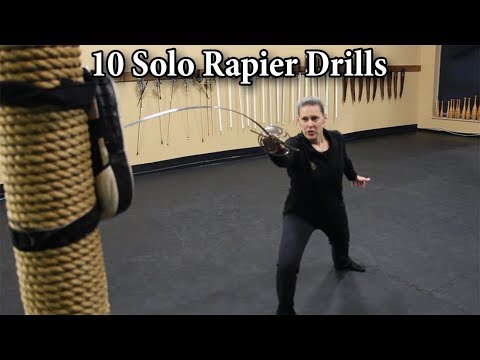
Sometimes it can be difficult to find the time to work with a group, so here are 10 solo drills you can do with a Rapier…
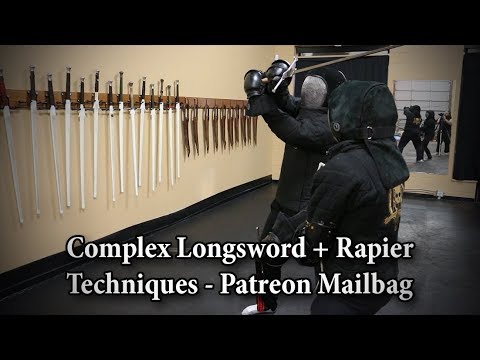
The flank cut in sabre sport represents a diagonal cutting action targeting the opponent's head or torso from an angled approach. Blood and Iron HEMA instructors Julien Schütze and Nicole Smith describe the technique as originating from high guard or other positions, executed with hands crossed and rotated to deliver a downward-diagonal strike. Schütze notes that while the cut can function as a counter-attack, its practical application proves challenging due to timing and positioning difficulties. He emphasizes that the flank cut achieves greatest success not as an isolated opening move, but rather as a follow-up to preceding actions—particularly after a thrust has been deflected, where transitioning from true edge to false edge creates a faster, more efficient cutting motion. Both instructors acknowledge that protective equipment significantly hampers the technique's execution in sparring, as arm guards and jackets restrict the diagonal trajectory necessary for effective delivery. Smith's solo drilling methodology, while focused on rapier, reinforces fundamental cutting principles applicable to sabre: maintaining proper stance, drawing through the cut for maximum effect, and combining cuts with other offensive actions. The instructors collectively present the flank cut as a transitional technique requiring situational awareness and predictive positioning rather than a straightforward primary attack.
Synthesized from 2 instructors
No instructional courses yet for this technique.
Sign in to suggest a course.
Risk of injury to the person this technique is applied to
Modern sport fencing uses blunted weapons and full protective gear; injury rate ~2.5 per 1000 exposures (Harmer 2008)
Skill level needed to execute this technique reliably
Whether this technique is allowed under major competition rule sets
The Art of Fencing (Luigi Barbasetti, 1932)
Alias sources — [1] FIE Rules of Competition [2] Classical Fencing (Rogers, 2014) [3] Classical Fencing (Rogers, 2014)
Effectiveness sources — [1] Czajkowski, Z., Understanding Fencing (SKA Swordplay Books, 2005)
Established Japanese martial arts naming convention — native Japanese term (和語/漢語)
Alias sources — [1] FIE Rules of Competition [2] Classical Fencing (Rogers, 2014) [3] Classical Fencing (Rogers, 2014)
Effectiveness sources — [1] Czajkowski, Z., Understanding Fencing (SKA Swordplay Books, 2005)
explosive lunge speed, finger/wrist dexterity, cardiovascular endurance
long reach (tall, long arms), fast-twitch legs
quadriceps (lunge), calves, forearm/finger flexors, core
According to Blood and Iron HEMA, the flank cut is most successful when used to break through an opponent's line after they've committed to a counter-attack, rather than as a standalone opener on the open side.
Blood and Iron HEMA recommends rolling around your opponent's blade, stepping forward, and maintaining pressure to keep your point online—this prevents them from successfully pushing you offline regardless of how hard they press.
The Flank Cut delivers a cutting attack to the side of the opponent's torso, targeting the area below the arm on either the left or right flank. The flank cut requires an upward or lateral blade trajectory to reach the side of the body, making it biomechanically different from the head and chest cuts which travel in downward or horizontal arcs.
The flank cut was a standard military sabre attack targeting the exposed side of an opponent, particularly effective against cavalry riders whose flanks were vulnerable during mounted combat. In sport sabre, the flank cut became a tactical tool for attacking below the opponent's guard.
FIE: legal — Legal fencing technique — governed by FIE rules for foil, épée, and sabre; HEMA: legal — Legal in historical fencing competition
Danger rating 2/10. Low — modern sport fencing uses blunted weapons and full protective gear; injury rate ~2.5 per 1000 exposures (Harmer 2008)
The standard setup chain: En Garde → Advance/Lunge Preparation → Attack → Recovery.
Standard counters include: Parry (Absetzen) — deflect the incoming blade with a counter-displacement / Void (Step Back) — withdraw from measure to avoid the cutting arc / Counter-Cut (Nachreisen) — strike into the opponent's opening during their attack.
Common variants: Simple attack (single blade action (disengage, beat, or direct) to score); Compound attack (multiple blade actions (feint then disengage) to create a…); Riposte (immediate counter after a successful parry); Counter-attack (attacking into the opponent's attack with priority or rig…).
Flank cuts to the dō area are valid scoring techniques in kendo competition.
Top errors to watch for: Cutting at the hip instead of the flank — the valid target is above the waist; the flank is the side of the torso / Using a downward cut for the flank — the flank cut typically uses an upward or horizontal trajectory / Not timing the flank cut to the opponent's arm lift — the flank opens when the arm rises; cut at that moment / Telegraphing the flank cut with an obvious low preparation — the cut should begin from the standard guard.
The Flank Cut is also known as Wakibara-giri, Coupe au Flanc Lateral, Side Cut, Belly Cut.