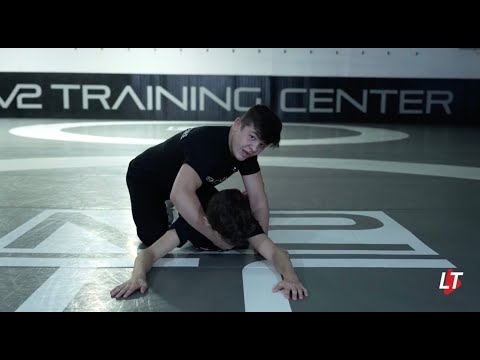
How To Correctly Gut Wrench With Bo Bassett
0
Standard Gut Wrench·Live Trained·Added by Admin
Bo goes in-depth to show you how to get into a gut wrench and how to turn someone with a gut wrench. This might look a l…
Translation: standard gut wrench suplex
Standard Gut Wrench is the conventional execution in which the wrestler locks hands around the belly-down opponent's midsection, drives forward to compress the opponent, then explosively lifts and rotates to turn the opponent over their back and onto the mat in a suplex-like motion. [1],[2] The technique is often repeated multiple times in sequence during the par terre phase of a Greco-Roman bout. [2],[3]
The gut wrench is one of the most effective par terre (ground) techniques in Greco-Roman wrestling, reliably scoring points by rolling the opponent from their stomach to expose their back. [1] Its mechanical simplicity and high success rate make it a staple of Greco-Roman competition at all levels. [2]
The gut wrench is the single most frequently scored par terre technique at UWW World Championships and Olympic Games in Greco-Roman wrestling. [1]
No images yet for this technique.
Sign in to suggest an image.
Bo goes in-depth to show you how to get into a gut wrench and how to turn someone with a gut wrench. This might look a l…
No instructional courses yet for this technique.
Sign in to suggest a course.
Risk of injury to the person this technique is applied to
High-amplitude backward arch throw; severe head/neck injury risk (UWW injury data)
Skill level needed to execute this technique reliably
Whether this technique is allowed under major competition rule sets
Japanese amateur wrestling terminology
Japanese amateur wrestling terminology
Standard katakana transliteration of Western martial arts terminology (外来語) — used in Japanese MMA, boxing, and BJJ communities
Standard katakana transliteration used in Japanese wrestling (レスリング)
exceptional lower back and hip extension power, body lock grip strength
strong, stocky build with powerful back
erector spinae, glutes, trapezius, biceps, forearms
Bo Bassett recommends coming across the face to the far shoulder and pec area, grabbing right around the shoulder where the pec meets—there's a small handle there that makes a good grip point.
Finding the floating rib is the most critical part. Bo Bassett emphasizes locating the second floating rib from the bottom, as that's where the technique is most effective and hurts the most when applied correctly.
Roll the lock tight after catching it and pinch your elbows to ensure your grip is secure—if you let it loose, your opponent can either fly out or limp arm out the other way, so keeping constant pressure is essential.
Keep your top leg anchored to block your opponent from jumping your hips and getting on top of you—if you uncover his hips, he'll be able to escape by jumping over.
Standard Gut Wrench is the conventional execution in which the wrestler locks hands around the belly-down opponent's midsection, drives forward to compress the opponent, then explosively lifts and rotates to turn the opponent over their back and onto the mat in a suplex-like motion. The technique is often repeated multiple times in sequence during the par terre phase of a Greco-Roman bout.
The standard gut wrench has been a core Greco-Roman wrestling par terre technique since the early 20th century, perfected by generations of Eastern European and Middle Eastern wrestlers.
IJF: legal — Legal throwing technique; IBJJF: legal — Legal at all belt levels; UWW: legal — Legal in both freestyle and Greco-Roman; Unified MMA: legal — Legal throwing technique; ADCC: legal — Legal; FIAS Sport Sambo: legal — Legal; FIAS Combat Sambo: legal — Legal
Danger rating 8/10. Very High — high-amplitude backward arch throw; severe head/neck injury risk (UWW injury data)
The standard setup chain: Grip Setup (Kumi-kata) → Off-Balance (Kuzushi) → Entry (Tsukuri) → Execution (Kake).
Standard counters include: Lower Centre of Gravity — bend knees and drop hips to make the throw harder to execute / Grip Break — deny the thrower their preferred gripping configuration / Stiff-Arm — maintain distance with straight arms to prevent the entry.
Common variants: Standard suplex (rear body lock with overhead arch); German suplex (clasped hands at the waist, arching the opponent over the…); Belly-to-belly suplex (front body lock suplex lifting and arching); Lateral suplex (side-angle suplex throwing the opponent to the side).
The gut wrench is the single most frequently scored par terre technique at UWW World Championships and Olympic Games in Greco-Roman wrestling.
Top errors to watch for: Not flattening the opponent before wrenching — if their base is wide, the roll is blocked / Trying to wrench from too far away — your chest must be pressed onto their back / Rolling without lifting the hip — the lift creates the space needed for the rotation / Releasing the lock during the roll — the opponent escapes immediately.
The Standard Gut Wrench is also known as Gatto Renchi Sūpurekkusu, Classical Gut Wrench, Standard Gut Lock Throw, Basic Gut Wrench Suplex.