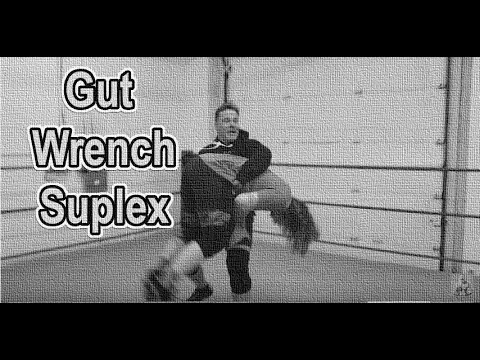
Gut Wrench Suplex - Bringing it Back
0
Gut Wrench Suplex·TDWF
Presented by HammerlockApparel.com - Bringing back forgotten or underutilized professional wrestling moves, the foundati…
Translation: gut wrench suplex (katakana)
The Gut Wrench Suplex is a suplex variation executed from the par terre (ground) position in which the attacker secures a body lock around the opponent's midsection while the opponent is on all fours, and uses an explosive lifting and rotating action to turn the opponent over and onto their back. [1],[2] The 'gut wrench' refers to the tight grip around the opponent's abdomen that provides the leverage for the lift. [2] This technique is a primary scoring method in Greco-Roman wrestling's par terre phase, where the attacking wrestler must turn the defending wrestler from the belly-down position. [2],[3] The gut wrench can be executed repeatedly, with the attacker rolling the opponent back and forth to accumulate points. [3]
The gut wrench has been a foundational par terre technique in Greco-Roman wrestling since the sport's early competitive era. [1] Soviet and Iranian Greco-Roman wrestlers became renowned for their devastating gut-wrench series, using the technique to accumulate large point totals from the par terre position. [1],[2]
The gut wrench is a fundamental Greco-Roman par terre technique, developed in European wrestling traditions. [1]
The gut wrench is one of the most commonly scored par terre techniques in Greco-Roman competition at all levels. [1]
No images yet for this technique.
Sign in to suggest an image.
Presented by HammerlockApparel.com - Bringing back forgotten or underutilized professional wrestling moves, the foundati…
No instructional courses yet for this technique.
Sign in to suggest a course.
Risk of injury to the person this technique is applied to
High-amplitude backward arch throw; severe head/neck injury risk (UWW injury data)
Skill level needed to execute this technique reliably
Whether this technique is allowed under major competition rule sets
Japanese amateur wrestling terminology
Japanese amateur wrestling terminology
Standard katakana transliteration of Western martial arts terminology (外来語) — used in Japanese MMA, boxing, and BJJ communities
Standard katakana transliteration used in Japanese wrestling (レスリング)
exceptional lower back and hip extension power, body lock grip strength
strong, stocky build with powerful back
erector spinae, glutes, trapezius, biceps, forearms
Every move, in any martial art, shares a few universal traits. Mix and match below to pinpoint the right tool — or compare equivalents across styles.
After taking your opponent over with a gut wrench suplex, you should float into a pin or get as close to a pin as possible rather than throwing them away. The goal is to maintain control and transition directly into a pinning position.
Pop your hips and rotate them over while ensuring your opponent goes straight up with control. Use your leg as a pivot point and grab their waist near the hips at a nice high position before picking them up and posting down to take them over.
They should bump flat on their back, not on their side. The opponent should use their opposite leg and opposite hand (not the closest hand, which can get trapped and cause arm injuries) to post during the bump.
Landing them on their side can cause multiple injuries including damage to the groin, hips, knees, and ankles, plus it makes for an unpleasant bump. A flat back bump distributes the impact properly and is much safer.
The Gut Wrench Suplex is a suplex variation executed from the par terre (ground) position in which the attacker secures a body lock around the opponent's midsection while the opponent is on all fours, and uses an explosive lifting and rotating action to turn the opponent over and onto their back. The 'gut wrench' refers to the tight grip around the opponent's abdomen that provides the leverage for the lift.
The gut wrench has been a foundational par terre technique in Greco-Roman wrestling since the sport's early competitive era. Soviet and Iranian Greco-Roman wrestlers became renowned for their devastating gut-wrench series, using the technique to accumulate large point totals from the par terre position.
IJF: legal — Legal throwing technique; IBJJF: banned — Suplex throws prohibited — throwing opponent backwards onto head/neck; UWW: legal — Legal in both freestyle and Greco-Roman; Unified MMA: legal — Legal throwing technique; ADCC: legal — Legal; FIAS Sport Sambo: legal — Legal; FIAS Combat Sambo: legal — Legal
Danger rating 8/10. Very High — high-amplitude backward arch throw; severe head/neck injury risk (UWW injury data)
The standard setup chain: Grip Setup (Kumi-kata) → Off-Balance (Kuzushi) → Entry (Tsukuri) → Execution (Kake).
Standard counters include: Lower Centre of Gravity — bend knees and drop hips to make the throw harder to execute / Grip Break — deny the thrower their preferred gripping configuration / Stiff-Arm — maintain distance with straight arms to prevent the entry.
Common variants: Standard suplex (rear body lock with overhead arch); German suplex (clasped hands at the waist, arching the opponent over the…); Belly-to-belly suplex (front body lock suplex lifting and arching); Lateral suplex (side-angle suplex throwing the opponent to the side).
The gut wrench is one of the most commonly scored par terre techniques in Greco-Roman competition at all levels.
Top errors to watch for: Locking the body lock too loosely — the opponent creates space and flattens out to block / Trying to lift the opponent straight up instead of using a rotational rolling motion / Not driving the chest into the opponent's back to flatten them before wrenching / Wrenching in the wrong direction relative to the opponent's base — read which way they're leaning.
The Gut Wrench Suplex is also known as Gatto Renchi Sūpurekkusu, Gut Wrench, Gut Lock Suplex, Brosok Perekruchivaniem (бросок перекручиванием).