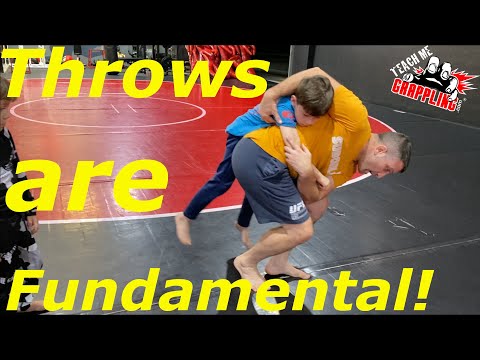
ALL You Need is a HEADLOCK!!!
0
Standard Headlock Throw·TeachMeGrappling Coach Brian
This video my kids help me demonstrate a simple headlock throw. Check out the details and you are sure to find somethin…
Translation: standard headlock throw
Standard Headlock Throw is the classical head-and-arm throw in wrestling, in which the attacker wraps one arm around the opponent's head, secures the grip with the other hand, loads the opponent onto the hip by turning in, and executes a hip throw that sends the opponent over and onto their back. [1],[2] The technique is biomechanically similar to judo's koshi guruma (hip wheel) but is executed without jacket grips, relying instead on the neck-and-arm clinch. [2],[3] The standard headlock throw is a high-amplitude technique that can score maximum points in both freestyle and Greco-Roman wrestling when the opponent is thrown with their back fully exposed. [3]
The standard headlock throw is the fundamental version, using a lateral hip toss combined with a headlock grip. [1]
The standard headlock throw is taught in wrestling programmes at all levels. [1]
Commonly used in folkstyle and freestyle wrestling competition. [1]
No images yet for this technique.
Sign in to suggest an image.
This video my kids help me demonstrate a simple headlock throw. Check out the details and you are sure to find somethin…
No instructional courses yet for this technique.
Sign in to suggest a course.
Risk of injury to the person this technique is applied to
Headlock position adds neck strain risk; moderate throw amplitude
Skill level needed to execute this technique reliably
Whether this technique is allowed under major competition rule sets
Japanese amateur wrestling terminology
Japanese amateur wrestling terminology
Mixed Japanese-Western terminology — combines traditional Japanese terms with katakana loanwords
Standard katakana transliteration used in Japanese wrestling (レスリング)
hip rotation speed, core strength, lower back stability
strong hips and core, good flexibility for turning entry
hip rotators, core, quadriceps, latissimus dorsi
Every move, in any martial art, shares a few universal traits. Mix and match below to pinpoint the right tool — or compare equivalents across styles.
Coach Brian emphasizes that teaching control of the position is just as important as teaching the throw itself. If you teach proper control, the throws won't end with you getting countered.
Coach Brian clarifies that when instructors refer to 'the hip' in a headlock throw, they mean your hip closest to your opponent—for example, your left hip when controlling your opponent's head.
Coach Brian stresses keeping your butt up and lifting your weight onto your opponent's chest while picking their head up to complete the throw effectively.
Standard Headlock Throw is the classical head-and-arm throw in wrestling, in which the attacker wraps one arm around the opponent's head, secures the grip with the other hand, loads the opponent onto the hip by turning in, and executes a hip throw that sends the opponent over and onto their back. The technique is biomechanically similar to judo's koshi guruma (hip wheel) but is executed without jacket grips, relying instead on the neck-and-arm clinch.
The headlock throw is one of the most ancient and universal wrestling techniques, practised in virtually every wrestling tradition worldwide. In modern Olympic wrestling, it has been a consistent scoring technique throughout the history of the Games.
IJF: legal — Legal throwing technique; IBJJF: legal — Legal at all belt levels; UWW: legal — Legal in both freestyle and Greco-Roman; Unified MMA: legal — Legal throwing technique; ADCC: legal — Legal; FIAS Sport Sambo: legal — Legal; FIAS Combat Sambo: legal — Legal
Danger rating 5/10. High — headlock position adds neck strain risk; moderate throw amplitude
The standard setup chain: Grip Setup (Kumi-kata) → Off-Balance (Kuzushi) → Entry (Tsukuri) → Execution (Kake).
Standard counters include: Lower Centre of Gravity — bend knees and drop hips to make the throw harder to execute / Block the Hip — post hand on the thrower's hip to prevent loading / Step Around — circle away from the throw direction to avoid being loaded / Grip Break — deny the thrower their preferred gripping configuration.
Common variants: Standard hip throw (full turn-in with hip below the opponent's centre of gravity); No-gi hip throw (adapted without gi grips, using overhook and collar tie); Drop hip throw (dropping to one knee to lower the fulcrum point); Combination hip throw (chaining from a failed foot technique or hand technique).
Commonly used in folkstyle and freestyle wrestling competition.
Top errors to watch for: Wrapping the head without stepping the hip in — no fulcrum means no throw / Trying to muscle the opponent over instead of using the hip pop / Pulling the head forward instead of sideways — the throw direction is lateral, not forward / Giving up back exposure by turning without completing the throw.
The Standard Headlock Throw is also known as Heddorokku Nage, Headlock Hip Toss, Head and Arm Throw, Brosok Zakhvatom Golovy (бросок захватом головы).