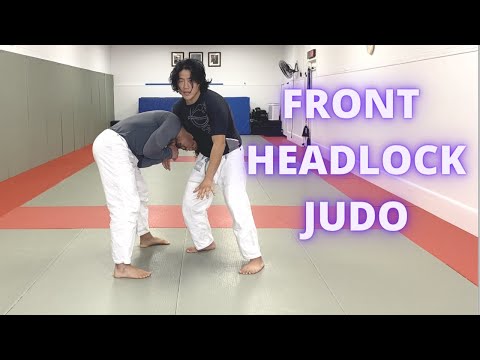
No Gi Judo Front headlock
0
Headlock Throw·Shintaro Higashi
No Gi Judo Front headlock Support my dojo which has been hit hard by the pandemic. https://www.gofundme.com/f/support-k…
Translation: headlock throw (katakana)
Headlock Throw is the family of wrestling throws executed from a headlock position, in which the attacker wraps one arm around the opponent's head or neck and uses hip rotation, lateral dropping, or rolling action to bring the opponent to the mat. [1],[2] Headlock throws are among the most instinctive throwing techniques in wrestling and are commonly seen at all competitive levels, from youth wrestling to Olympic competition. [2],[3] The family includes the standard headlock throw (sometimes called a head-and-arm throw) and the pancake, a flattening technique used from the headlock position. [3],[4] While powerful, headlock throws carry an inherent risk — if the attacker fails to complete the throw, they may expose their own back to the mat, resulting in points for the opponent. [4]
Headlock throws are among the oldest wrestling techniques, appearing in wrestling traditions across virtually every culture. [1] In competitive Greco-Roman and freestyle wrestling, the headlock throw became a fundamental technique taught at the earliest stages of training. [1],[2] The technique has been used extensively in professional wrestling entertainment as well, though the competitive version requires genuine hip throwing mechanics. [2],[3]
Headlock throws are common in folkstyle and Greco-Roman wrestling, and are occasionally seen in MMA. [1]
No images yet for this technique.
Sign in to suggest an image.
No Gi Judo Front headlock Support my dojo which has been hit hard by the pandemic. https://www.gofundme.com/f/support-k…
No instructional courses yet for this technique.
Sign in to suggest a course.
Risk of injury to the person this technique is applied to
Headlock position adds neck strain risk; moderate throw amplitude
Skill level needed to execute this technique reliably
Whether this technique is allowed under major competition rule sets
Japanese amateur wrestling terminology
Japanese amateur wrestling terminology
Mixed Japanese-Western terminology — combines traditional Japanese terms with katakana loanwords
Standard katakana transliteration used in Japanese wrestling (レスリング)
hip rotation speed, core strength, lower back stability
strong hips and core, good flexibility for turning entry
hip rotators, core, quadriceps, latissimus dorsi
Every move, in any martial art, shares a few universal traits. Mix and match below to pinpoint the right tool — or compare equivalents across styles.
The Pancake is a wrestling throw variation from the headlock position in which the attacker, rather than executing a full hip throw, drives the opponent directly to the mat in a flattening motion, pressing them face-down. [1,2] The name 'pancake' refers to the flat, compressed position the opponent ends up in. [2] The technique is typically executed when the attacker has a headlock but cannot generate sufficient rotation for a full throw, instead using downward pressure and body weight to flatten the opponent. [2,3] The pancake is widely used in folkstyle (collegiate) wrestling as a scoring technique from the neutral or front headlock position. [3]
Standard Headlock Throw is the classical head-and-arm throw in wrestling, in which the attacker wraps one arm around the opponent's head, secures the grip with the other hand, loads the opponent onto the hip by turning in, and executes a hip throw that sends the opponent over and onto their back. [1,2] The technique is biomechanically similar to judo's koshi guruma (hip wheel) but is executed without jacket grips, relying instead on the neck-and-arm clinch. [2,3] The standard headlock throw is a high-amplitude technique that can score maximum points in both freestyle and Greco-Roman wrestling when the opponent is thrown with their back fully exposed. [3]
The headlock throw uses a standing headlock (kubi-nage in judo) to spin the opponent over the hip. Common in street fights and self-defense scenarios. In wrestling, the headlock throw is taught early but can be countered by experienced wrestlers who take the back. (Wrestling coaching manuals; Kano, Kodokan Judo)
Once your head is over your opponent's head, throw your shoulder over to the back of their neck to secure the position before executing the throw. Shintaro Higashi emphasizes this shoulder placement as critical to controlling the opponent.
If your opponent connects their hands to prevent you from locking, immediately snap down to bring their hands to the ground and maintain control of the position. Shintaro Higashi notes this is a common defensive reaction you must counter decisively.
Headlock Throw is the family of wrestling throws executed from a headlock position, in which the attacker wraps one arm around the opponent's head or neck and uses hip rotation, lateral dropping, or rolling action to bring the opponent to the mat. Headlock throws are among the most instinctive throwing techniques in wrestling and are commonly seen at all competitive levels, from youth wrestling to Olympic competition.
Headlock throws are among the oldest wrestling techniques, appearing in wrestling traditions across virtually every culture. In competitive Greco-Roman and freestyle wrestling, the headlock throw became a fundamental technique taught at the earliest stages of training.
IJF: legal — Legal throwing technique; IBJJF: legal — Legal at all belt levels; UWW: legal — Legal in both freestyle and Greco-Roman; Unified MMA: legal — Legal throwing technique; ADCC: legal — Legal; FIAS Sport Sambo: legal — Legal; FIAS Combat Sambo: legal — Legal
Danger rating 5/10. High — headlock position adds neck strain risk; moderate throw amplitude
The standard setup chain: Grip Setup (Kumi-kata) → Off-Balance (Kuzushi) → Entry (Tsukuri) → Execution (Kake).
Standard counters include: Lower Centre of Gravity — bend knees and drop hips to make the throw harder to execute / Block the Hip — post hand on the thrower's hip to prevent loading / Step Around — circle away from the throw direction to avoid being loaded / Grip Break — deny the thrower their preferred gripping configuration.
Common variants: Standard hip throw (full turn-in with hip below the opponent's centre of gravity); No-gi hip throw (adapted without gi grips, using overhook and collar tie); Drop hip throw (dropping to one knee to lower the fulcrum point); Combination hip throw (chaining from a failed foot technique or hand technique).
Headlock throws are common in folkstyle and Greco-Roman wrestling, and are occasionally seen in MMA.
Top errors to watch for: Locking only the neck without hip contact — a headlock without a hip fulcrum is just a crank / Not popping the hip into the opponent — the hip is the throwing mechanism / Pulling the head down without the hip throw — you bend the opponent over but don't throw them / Over-squeezing the headlock and losing body position — focus on the throw, not the squeeze.
The Headlock Throw is also known as Heddorokku Nage, Head-and-arm throws, Headlock takedowns.