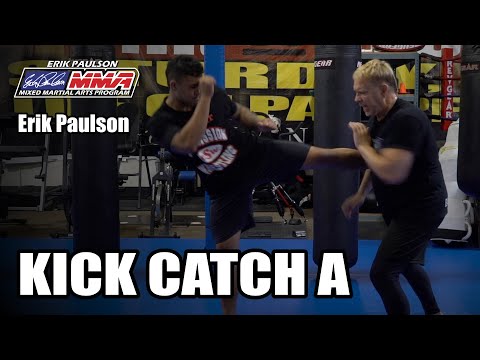
Kick Catches - Introduction - Catch A
0
Kick Catch Throw·CSW Association
CSW Kick Catches - Takedowns - Submissions now available for download! https://gumroad.com/l/kickcatches Kick Catches …
Translation: Sanda kick catch throw
Kick Catch Throw is a distinctive subfamily of sanda throws in which the fighter intercepts an incoming kick — typically a roundhouse, side kick, or front kick — catches the kicking leg, and uses the trapped limb as a lever to throw the opponent off balance and to the ground. [1],[2] This technique category is uniquely prominent in sanda, where the combination of full-contact kicking and throwing rules creates frequent opportunities for kick-catching. [2],[3] The thrower may execute a variety of finishes from the caught-kick position, including sweeping the standing leg, lifting and dumping, or rotating the opponent. [3]
Kick-catch throws have been a signature element of sanda competition since the sport's inception, reflecting the traditional Chinese martial arts emphasis on intercepting and controlling an opponent's attacking limbs. [1],[2] The technique category has no direct equivalent in judo or wrestling, making it uniquely characteristic of sanda. [2],[3]
Kick catches and subsequent throws are common in sanda competition and are also seen in UFC and Muay Thai events. [1]
No images yet for this technique.
Sign in to suggest an image.
CSW Kick Catches - Takedowns - Submissions now available for download! https://gumroad.com/l/kickcatches Kick Catches …
No instructional courses yet for this technique.
Sign in to suggest a course.
Risk of injury to the person this technique is applied to
Sanda/Sanshou throws emphasize speed and catching strikes into throws
Skill level needed to execute this technique reliably
Whether this technique is allowed under major competition rule sets
Japanese Sanda/Sanshou terminology
Japanese Sanda/Sanshou terminology
Original Chinese martial arts term used in Japanese context
Katakana transliteration used in Japanese Sanda (散打)
precise timing, ankle coordination, upper body kuzushi ability
excellent balance and quick reflexes
tibialis anterior, calves, hip rotators, forearms (grip)
Every move, in any martial art, shares a few universal traits. Mix and match below to pinpoint the right tool — or compare equivalents across styles.
Kick Catch Throw is a distinctive subfamily of sanda throws in which the fighter intercepts an incoming kick — typically a roundhouse, side kick, or front kick — catches the kicking leg, and uses the trapped limb as a lever to throw the opponent off balance and to the ground. This technique category is uniquely prominent in sanda, where the combination of full-contact kicking and throwing rules creates frequent opportunities for kick-catching.
Kick-catch throws have been a signature element of sanda competition since the sport's inception, reflecting the traditional Chinese martial arts emphasis on intercepting and controlling an opponent's attacking limbs. The technique category has no direct equivalent in judo or wrestling, making it uniquely characteristic of sanda.
IJF: legal — Legal throwing technique; IBJJF: legal — Legal at all belt levels; UWW: legal — Legal in both freestyle and Greco-Roman; Unified MMA: legal — Legal throwing technique; ADCC: legal — Legal; FIAS Sport Sambo: legal — Legal; FIAS Combat Sambo: legal — Legal
Danger rating 6/10. High — Sanda/Sanshou throws emphasize speed and catching strikes into throws
The standard setup chain: Grip Setup (Kumi-kata) → Off-Balance (Kuzushi) → Entry (Tsukuri) → Execution (Kake).
Standard counters include: Lower Centre of Gravity — bend knees and drop hips to make the throw harder to execute / Lift the Targeted Leg — raise the foot being attacked above the sweeping action / Counter-Throw — exploit the attacker's committed weight to throw them instead / Grip Break — deny the thrower their preferred gripping configuration.
Common variants: Forward sweep (sweeping the foot in the direction the opponent is stepping); Rear sweep (sweeping the foot backward as the opponent retreats); Combination sweep (chaining sweeps to both feet); Counter sweep (timing the sweep as the opponent initiates their own attack).
Kick catches and subsequent throws are common in sanda competition and are also seen in UFC and Muay Thai events.
Top errors to watch for: Reaching for the kick instead of letting it come to you — reaching exposes you to feints and overextension / Catching with one hand — use both hands to secure the leg firmly / Holding the caught leg without throwing — the referee will break it, and you waste the opportunity / Not immediately attacking the standing leg — the window to sweep is short before the opponent hops to safety.
The Kick Catch Throw is also known as Sanda Kikku Kyatchi Nage, Jiē Tuǐ Shuāi (接腿摔), Leg Catch Sweep, Kick Catch Slam.