UCHI MAKIKOMI
0
Uchi Makikomi·welcomematstevescott
Uchi Makikomi (Inner Winding Throw) is a throw that is not often practiced but part of Judo's syllabus of throwing techn…
Translation: inner wraparound
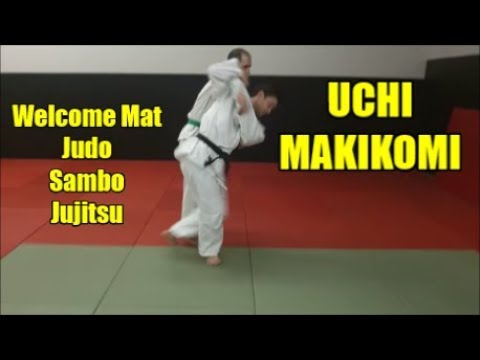
Uchi Makikomi is an inner winding throw in which tori wraps their arm around uke's body from the inside — threading the arm under uke's armpit — and then drops into a rolling sacrifice to bring uke to the ground. [1],[2] The 'uchi' (inner) label distinguishes it from soto makikomi, with the wrapping action occurring on the inside of uke's body rather than over the top. [2],[3] Uchi makikomi is particularly effective when tori has an underhook position and can generate significant rotational force. [3]
Uchi makikomi (inner winding throw) winds the opponent from the inside using an arm-lock grip combined with a rolling sacrifice. [1]
Uchi makikomi is part of the Kodokan judo yoko-sutemi-waza syllabus. [1]
Uchi makikomi is scored in IJF competition. [1]
No images yet for this technique.
Sign in to suggest an image.
Uchi Makikomi (Inner Winding Throw) is a throw that is not often practiced but part of Judo's syllabus of throwing techn…
🥋This is a judo technique instructed by David Loshelder. Dave was a former #1 ranked Judo player in USA in his respecti…
No instructional courses yet for this technique.
Sign in to suggest a course.
Risk of injury to the person this technique is applied to
Rolling sacrifice adds rotational momentum; uncontrolled landing risk
Skill level needed to execute this technique reliably
Whether this technique is allowed under major competition rule sets
Kodokan Judo — Official Nage-waza Classification
Traditional Judo throwing technique terminology (Kodokan Institute)
Official Kodokan ground technique classification system
Standard Japanese martial arts terminology (kanji/hiragana)
Established Japanese martial arts naming convention — native Japanese term (和語/漢語)
Traditional Judo throwing technique terminology (Kodokan Institute)
commitment, timing, body weight manipulation, falling skill
heavier build (body weight drives the throw), good ukemi
core rotators, hip flexors, abdominals
Every move, in any martial art, shares a few universal traits. Mix and match below to pinpoint the right tool — or compare equivalents across styles.
You want to get approximately 90 degrees from your opponent, and adopting a horse stance gives you a stable base from which to execute the technique.
According to DadBod Judo, if you get blocked a couple times, take your opponent's weight backwards and come in halfway rather than circling all the way in; wrap your leg around the inside of theirs and sit to your butt while pulling down in a quick jerking motion.
Uchi Makikomi is an inner winding throw in which tori wraps their arm around uke's body from the inside — threading the arm under uke's armpit — and then drops into a rolling sacrifice to bring uke to the ground. The 'uchi' (inner) label distinguishes it from soto makikomi, with the wrapping action occurring on the inside of uke's body rather than over the top.
Uchi makikomi emerged as a complementary technique to soto makikomi within judo's makikomi family, offering an alternative entry when the outside wrap is unavailable. The technique has been widely used in both judo and sambo competition.
IJF: legal — Legal throwing technique; IBJJF: legal — Legal at all belt levels; UWW: legal — Legal in both freestyle and Greco-Roman; Unified MMA: legal — Legal throwing technique; ADCC: legal — Legal; FIAS Sport Sambo: legal — Legal; FIAS Combat Sambo: legal — Legal
Danger rating 6/10. High — rolling sacrifice adds rotational momentum; uncontrolled landing risk
The standard setup chain: Grip Setup (Kumi-kata) → Off-Balance (Kuzushi) → Entry (Tsukuri) → Execution (Kake) → Fall (Sutemi).
Standard counters include: Lower Centre of Gravity — bend knees and drop hips to make the throw harder to execute / Grip Break — deny the thrower their preferred gripping configuration / Stiff-Arm — maintain distance with straight arms to prevent the entry.
Common variants: Rear sacrifice (falling backward while pulling the opponent over); Side sacrifice (falling to the side to project the opponent laterally); Rolling sacrifice (combining a roll with the sacrifice throw for rotation); Counter sacrifice (using the opponent's forward pressure as the driving force).
Uchi makikomi is scored in IJF competition.
Top errors to watch for: Confusing uchi makikomi with soto makikomi — uchi wraps from inside (underhook), soto from outside (overhook) / Not getting deep enough inside position before rolling — the inner wrap requires close proximity / Rolling without body-to-body contact — you must be pressed against uke throughout / Losing the underhook grip during the roll — it must stay locked.
The Uchi Makikomi is also known as Inner Winding Throw, Inside Wrap-Around, Uchi Makikomi, Inner Rolling Throw.